
When you think about flying private, you probably picture efficiency, comfort, and luxury. What many don’t consider, however, is one of the most critical components of every aircraft, which is the landing gear.
Whether boarding a sleek, light jet or a long-range private aircraft, understanding the landing gear helps establish expectations for safety, performance, and functionality. However, unlike commercial aircraft, private aircraft often feature different types of landing gear.
This landing gear is carefully designed for their unique speed, weight, and operational requirements. It goes beyond just “wheels on a plane.” It’s a sophisticated system built to withstand high speeds, enable safe takeoff and landing, facilitate taxiing, and absorb landing impact.
Of course, while precision-engineered aircraft systems ensure a safe journey, passenger comfort is just as essential. That’s where JetBed comes in. Proudly manufactured in the U.S. with a patented design, JetBed transforms your cabin into a relaxing space. Easy to carry, lightweight, and precision-fitted to your jet model, it ensures your private flight feels just as comfortable as it is efficient. Choose JetBed, the comfortable way to fly.
What Is a Private Aircraft Landing Gear?
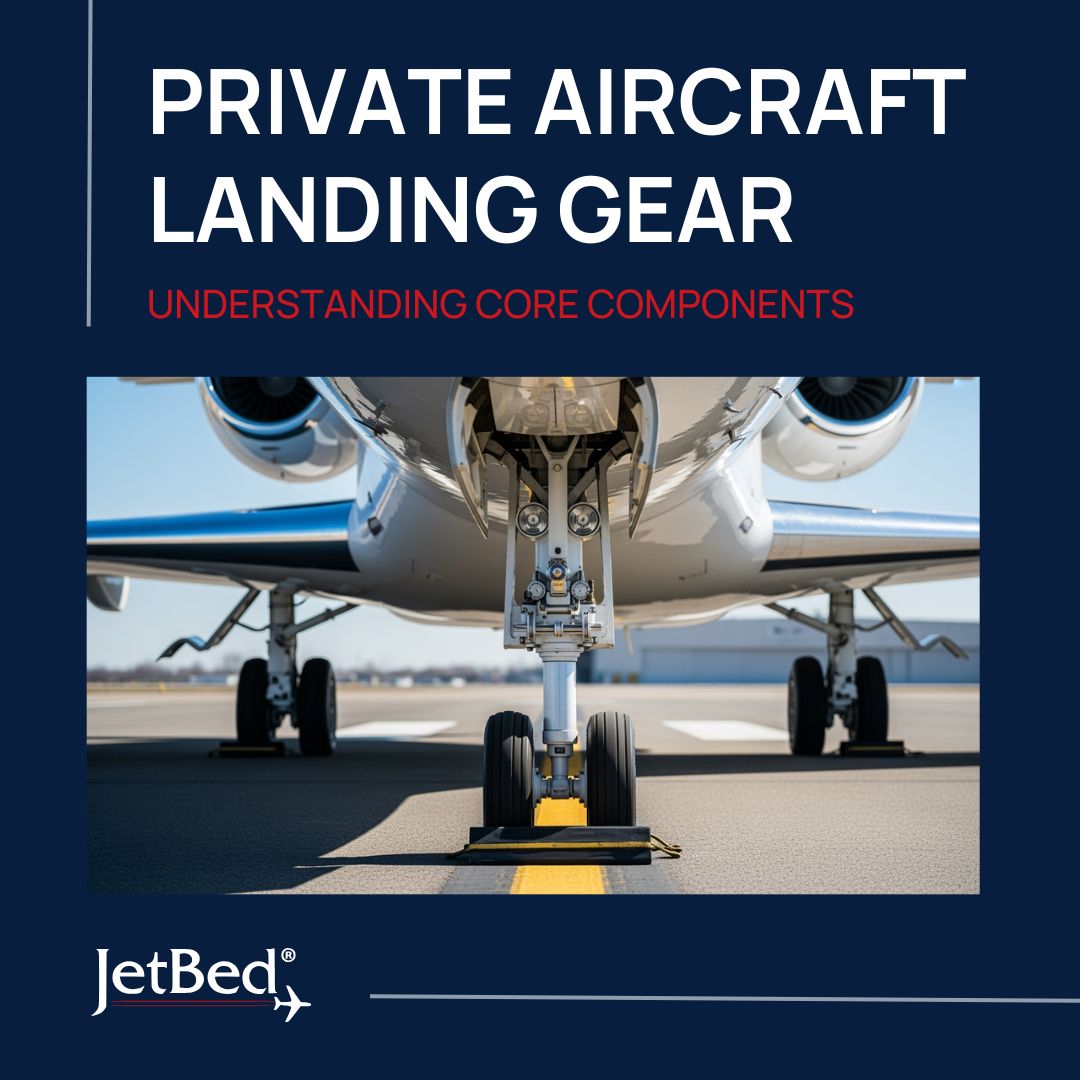
A private aircraft landing gear is the system of struts, wheels, and support mechanisms that allows an aircraft to safely take off, land, and maneuver while on the ground. It does far more than support the aircraft while it’s stationary. The landing gear absorbs impact during touchdown, withstands stresses at high speeds on the runway, and ensures stability while taxiing.
Landing gear legs and assemblies vary in complexity, based on the aircraft type. For example, small wheel aircraft require gear designs that are lightweight yet strong. Larger business jets, on the other hand, require retractable landing gear systems that reduce drag at cruising altitude. In every case, the gear is designed to withstand heavy loads and repetitive stress without compromising the safety of passengers.
Just like understanding how fast airplanes go when taking off gives you insight into flight performance, knowing the common types of landing gear helps you appreciate the engineering behind private aviation. It’s a reminder that even rarely noticed parts of a plane play a vital role in every smooth, safe flight.

How Does Aircraft Landing Gear Work for Private Planes?
Private aircraft utilize landing gear systems tailored to their purpose, size, and performance expectations. To better understand this, it is essential to know how the landing gear operates. At a high level, the gear is designed to:
Retract to Improve Aerodynamics
Once airborne, landing gear creates drag that slows the aircraft, reducing fuel efficiency. To solve this, most private jets feature retractable landing gear that tucks away neatly into the fuselage.
After takeoff, the system folds away, allowing for smoother airflow and greater cruising speeds. When needed, the gear can be extended and locked into place for a stable landing. We discuss this more in our post, “ATA Codes for Aviation.” The balance between support on the ground and efficiency in the air is a hallmark of modern private jet design.
Enable Ground Maneuvering
Landing gear isn’t only necessary for takeoffs and landings. In fact, it also enables taxiing. Nose gear steering allows pilots to maneuver the aircraft safely while moving around the tarmac.
Smaller, private planes may use direct mechanical systems for this purpose. Comparatively, larger jets rely on hydraulically powered steering to manage greater torque and weight. This steering capability is essential for navigating tight spaces, ensuring smooth ground operations before the plane even leaves the runway.
Support the Aircraft on the Ground
The landing gear legs and wheels carry the entire weight of the aircraft while it’s parked, taxiing, or preparing for takeoff. In private jets, this system must combine light weight with power and strength to handle the repeated and concussive strength.
Without this support, the aircraft would not be able to remain balanced on the ground. This design also accommodates various surfaces from smooth runways to slightly rough private airstrips without compromising safety.
Enable Safe Takeoff and Landing
Takeoff and landing are the most critical phases of flight, during which the aircraft reaches high speeds close to the ground. The landing gear works to stabilize the aircraft during these moments, ensuring safety for both passengers and crew. Private jets typically use a tricycle landing gear setup, featuring a nose wheel and two main wheels.
This configuration minimizes the risk of a dangerous ground loop and provides better directional control. It also helps distribute weight more evenly, creating smoother and safer transitions on and off the runway. During takeoff, the correct power setting, combined with gear stability, ensures smooth acceleration.
Absorb Shock Loads
When an aircraft touches down, a significant impact force occurs between the tires and the runway. The landing gear absorbs these shock loads using springs, struts, and tires designed specifically to cushion the landing.
This prevents excessive force from transferring directly to the fuselage, which could otherwise damage the structure. By absorbing energy, the system protects both passengers and onboard equipment. It can also extend the life of the airframe by minimizing wear and tear over many flights.
What Are the Different Private Aircraft Landing Gear Types?
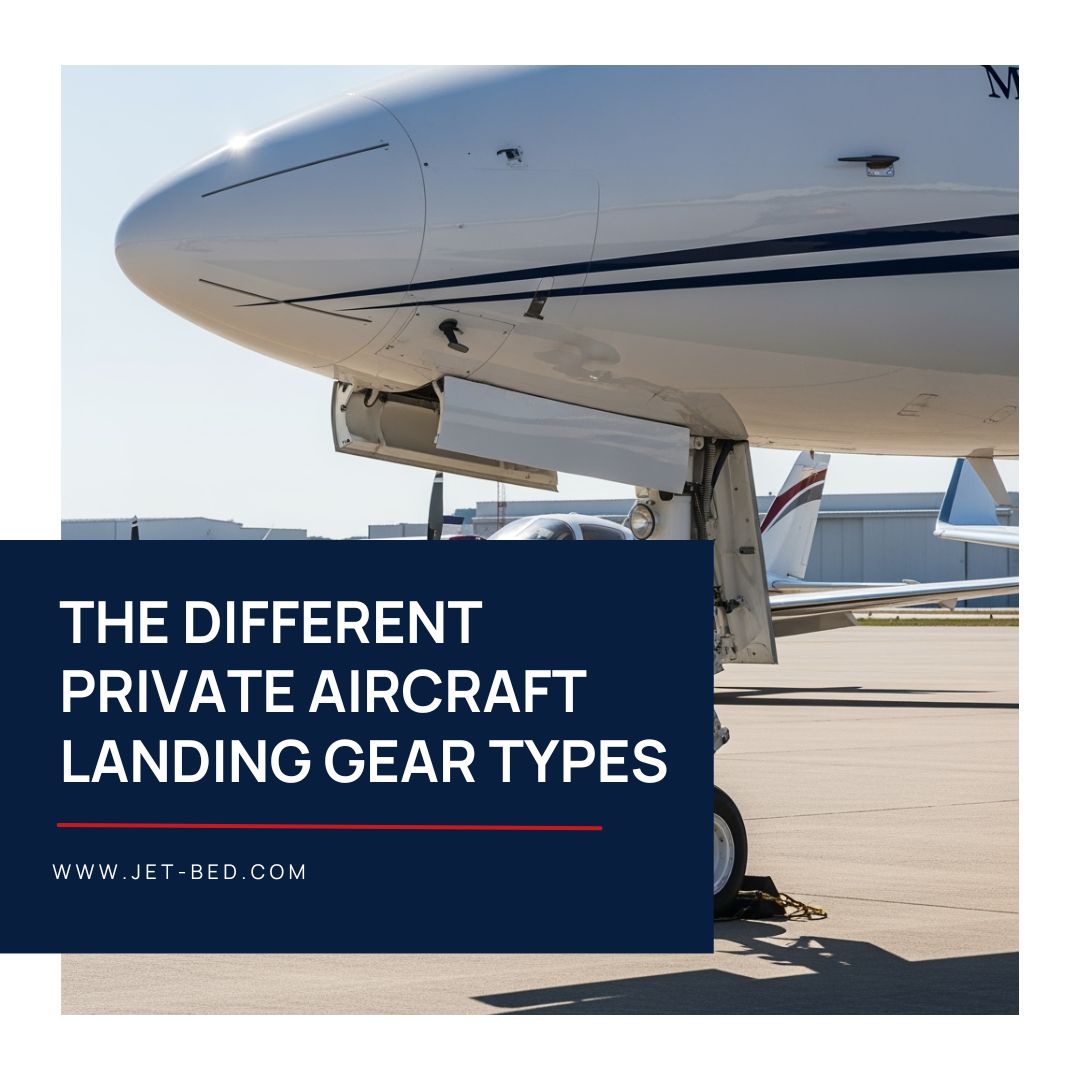
Just as there are different types of private jets, there are also different types of landing gear systems that have unique functions. The landing gear will vary from aircraft to aircraft. Here is a comprehensive overview:
Fixed Landing Gear
Fixed landing gear is permanently extended, meaning the wheels don’t retract into the fuselage. While much less aerodynamic, this type of gear is lighter and simpler. It’s often used in training aircraft or light aircraft where performance demands are lower.
For private pilots who operate compact planes, fixed landing gear offers reduced maintenance complexity and lower operating costs. However, the trade-off comes in the form of increased drag, which limits overall speed and fuel efficiency.
Retractable Landing Gear
Retractable landing gear is common in business jets and higher-performance aircraft. This system improves aerodynamics by tucking the wheels into the aircraft body after takeoff. While it adds complexity, weight, and maintenance requirements, retractable systems enable smoother cruising at high speeds. They also contribute to significantly improved fuel economy.
Tricycle Landing Gear
This configuration, featuring a nose wheel (or nose gear) and two main landing gear legs, is the most common type of landing gear on private jets. A tricycle landing gear greatly reduces the chance of ground loops.
It also provides easier handling during takeoff, landing, and taxiing. Additionally, tricycle landing offers better visibility for pilots on the ground as well. Because of these advantages, it has become the standard choice for most modern aircraft designs.
Conventional Landing Gear (Tailwheel)
Sometimes called a “taildragger,” this setup features two main wheels positioned forward of the center of gravity, as well as a smaller tail wheel at the rear. While far less common in modern jets, conventional landing gear is used in smaller, vintage-style planes. As a benefit, tailwheel aircraft operate from rougher airstrips with ease. However, they require more skill to avoid ground loops during landing.
Specialized Gear Designs
Certain aircraft, including amphibious or multi-surface planes, usually feature specialized gear design with unique landing gear wheel configurations. These systems allow safe operation on gravel, grass, and even water.
This expands on the versatility of private aviation. Such specialized gear helps to ensure that pilots can operate in diverse environments without compromising safety or performance.
Tandem Landing Gear
Tandem landing gear has the main wheels aligned along the aircraft’s centerline. This is most commonly seen in military and large cargo planes.
Additionally, this setup distributes weight along the fuselage and manages landing power efficiently. However, smaller outrigger wheels are often needed for stability during taxiing. This design enables a narrower fuselage and improved weight management on very heavy aircraft.
Multi-Bogie Landing Gear
Multi-bogie landing gear includes multiple wheels on a single assembly. This configuration spreads the aircraft’s weight over a large area. Used on large aircrafts and specialized jets, it effectively absorbs landing power, improves stability, and feels smoother.
In addition to this, multi-bogie landing gear enables safe operations on soft or uneven surfaces. This design is mostly ideal for aircraft that carry heavy loads and operate from less-than-ideal runways, helping to ensure safer takeoffs and landings.
From takeoff to touchdown, landing gear is essential for safety, stability, and a smooth flying experience.
Private aircraft landing gear is a critical system that supports the aircraft at various stages, while also absorbing shock, ensuring stability, and enhancing aerodynamics. From fixed landing gear on small wheel aircraft to advanced retractable landing gear on jets, the system is engineered to provide both safety and performance.
For passengers, the technology behind the landing gear ensures a smooth and secure journey. At the same time, in-flight solutions like JetBed elevate comfort once airborne. Crafted with a patented design, lightweight, and high-quality materials, Jetbed is the comfortable way to fly. It effortlessly transforms private aviation not just into a mode of travel, but a luxury experience.