
A career in private aviation offers a unique and rewarding path for pilots who value flexibility, versatility, and a more personalized flying experience. For many aviators, working as a first officer pilot on private planes is particularly compelling. It’s an extremely prestigious position that requires extensive training and proficient technical and operational skills.
Additionally, as discussed in our guide, “How Long Does It Take to Become a Pilot?”, the aviation industry is governed by ongoing regulatory requirements, technical knowledge, and licensing standards. Therefore, understanding the criteria for the various job opportunities available for first officers (FO) in private aviation is essential.
In this post, we’ll provide a comprehensive overview of first officer pilot jobs for private planes. We will explore what each role entails, the daily responsibilities, and the types of positions available.
At JetBed, we understand thatonboard comfort isessential todelivering the elevated experience the field is known for. Our patented, custom-fit system delivers a perfectly uniform surface for optimal, hotel-quality rest. With USA manufacturing and luxury Italian linens, there’s never been a more efficient way to fight pilot fatigue.

First Officer Pilot Jobs for Private Planes: Career Guide
First officer pilot jobs can significantly vary from one operation to the next. Unlike commercial airlines, private plane operations prioritize bespoke guest interactions, highly customized schedules, and a deep understanding of different aircraft.
Therefore, irrespective of the specific role, FOs must maintain both strong technical skills and excellent adaptability. Before exploring job opportunities, however, we will first discuss what a first officer pilot is—and how the role functions within private aviation.
For additional information, visit our guide: “How to Get a Pilot’s License.”
What Is a First Officer Pilot?
A First Officer (FO) is the co-pilot or the second-in-command (SIC) in the cockpit, safely working alongside and sharing responsibilities with the Captain. While the Captain holds definitive judgment over the flight, the First Officer plays an essential role in flight planning, aircraft operation, and overall safety.
Additionally, first officers are deeply involved in flying the aircraft. They’re not taking a second seat to operations. They need to be fully ready to handle any situation and to fly the plane if conditions warrant. Because of this, the role requires stringent certifications, licenses, and credentials beyond a standard commercial pilot license.
14 CFR Part 61 (61.55) concretely outlines basic—yet necessary—second-in-command qualifications. Additionally, under CFR 61.160, the FAA requires first officers to hold the Airline Transport Pilot (ATP) certificate and to have 1,500 total flight hours.
Moreover, this position requires individuals to further illustrate their dedication to private aviation. Requirements include an Instrumental Rating (IR) endorsement, both Private Pilot and Commercial Pilot Licenses, a Multi-Engine Rating (MER), and a FAA First-Class Medical Certificate. And, most importantly, all first officers must have a thorough understanding of the Airman Certification Standards, as taught in flight school.
Ultimately, first officers must be able to navigate and operate an aircraft successfully, safely, and confidently. While captains hold additional years of experience, the role of the first officer is equally critical to safe, efficient operations.
To learn more, visit our guide: “How Many Pilots Are Required per Aircraft?”
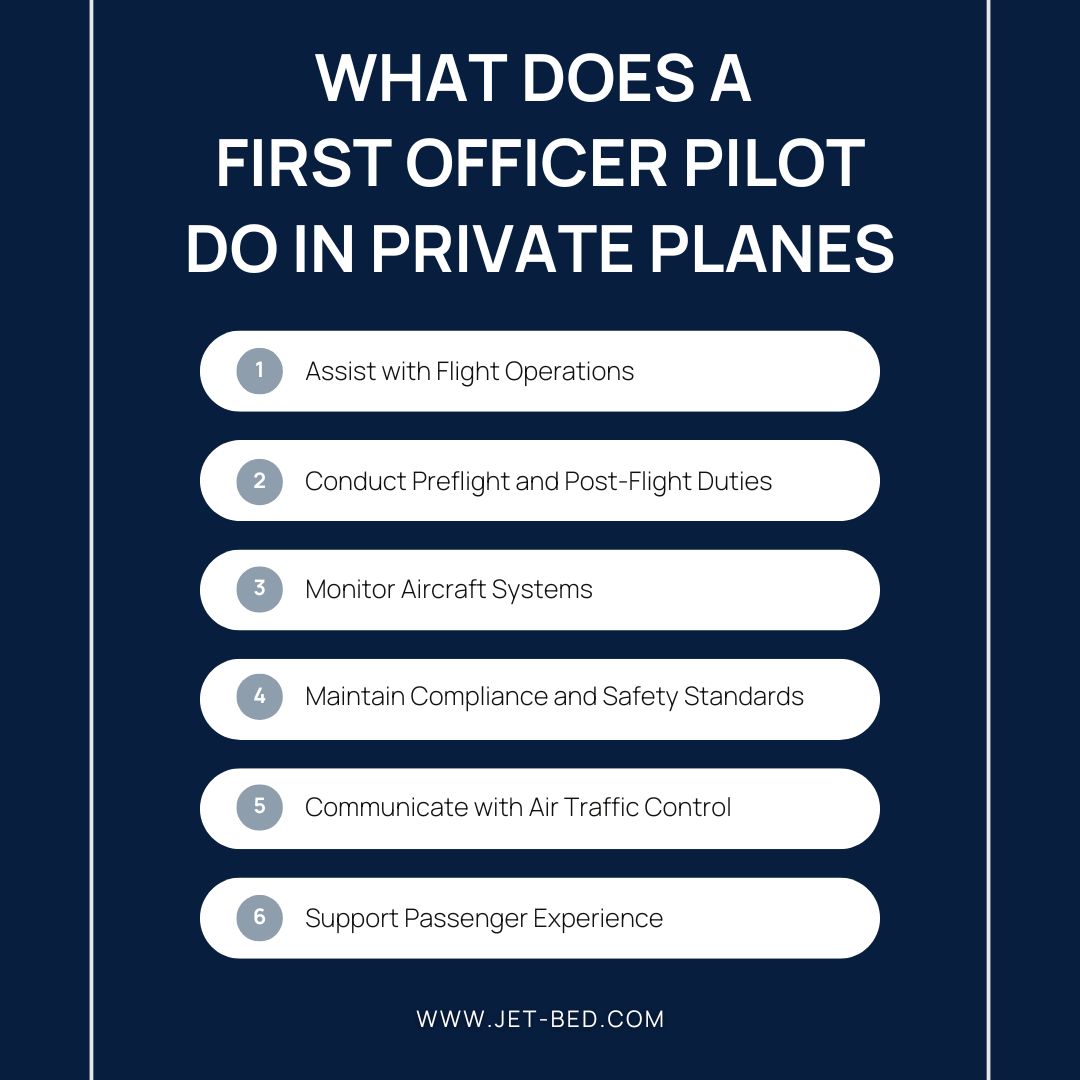
What Does a First Officer Pilot Do in Private Planes
Assist with Flight Operations
The responsibilities associated with the first officer role are essential to maintaining safe operations. In this context, they should continuously monitor systems, fuel levels, and weather conditions to ensure the aircraft remains within operational limits.
Additionally, the FO will follow procedural checklists, periodically refine the Flight Management System (FMS), and assist the pilot in decision-making. And if and when necessary, the officer will typically alternate flying duties in accordance with company procedures and experience.
Conduct Preflight and Post-Flight Duties
Both pre- and post-flight duties are crucial to ensuring each flight begins and ends safely. Before departure, first officers assist with reviewing NOTAMs, performing exterior checks, participating in briefings, and preparing the flight deck.
After landing, the post-flight responsibilities ensure adherence and prepare the aircraft for future flights. Examples include completing logs, securing the aircraft, reporting any relevant maintenance discrepancies, and updating all documentation.
Monitor Aircraft Systems
During flight, both captains and first officers must consistently and closely monitor aircraft systems, instrumentation, and performance data. Namely, second-in-commands serve as a second set of eyes.
They will track engine performance, pressurization systems, and situational awareness, ensuring all standard operating procedures (SOPs) are met. By maintaining contextual understanding, the FO can quickly identify irregularities and communicate them effectively.
Maintain Compliance and Safety Standards
Regulatory compliance and safety standards are cornerstones in private aviation. They demonstrate the industry’s strict adherence to operational integrity and aircraft reliability. The FO should ensure all crew members comply with FAA regulations and applicable safety management systems.
Moreover, FOs must operate under 14 CFR Part 91, which outlines criteria for general operations and flight rules. Responsibilities include (but are not limited to) civil aircraft worthiness, minimum safe altitudes, and fuel requirements for IFR.
For additional information, visit: “Importance Safety Management Systems” and “Flight and Safety at High Altitudes.”
Communicate with Air Traffic Control
In private aviation, communicating with air traffic control is among the many core responsibilities of a first officer. Doing so is essential for safety, legality, and efficiency. They often handle radio communications to relay clearances, altitude changes, routing instructions, flight plan changes, and weather updates.
Additionally, air traffic controllers ensure collision avoidance and, if necessary, emergency assistance. Accurate and timely communication reduces workload in the cockpit, supporting safe coordination with other aircraft and ground facilities.
To learn more about related concepts, visit: “What Is Flight Information Region?” and “ATA Codes for Aviation.”
Support Passenger Experience
Professionalism extends beyond the cockpit—especially in private aviation, where passengers expect personalized interaction and premier service. First officers will anticipate the needs of those onboard, handle last-minute requests, and coordinate necessary ground transportation.
Additionally, they ensure checklist completion and effective crew resource management throughout the flight. This level of attention creates a seamless experience, allowing passengers to feel secure in both operations and their level of service.
Visit “What Does CRM Stand for in Aviation?” to learn more.
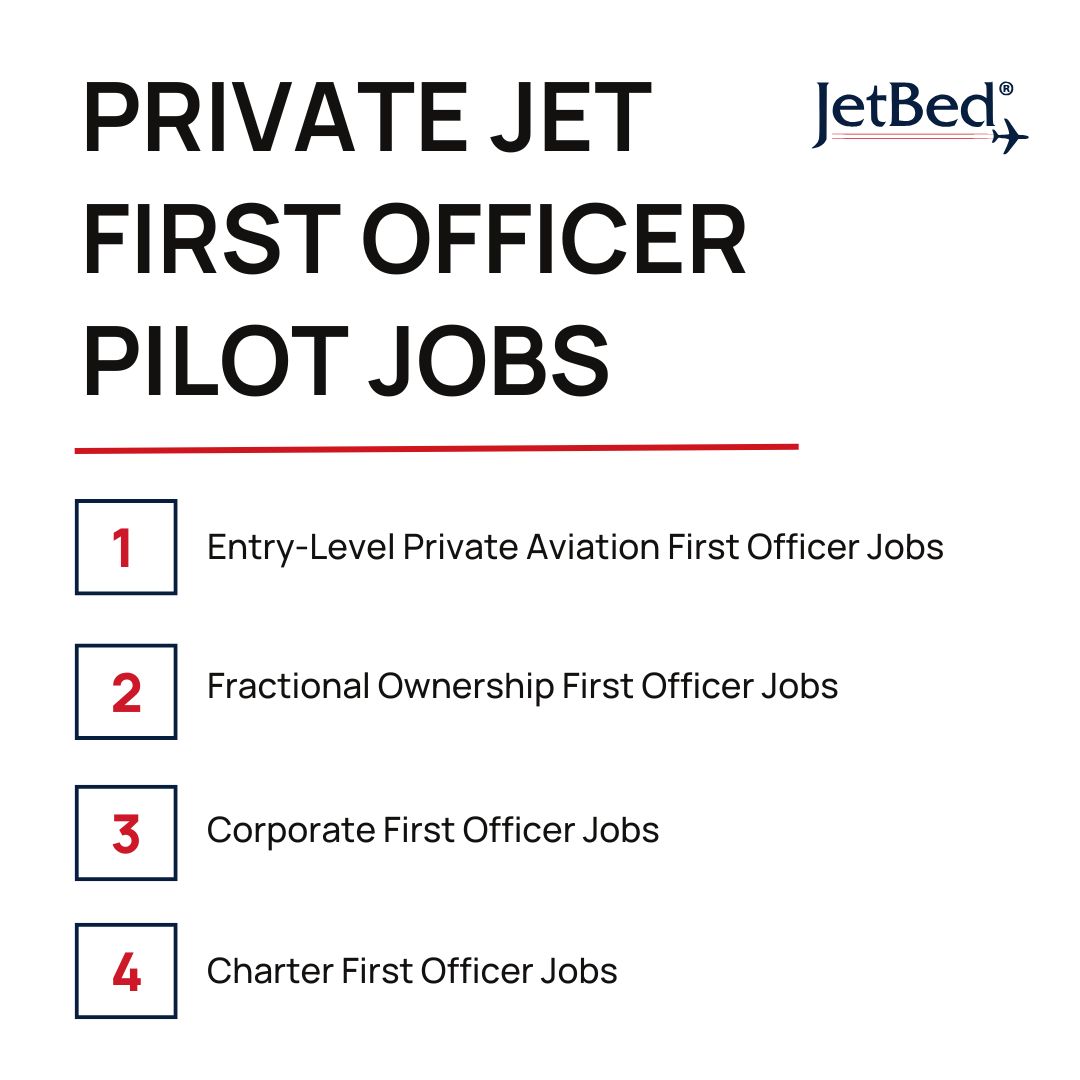
Private Jet First Officer Pilot Jobs
There are various career opportunities available for first officers, all offering different schedules, experience requirements, and career advantages. Below are some of the most common pathways in private aviation.
Entry-Level Private Aviation First Officer Jobs
Although entry-level, SICs require significant flight hours and ratings for qualification. This is an important reason why many obtain their flight instructor certification, building the required hours and gaining the mandatory experience.
Afterward, turboprops serve as an impactful milestone, introducing first officers to diverse conditions and multi-crew environments essential for career progression. While the pay is initially lower, the exposure to real-world operations and networking opportunities is invaluable within the industry.
It’s important to note that entry-level first officers must comply with 14 CFR Part 121 and hold an ATP Certificate.
For similar information, review “How Much Does a Private Pilot Earn?”
Fractional Ownership First Officer Jobs
Fractional operators manage aircraft shared by multiple owners. Therefore, these programs permit first officers to fly planes for different owners, offering consistent, reliable employment and varying benefits.
Additionally, it’s an excellent opportunity to work hands-on with varying crew sizes, different private jet classes, and major airlines. This role typically requires structured training programs and defined experience minimums, making them ideal for pilots who value career progression.
For relevant information to this career path, visit: “How Does Fractional Jet Ownership Work?”
Corporate First Officer Jobs
Corporate flight departments operate aircraft exclusively for a company or private owner. Their goal is to provide tailored and efficient travel for passengers ranging from corporate leaders to larger families. As a result, this role offers predictable schedules and long-term stability.
Corporate officers generally need greater experience while also demonstrating discretion, professionalism, and strong collaboration skills. The role itself can be highly rewarding for those seeking increased pay, unique networking opportunities, and variety.
Charter First Officer Jobs
Charter operators fly on demand, meaning schedules may vary weekly. Flexibility and seamless adaptation to dynamic itineraries are crucial. Additionally, like for corporate positions, these flights often transfer business executives, government officials, and high-net-worth individuals.
Charter first officer positions are popular among pilots building flight time, as they offer diverse flying experience and exposure to both different airports and aircraft types. Additionally, this sector serves as a vital stepping stone to progression to major airlines.
First officer pilot positions highlight the variety, responsibility, and career potential available in private aviation.
There are numerous opportunities available for those pursuing a career in private aviation. With responsibilities that extend beyond the cockpit and opportunities across operations, these roles provide valuable experience and long-term growth potential unparalleled in other sectors.
With such a lucrative position comes exceptional opportunities to experience elevated standards that define private aviation, one of which is sleep. At JetBed, our inflatable, custom-fit design allows pilots to experience a level of rest crucial to safe and effective operations. Contact us today to discover how JetBed can elevate your in-flight experience.