
Frequent fliers often have one prevalent question: “Are private jets safer than commercial flights?” Private aviation has long been associated with greater control, fewer crowds, and personalized experiences—all of which contribute to a feeling of increased safety. However, secure operations depend on far more than exclusivity alone.
Factors such as pilot training, aircraft maintenance, federal oversight, weather conditions, and operational standards all play significant roles in determining flight safety. While both private and commercial sectors operate under strict aviation regulations, operational consistency can vary significantly.
In this guide, we take a closer look at private jet safety, how it compares to that of commercial aircraft, and what travelers should know before booking a flight. When you understand the rigorous logistics behind aviation, you can make more informed travel decisions.
Outside of stringent safety protocols that define modern aviation, private jets offer the one thing commercial airlines cannot: a fully customized sleep experience. At JetBed, we patented an in-flight sleep system custom-fit to your unique aircraft model. Made in the USA and complemented with premium Italian linens, your journey can be both safe and comfortable.

Are Private Jets Safer Than Commercial Flights?
Many often misunderstand aviation safety, especially when comparing private and commercial airlines. It’s far more complex than stating one sector is safer than the other—especially without analyzing the different factors that impact each.
Commercial airlines operate within one of the most standardized transportation systems in the world. Because of this, large carriers follow highly structured procedures, extensive requirements, and continuous federal oversight. This is one of the many reasons commercial aviation maintains such a strong safety record.
However, private jets operate differently. Safety can vary depending on factors such as operator quality, pilot experience, and aircraft maintenance history. Professionally managed charter companies, for example, often maintain exceptionally high safety records, demonstrating their commitment to both proactive frameworks and a distinguished reputation.
Ultimately, commercial flights are not inherently safer or less safe than private aviation across the board. To better understand how this system works, we will provide a comprehensive overview of safety standards and statistics below.
Private Jet vs. Commercial Airline Safety Statistics
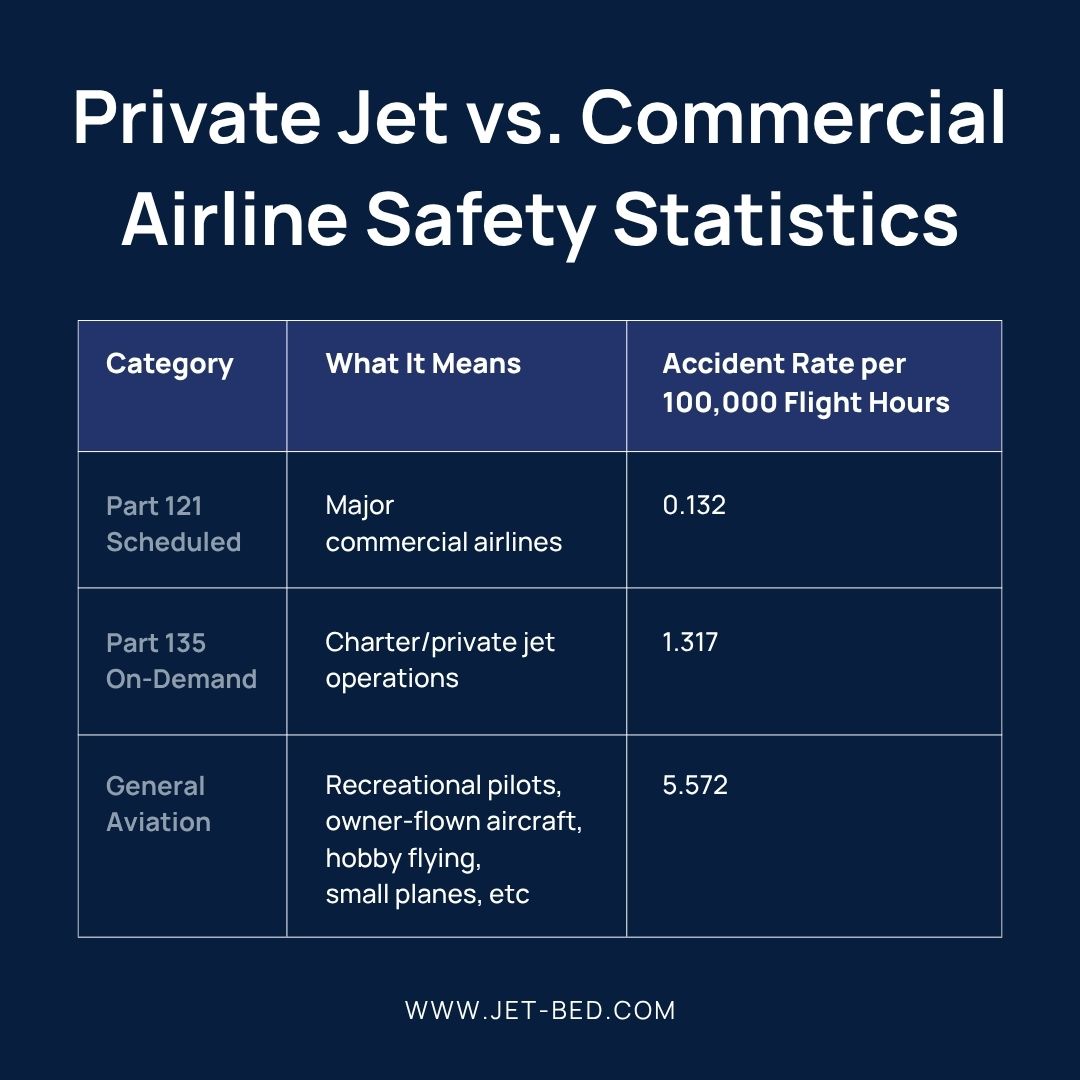
When analyzing factors as important as safety, it’s critical to review relevant, modern data. From a statistical standpoint, commercial airlines generally report the industry’s lowest overall accident rates. To better understand what this means, here is a more comprehensive breakdown of research-based aviation data per the National Transportation Safety Board:
However, those numbers require important context.
Most private aviation statistics include a wide range of operations, from owner-operated recreational aircraft to professionally managed charter fleets. This results in a less consistent range when compared to commercial airlines, which operate under highly standardized systems.
That said, comparing commercial airlines to private aviation is more nuanced than many travelers realize. This is largely because private aviation encompasses multiple operational categories with very different safety standards. Moreover, many modern jets are also equipped with increasingly advanced technology, including synthetic vision systems (SVS), predictive maintenance, and terrain awareness systems.
To put this in perspective, industry data reveals that the general aviation fatal accident rate as of 2026 remains at 0.47 accidents per 100,000 flights. Compared to the yearly target of 0.91, this is paramount in validating the increased safety in private aviation.
When Is a Private Jet Safer Than Commercial Planes?
Flying with a Highly-Rated Charter Operator
Ultimately, not all charter operators provide the same level of safety oversight. Therefore, it’s important to choose a reputable provider with strong safety audits and experienced pilots. Top-tier operators invest heavily in recurrent pilot training, internal safety management systems, and third-party audits.
Many also voluntarily exceed minimum Federal Aviation Administration (FAA) requirements to maintain industry certifications and client trust. When travelers choose operators with transparent safety records and established reputations, private flights can provide a highly controlled experience.
Avoiding Congested Commercial Airports
Commercial airlines often involve high traffic volumes, particularly during peak travel periods. Heavy runway congestion, gate delays, and dense air traffic management systems all add operational complexity. To avoid this, private aircraft frequently use smaller airports and private terminals.
Smaller regional airports naturally reduce traffic density, lowering the chances of delays and air traffic complications. While seemingly minor, fewer operational complexities can also reduce the likelihood of in-flight disruptions and unnecessary safety risks.
For additional information, review our guide: “Where Do Private Jets Land?”
Greater Control Over Flight Scheduling
One of the major advantages of private aviation is its unparalleled flexibility. We discussed this concept in our post, “Are Flights Canceled During Tropical Storms for Private Jets?” Unlike commercial airlines, which operate on fixed schedules, private flights can often adjust departure times accordingly. This proves especially pertinent regarding unsafe weather conditions.
Commercial airlines may still operate during marginal weather conditions due to network obligations and passenger schedules, provided conditions remain within legal safety limits. However, the ability to create individualized schedules can enhance overall safety in high-risk travel times.
More Direct Routing and Shorter Travel Time
Along with flexible scheduling, private aviation offers more direct routing, reducing overall flight time. Not only does this enhance efficiency, helping travelers arrive at destinations more quickly, but it also increases safety.
Commercial airlines frequently operate through hub-and-spoke systems. Essentially, passengers arrive at a central airport that transfers them to smaller “spoke” cities. Private aviation, on the other hand, operates on a point-to-point system, shortening travel length and limiting exposure to potential in-flight risks.
Learn more about the benefits of direct routing in our post, “What Is the Difference Between Eastbound and Westbound Flights?”

What Affects Private Jet Safety?
Pilot Training, Experience, and Crew Requirements
Qualified charter operations prioritize both pilots and crew members who exceed standard regulations. For example, experienced pilots will have extensive flight hours, recurrent simulator training, and specific aircraft type ratings. Likewise, top-tier crew members will receive specialized training, strict duty time-limits, and verifiable crew pairings.
You can gain deeper insights by reading our guides, “Private Pilot Privileged and Limitations” as well as “How Many Hours Does a Flight Attendant Work?” Ultimately, however, those operating private flights must be equipped to handle complex weather conditions, emergency procedures, and high-pressure decision-making.
Aircraft Maintenance History and Inspection Frequency
Aircraft maintenance plays a foundational role in private jet safety. In addition to mandatory maintenance checks, aircraft must also undergo scheduled and preventative inspections to ensure safety, airworthiness, and regulatory compliance. We discuss this concept comprehensively in our guide, “Private Jet Inspection and Maintenance.”
High-quality operators follow strict maintenance schedules designed around manufacturer recommendations and FAA regulations. Not only does this ensure the aircraft functions optimally, but it also enhances the safety of both flight crew and passengers.
Type of Operation
Private aviation is a large sector, and the type of operator matters greatly when evaluating safety standards. More specifically, here is a brief overview of the key types of private aviation operations and which standards they’re subject to:
- On-Demand Charter: Commercial private jet operations that operate under FAA Part 135. These flights are subject to stricter oversight, including pilot qualification requirements, crew duty limitations, operational control standards, and routine aircraft maintenance.
- General Operations: Under FAA Part 91, non-commercial private aviation operations include personal, corporate, and owner-flights. They are less strict, offering greater regulation flexibility.
- Large Aircraft: Flights involving aircraft with more than 20 passenger seats or payload capacity exceeding 6,000 pounds may operate under FAA Part 125 regulations. Standards fall between general aviation and commercial standards, subject to additional crew, training, maintenance, and operational requirements.
This distinction is among the many reasons why professionally managed charter flights are generally considered safer than privately operated recreational aircraft. Moreover, it emphasizes the importance of conducting thorough research when choosing both a charter provider and an aircraft type.
Weather Conditions and Route Planning
Weather conditions remain among the most influential factors in aviation safety. Thunderstorms, icing, turbulence, low visibility, and high winds can all affect flight operations. However, advanced route planning, real-time forecasting tools, and scheduling flexibility help minimize unnecessary risk exposure.
Modern private jets are equipped with highly advanced avionics and weather mapping systems. That said, technology alone cannot replace sound pilot judgment and operational discipline. This is one of the many reasons charter operations require such stringent qualifications and skill sets.
Airport Infrastructure and Runway Conditions
Private jets frequently access smaller airports with shorter runways or unique infrastructure compared to major commercial hubs. Smaller regional airports may offer less congestion and better ground transportation efficiency, but pilots must handle them skillfully.
An experienced pilot will best understand the precise operational planning depending on terrain, weather conditions, and runway limitations. From there, they can execute meticulous performance calculations to ensure safe, efficient arrival and departure from specialized airports.
Learn additional information in our post, “Can Private Planes Land at Public Airports?”
What Are the Safety Standards of Chartering Private Jets?
FAA Part 135 Certification
As discussed previously, FAA Part 135 establishes operational standards for charter operations across the United States and surrounding international waters. These regulations cover operational procedures, pilot qualifications, maintenance requirements, and crew duty limitations.
Operators must maintain consistent oversight to demonstrate continued compliance and retain certification. This regulatory framework is crucial to standardizing safe operations and consistent guidelines across private aircraft charters.
For those interested in learning more, visit: “What Is Private Aircraft Management?”
Pilot Training and Experience Requirements
As mentioned previously, pilots are subject to FAA Part 135 regulations. This means they must meet minimum flight requirements, complete recurrent training, and pass systematic proficiency tests throughout their careers. Below, we will provide a brief overview of what the FAA requires of pilots who operate private charters:
- A Commercial Pilot License (CPL) or Airline Transport Pilot (ATP) license
- Minimum of 1,200 total flight hours, including 500 hours cross-country and 100 hours at night time
- Mandatory annual recurrent training, including simulator training and proficiency checks
- Minimum of a second-class medical certificate
- Mandatory drug and alcohol testing
- Strict rest limitations
The above qualifications are crucial to ensuring pilots remain fully prepared for complex, time-sensitive scenarios.
Routine Aircraft Maintenance and Inspections
Routine aircraft maintenance is a core component of private jet safety, regardless of aircraft type. Operators must complete scheduled inspections, maintenance checks, component servicing, and system upgrades in accordance with federal regulations and manufacturer standards.
Many high-end operators also implement additional internal inspection programs and more frequent servicing beyond minimum compliance requirements. More importantly, they do so to prioritize passenger safety and increase operational reliability.
Both passengers and aircraft owners can benefit from our guide, “Private Plane Maintenance.”
Safety Management Systems (SMS)
Safety Management Systems (SMS) in aviation refer to the formal, industry-wide approach to managing safety through integrating hazard identification and risk control into business operations. Many leading operators implement SMS, as this restructures safety from a reactive practice to a proactive, data-driven approach.
SMS programs ultimately analyze safety trends, operational reports, maintenance data, and procedural performance to continuously improve flight operations. Ultimately, this reduces the likelihood of plane crashes, ensuring passenger safety on every journey.
Review further information regarding this concept in our post, “Importance of Safety Management Systems in Aviation.”
Third-Party Safety Audits
Reputable independent aviation safety organizations often conduct third-party audits on charter operators. These audits are particularly valuable because they evaluate pilot training, operational control systems, maintenance procedures, documentation standards, and the company-wide safety culture.
Ultimately, these voluntary audits exceed standard minimums. Audit providers such as ARGUS, Wyvern, and IS-BAO are widely recognized throughout private aviation for their rigorous evaluation standards and ongoing oversight programs.
Operators that voluntarily complete these audits often demonstrate a stronger long-term commitment to aviation safety. For further context, review: “Safest Private Jets: Aircraft with the Highest Safety Standards.”
Operational Control and Flight Planning Standards
Every private flight involves extensive operational planning that most passengers remain unaware of. For example, crews evaluate weather conditions, runway performance, fuel requirements, alternate airports, aircraft weight limitations, and routing considerations before departure.
These procedures are foundational in helping reduce operations risk, both in the air and on the ground. Moreover, they also improve overall flight safety for all those on board.
Safest Private Jets in the World
Gulfstream G650
The Gulfstream G650 boasts an incredible safety record, with only one fatal, major hull-loss accident in April 2011. The aircraft features triple-redundant fly-by-wire control systems, situational awareness technologies, predictive landing performance systems, and enhanced flight vision. Moreover, two Rolls-Royce BR725 engines power the G650, which are known for efficiency and reliability.
Review the Gulfstream G650 JetBed to enhance your in-flight comfort.
Dassault Falcon 8X
The Dassault Falcon 8X is known for its exceptional handling, advanced digital flight controls, and its ability to operate efficiently at smaller airports. More specifically, the aircraft features triple-engine redundancy, fighter jet-derived fly-by-wire technology, FalconEye combined vision systems, and an EASy III flight deck to reduce pilot workload. Not only is this jet operationally efficient, it simultaneously enhances passenger safety.
Bombardier Global 7500
Considered one of the safest jets in the industry, the Bombardier Global 7500 combines ultra-long range performance with advanced flight deck technology and sophisticated safety systems. Operators favor the aircraft for its innovative, smooth flěx wing, advanced synthetic vision systems, fly-by-wire technology, and GE Passport engines.
Moreover, the Global 7500 is the first business jet to break the sound barrier, showcasing its distinguished engineering.
Explore the Bombardier Global 7500 JetBed complemented with luxury Italian linens.
With advanced technology, rigorous maintenance, and regulatory compliance, private jets remain among the safest forms of travel.
When traveling by aircraft, many passengers associate flexibility and convenience with increased safety. While these factors are the cornerstone of private aviation, they are only part of the equation. Reputable operators exceed standard minimums, including maintenance, crew requirements, and pilot training. By doing so, they demonstrate their dedication to maintaining private aviation’s reputation of operational excellence and remarkably high safety standards.
When flying privately, it’s important to feel as confident in your comfort as you do in your safety. At JetBed, we spent years engineering and designing what most modern fleets lack: a patented sleep solution free of grooves or pressure points. Experience what true luxury is like by contacting the JetBed team or filling out our online form.