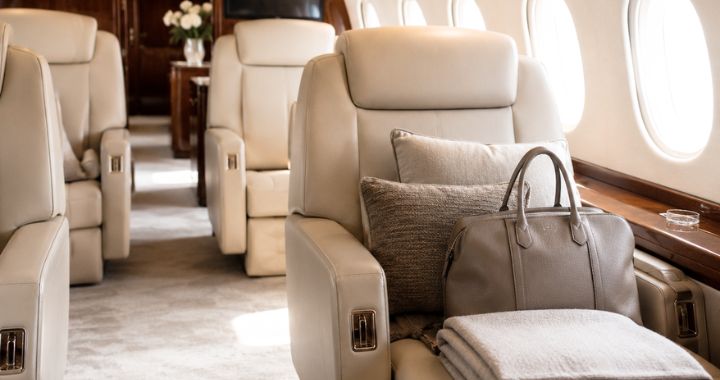
One of the many unparalleled advantages of private jet travel is the flexibility in seating capacities. Unlike commercial aviation, passengers can intentionally choose a jet that reflects the cabin space, comfort level, and operational efficiency their travel itineraries require. Nonetheless, many still have one common question: “How many people can fit in a private jet?”
Ultimately, the answer depends on far more than seat count alone. While the passenger capacity of a private jet can range from 4 to 19+ individuals, that number doesn’t always reflect how many people can realistically travel comfortably. It’s equally important to consider flight distance, luggage requirements, and onboard layout.
To help passengers prepare for travel, we are discussing how many people can fit in a private jet. We will also cover what affects capacity and how large each aircraft type is. Whether arranging travel for larger groups or planning an intimate family vacation, understanding these differences is essential when choosing the right private aircraft.
In private aviation, premium comfort extends beyond seating arrangements to include meaningful sleep onboard. At JetBed, we’ve spent years blending precision engineering and artisanal craftsmanship to create a groove-free in-flight sleep system that custom-fits to your aircraft model. After all, flying privately should elevate every aspect of your journey.
How Many People Can Fit in a Private Jet?
The capacity of a private jet varies significantly across aircraft categories. More specifically, some aircraft are designed for short-haul regional operations, whereas others are engineered for long-range flights.
Because of this, it’s important to avoid evaluating a private jet solely on numbers. Instead, a more practical assessment considers comfortable seating, travel duration, baggage requirements, and passenger expectations.
For example, while light jets are the more practical and cost-effective option for short trips, they may not be the most ideal for a large group. Similarly, ultra-long-range aircraft may offer dedicated workspaces and separate bedrooms, but they may be unnecessary for small groups taking regional trips. You can learn more about this in our guide, “How Far Can Private Planes Fly?”
Ultimately, choosing the right aircraft size creates an ideal balance that exceeds passenger expectations. It aligns comfort, operational efficiency, and travel practicality, ensuring the journey remains seamless and passengers remain well accommodated.
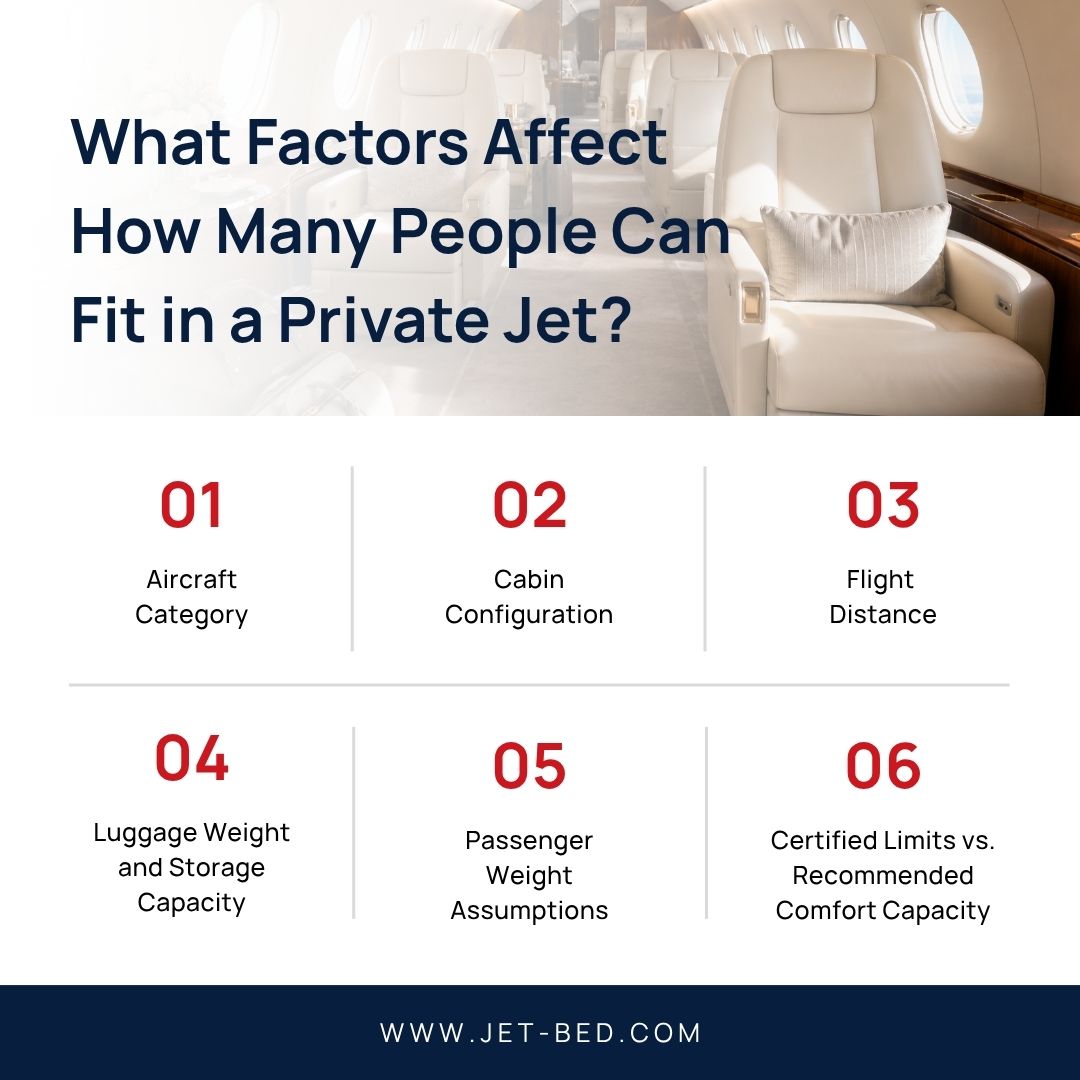
What Factors Affect How Many People Can Fit in a Private Jet?
The size of an aircraft is notably the most important factor for determining capacity. However, scale alone doesn’t define how many passengers can realistically travel comfortably. Below, we will provide an overview of specific operational considerations that influence private jet travel:
Aircraft Category
Private aviation consists of multiple aircraft categories, including:
- Light jets
- Midsize jets
- Super midsize jets
- Large jets
- Ultra-long-range jets
Each category serves an entirely different purpose, mission profile, seating capacity, and cabin layout. In terms of space, however, light jets primarily prioritize efficiency for short-haul flights, while larger aircraft prioritize extended comfort and flexibility.
For those interested in how JetBed can seamlessly fit into their aircraft model, visit: “How to Sleep on Long Flights: Tips for Restful Travel.”
Cabin Configuration
While some jets may offer identical passenger capacity, they present entirely different onboard experiences. And for passengers, cabin configuration can directly affect both usable seating and overall comfort.
Light jets, for example, feature club seating arrangements that encourage conversation and workspace functionality. Larger and ultra-long-range jets emphasize conference groupings, fully enclosed bathrooms, and, in some cases, full-size kitchens. This distinction matters as certified seat counts may not include options that are as practical for long-haul flights.
For additional information regarding in-flight amenities, learn more in “Private Jets with Showers: The Ultimate Luxury in the Sky.”
Flight Distance
While passengers may be willing to compromise comfort on short flights, this quickly becomes non-negotiable when sitting for long periods. Ultimately, a two-hour regional trip creates a very different experience than a ten-hour international journey.
On shorter flights, travelers are naturally willing to accept tighter cabin space in exchange for operational efficiency and lower charter costs. However, long-haul flights demand factors such as:
- Additional legroom
- Sleeping flexibility
- Lavatory accessibility
- Jet catering service space
- Room to move throughout the cabin
Even aircraft that can technically fit larger groups may feel considerably less spacious in practice. This is one of the many reasons it’s important to consider travel duration alongside overall comfort factors.
Luggage Weight and Storage Capacity
Passenger capacity extends far beyond general comfort. In accordance with FAA regulations, every flight must comply with strict Maximum Takeoff Weight (MTOW) requirements.This means that every additional pound of fuel, baggage, or onboard provisions contributes to the aircraft’s total allowable load.
A qualified charter operator accounts for these variables when planning each excursion, balancing passenger count, baggage requirements, and fuel needed to remain within safe operating parameters. As a result, practical passenger capacity may vary depending on the final destination rather than the aircraft’s maximum seating alone.
Passenger Weight Assumptions
As mentioned previously, certified charter operators profusely align flight planning itineraries with operational readiness and requirements. However, in addition to baggage, catering, and fuel requirements, passenger group weight may vary considerably. This becomes increasingly important on longer routes, where fuel consumption increases significantly.
It’s important to remember that private aviation also consists of pilots, crew members, and flight attendants. As a result, without proper preparation, this can reduce the number of passengers who can be accommodated safely. This is an essential factor to consider, as passengers alone do not account for the entire weight onboard.
For additional information, review our comprehensive guides: “How Many Pilots Are on a Plane?” as well as “Where Do Flight Attendants Sleep?” Both resources offer accessible information regarding how many pilots and crew members flights require, depending on the itinerary.
Certified Limits vs. Recommended Comfort Capacity
One of the most misunderstood distinctions in private aviation is the difference between legal certification and recommended comfort. An aircraft may be certified to safely carry eight passengers, but feel optimally configured for six.
This becomes increasingly relevant for executive travelers prioritizing privacy, productivity, and rest. More specifically, it’s important that passengers consider additional, yet necessary, space for factors such as extra storage, fully reclined sleeping arrangements, and ample legroom.
Certified limits represent regulatory maximums—comfort capacity reflects practical functionality.
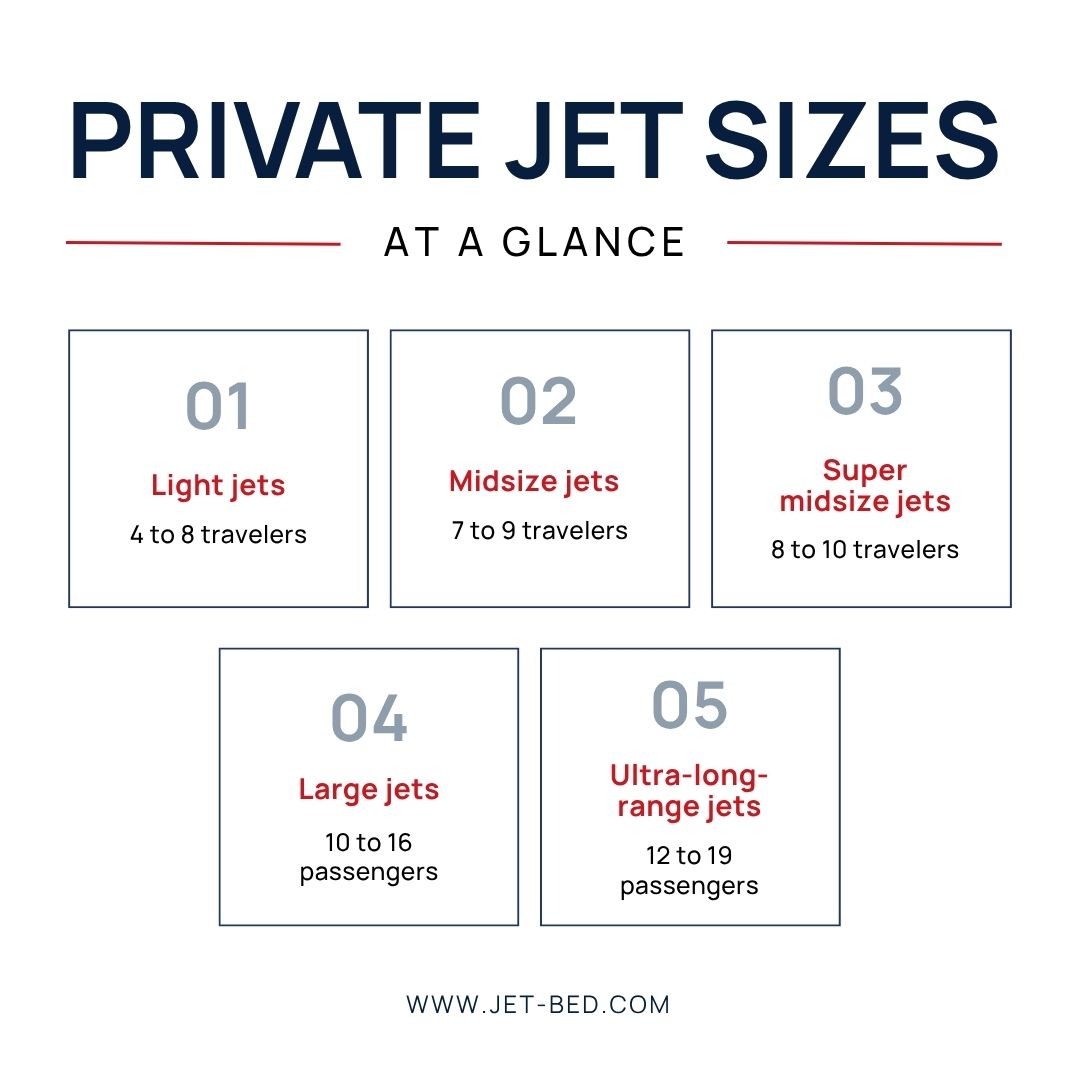
How Big Are Private Jets?
Light Jets
Light jets, also commonly referred to as business jets, are among the most compact options in aviation. Because passengers often use them for short regional travel, they do not offer the same level of amenities as other models. More specifically, light jets often feature curtained lavatories, lounge-style seating, and limited headroom.
While specifications can vary per aircraft, typical dimensions reflect common industry ranges:
- Cabin Height: Approximately 4–5 feet
- Range: Between 1,500 and 2,000 nautical miles
- Passenger Capacity: 4–8 travelers
The most common light jets include the Embraer Phenom 300E, HondaJet Elite 11, and Cessna Citation M2. Additionally, if you’re planning future travel in a light jet, we implore you to visit our guide: “Small Aircraft Charter Flights.”
Midsize Jets
Midsize jets are the ideal alternative for travelers seeking a bridge between light and long-range aircraft. In addition to offering a greater range, they also provide improved cabin comfort, increased baggage flexibility, and stronger overall versatility.
The typical dimensions for midsize jets measure:
- Cabin Height: Approximately 5’7” to 5’9”
- Range: Between 2,000 and 3,000 nautical miles
- Passenger Capacity: 7–9 travelers
Popular midsize private aircraft models include the Cessna Citation XLS Gen 2, Gulfstream G280, and Embraer Praetor 500/600. We discuss this aircraft category in our post, “Private Plane Models You Should Know About.”
Super Midsize Jets
A highly favorable option for travelers seeking non-stop transcontinental flights, super midsize jets blend midsize efficiency with heavy aircraft comfort. Beyond effective cross-country routing, midsize models also boast wide aisles, extended headroom, luxury amenities, and more favorable cost profiles.
Measurements vary depending on the aircraft model, but average dimensions often include:
- Cabin Height: Approximately 5’8” to 6’3”
- Range: Between 3,000 and 4,500 nautical miles
- Passenger Capacity: 8–10 travelers
The Bombardier Challenger 350/3500, the Dassault Falcon 2000 Series, and the Cessna Citation Longitude are among the most popular super midsize jet options. For further context regarding travel possibilities with super midsize aircraft, visit “How Far Can a Private Jet Fly?”
Large Jets
Larger jets offer significant advantages in range, flight smoothness, cabin comfort, and luxury amenities. Moreover, many passengers prefer this aircraft type when traveling in large groups, requiring generous baggage capacity, or seeking over-ocean travel without refueling.
Across the industry, large private aircraft generally feature the following measurements:
- Cabin Height: Approximately 6’3” to 6’6”
- Range: Between 3,500 and 8,000 nautical miles
- Passenger Capacity: 10–16 passengers
The most popular large private jets include the Gulfstream G550, Embraer Legacy 600/650, and Bombardier Global 6500. Because this is a popular option for cross-country exploration, visit “How Far Can a Private Jet Fly Without Refueling?” to learn additional information.
Ultra-Long-Range Jet
Ultra-long-range aircraft represent the most capable category in private aviation. Designed for intercontinental missions where productivity, comfort, and endurance are non-negotiable, ultra-long-range models feature expansive cabin space, gourmet galleys, in-flight showers, and high-speed Wi-Fi. It’s an effortless option for passengers seeking a seamless long-haul experience.
Ultra-long-range aircraft commonly feature dimensions such as:
- Cabin Height: Approximately 6’2” to 6’5”
- Range: Between 6,500 and 8,000+ miles
- Passenger Capacity: 12-19 passengers
For those seeking unparalleled luxury, common ultra-long-range models include the Gulfstream G650ER, Dassault Falcon 8x, and Bombardier Global 7500.
How Many People Can a Private Jet Hold?
As we mentioned earlier, certified seat counts differ significantly from passenger capacity. Below, we will discuss how many travelers are generally permitted to travel on each aircraft type—as well as how many are recommended. Practical comfort should remain the priority.
Light Jet Passenger Capacity
According to the FAA, light jets can legally carry 7–9 passengers. However, the ideal capacity ranges from 4 to 6 passengers. For shorter trips involving small groups, this category remains highly efficient. However, for those at the upper end of certified passenger capacity, it’s worth considering more spacious options.
Midsize Jet Passenger Capacity
Midsize jets are certified to carry between 7 and 10 passengers. However, practical passenger capacity can vary depending on the specific aircraft model, baggage requirements, and trip length. For a more comfortable onboard experience, many travelers find that accommodating 6 to 8 passengers allows for greater flexibility.
Super Midsize Jet Passenger Capacity
Standard super midsize jet models are certified to carry up to 12 passengers. This reflects the aircraft type’s popularity for its expanded passenger capacity, impressive performance, and greater baggage flexibility. Nonetheless, the ideal passenger capacity remains around 8 to 9 passengers.
Large Jet Passenger Capacity
Large jets, known for their premium amenities and expansive cabin layouts, are a preferred option for longer-range private jet travel. More specifically, travelers particularly benefit from improved cabin mobility and better overall comfort. In practice, large private jets are certified to carry approximately 16 passengers. However, when comfort is the priority, many operators recommend seating closer to 10–14 passengers, depending on the aircraft configuration and mission profile.
Ultra-Long-Range Jet Passenger Capacity
Ultra-long-range jets are widely known for their unmatched range, premium onboard amenities, and exceptional passenger comfort. However, even still, it’s important to balance certified seats with the recommended capacity. While many models are certified to carry up to 19 passengers, many find that 12 to 16 passengers create a more spacious and comfortable onboard experience.
How Much Luggage Can a Private Jet Carry?
Baggage requirements can significantly alter the overall experience when traveling on a private aircraft. However, this is often an overlooked factor, making it essential to consider prior to booking a private flight.
Light Jet Luggage Capacity
On average, light jets offer approximately 50 to 90 cubic feet of formal luggage capacity. In practice, this looks like:
- 5–10 soft-sided bags
- Limited oversized storage
Light jets, due to their compact size, often present the most restrictive baggage limitations. Hard-shell luggage, sports equipment, and oversized items may ultimately create operational challenges, requiring passengers to use cabin space for additional storage.
Midsize Jet Luggage Capacity
Midsize jets commonly offer 60 to 170 cubic feet of recognized luggage capacity. As a passenger, this commonly looks like:
- 7–14 large suitcases
- Moderate oversized item flexibility
Ultimately, the exact capacity limit depends on your specific aircraft model. However, many passengers often bring on both a medium-to-large roller bag and a personal item. Compared to light aircraft, midsize models feature significantly more flexibility.
Super Midsize Jet Luggage Capacity
Super midsize jets, offering 90 to 177 cubic feet of formal luggage capacity, provide a meaningful step up from midsize aircraft for travelers with heavier baggage requirements. More specifically, super midsize models commonly accommodate:
- 9–12 large suitcases
- Personal items
- Bulky sporting gear
Moreover, super midsize aircraft often offer significantly improved baggage handling compared to smaller, more compact aircraft. For passengers, this can make a meaningful difference when traveling for leisure.
Large Jet Luggage Capacity
Large jets are far more forgiving for larger groups or premium travel expectations. With an average of 170+ cubic feet of luggage capacity, many travelers can often bring:
- 10–15+ large suitcases
- Additional cabin-accessible in-flight storage items
As we’ll discuss below, many find these limitations similar to those of ultra-long-range jets. However, in comparison, large jets are much more forgiving when it comes to weight limitations.
Ultra-Long-Range Jet Luggage Capacity
As one of the most premium options in private aviation, ultra-long-range jets feature approximately 195 cubic feet of formal luggage capacity. With this, passengers can expect accommodations such as:
- 15–20+ large suitcases
- In-flight cabin accessibility to additional items
- Speciality cargo
Unlike shorter-range aircraft, ULR jets may face tighter payload constraints on extended missions, as a larger portion of the allowable weight is allocated to fuel. However, it’s important to discuss potential limitations with charter operators prior to booking.
When booking private travel, choosing the right aircraft based on comfort matters.
Ultimately, the question isn’t “How many people can fit in a private jet?” Instead, it’s “How many people can fit in a private jet comfortably, efficiently, and realistically?” When flying privately, comfort is of utmost importance—regardless of itinerary and final destination. And by understanding the differences in aircraft type, you can better prepare for every type of travel.
Comfort plays a direct role in how much passengers enjoy their private flight experience. And at JetBed, we understand this better than most. Made in the USA and custom-fit to your unique aircraft model, JetBed’s patented inflatable design creates a completely flat, hotel-quality bed in minutes.
That isn’t just the better way to fly—it’s the right way to rest. Contact the JetBed team or fill out an online form today to learn more.