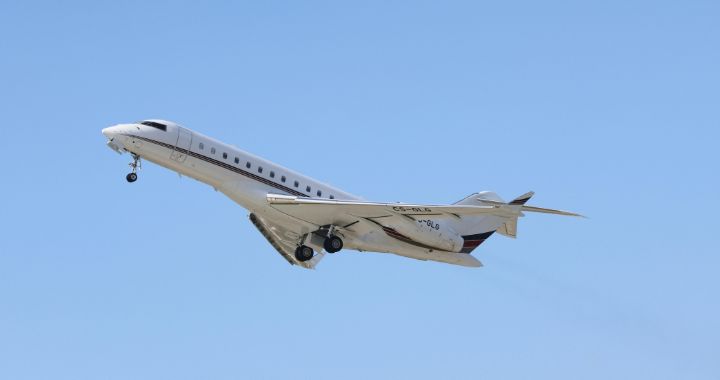
Three-engine private jets offer range, climb performance, and redundancy that twin-engine aircraft in the same cabin class cannot match. Long-range business aviation favored them before modern high-bypass turbofans changed the calculus. Meanwhile, several remain in active service today.
Understanding what sets a trijet apart from a conventional twin is useful context before booking a long-range private flight. Ultimately, the engine configuration affects performance, operating costs, and aircraft availability in ways that are worth knowing upfront.
This guide covers what three-engine private jets are, how they compare to twin-engine alternatives, and which models are worth considering. By the end, you can confidently decide which engine configuration meets your mission’s requirements.
Long-range flights are where in-flight rest has the most operational value. JetBed’s patented inflatable design creates a flat, comfortable sleeping surface in minutes. They are custom-fit to your specific aircraft model, made in the USA, and finished with luxury Italian linens. JetBed is the comfortable way to fly.

What Is a 3 Engine Private Jet?
A three-engine jet, or a trijet, has three engines rather than the more common two. The third engine adds thrust, extends range, and provides redundancy. So, if one engine fails, two remain to keep the aircraft operational.
Trijets handle long-distance operations seamlessly. The additional thrust supports faster climb rates, higher cruise altitudes, and access to shorter runways that twin-engine jets cannot use. That operational flexibility is particularly valuable on routes over open ocean or remote terrain with limited diversion options.
Dassault Aviation is currently the only manufacturer still producing jets with three engines. The format traces back to the Falcon 50, which entered service in 1979 and proved the trijet viable for private aviation. Their Falcon 900LX, 7X, and 8X carry that lineage forward with ranges spanning 4,750 to 6,450 nautical miles. For operators flying demanding long-haul missions, the trijet configuration is a practical performance advantage, not just an engineering distinction.
How Many Engines Does a Private Jet Have?
Most private jets fly on two engines, as the twin-engine configuration balances performance with efficiency. Additionally, lower operating costs make it the practical choice for the majority of operators and routes.
Conversely, three-engine aircraft offer greater thrust, range, and redundancy than twin-engine platforms in the same cabin class. Dassault’s Falcon series is the only current manufacturer producing trijets, with models spanning the 900 series to the 8X. The configuration earns its place on long-haul routes where range, climb performance, and diversion flexibility matter most.
The mission profile determines which configuration makes sense. Two engines cover most routes, whereas three engines are the right call on the longest and most demanding ones.
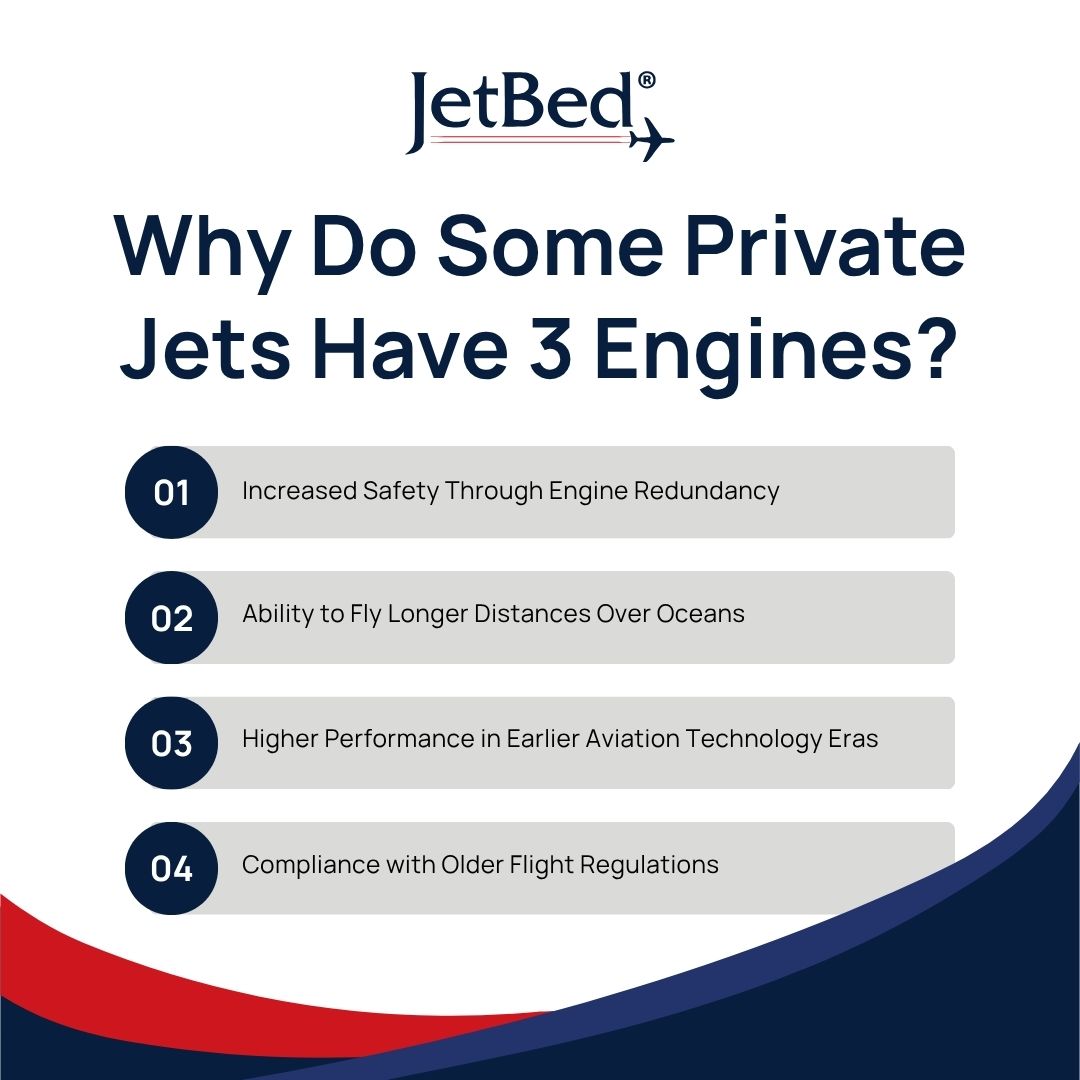
Why Do Some Private Jets Have 3 Engines?
Increased Safety Through Engine Redundancy
A trijet carries a built-in, enhanced safety advantage. If one engine fails, two remain to keep the aircraft flying. This is a meaningful margin on long overwater routes and flights over remote terrain where diversion airports are scarce.
Twin-engine jets meet modern safety standards, and ETOPS certification has closed the performance gap considerably. However, for operators flying demanding long-haul missions, the third engine provides a level of redundancy that twin-engine platforms cannot replicate.
For more information about safety, review our guides “How Safe Are Private Jets” and “Safest Private Jets.”
Ability to Fly Longer Distances Over Oceans
Trijets are built for long overwater routes. The third engine adds thrust and fuel capacity, extending range beyond what most two-engine jets can achieve. That additional power also means the aircraft can maintain altitude and speed with one engine inoperative. This is a critical capability when the nearest diversion airport is hours away.
Dive deeper into long-haul private flights in our guide “How to Plan an International Trip on Your Own Plane.”
Higher Performance in Earlier Aviation Technology Eras
Before modern engine technology matured, three engines delivered performance that twin-engine aircraft could not match. The additional thrust supports faster climbs, higher cruising altitudes, and operations from shorter or higher-elevation airstrips.
Early regulations required at least three engines on overwater routes. Twin-engine reliability had not yet earned regulatory confidence for long oceanic flights. The trijet filled that gap—more capable than a twin, more economical than a four-engine aircraft.
Compliance with Older Flight Regulations
Before ETOPS certification changed the rules, regulations restricted two-engine aircraft from long overwater routes. The logic was straightforward—a single remaining engine after a failure over open ocean was not sufficient. Three-engine jets met those requirements with two engines in reserve. This opened transatlantic and transpacific routes that twins could not fly.
That regulatory advantage made the trijet a practical necessity for long-range international operations, not just a performance preference.
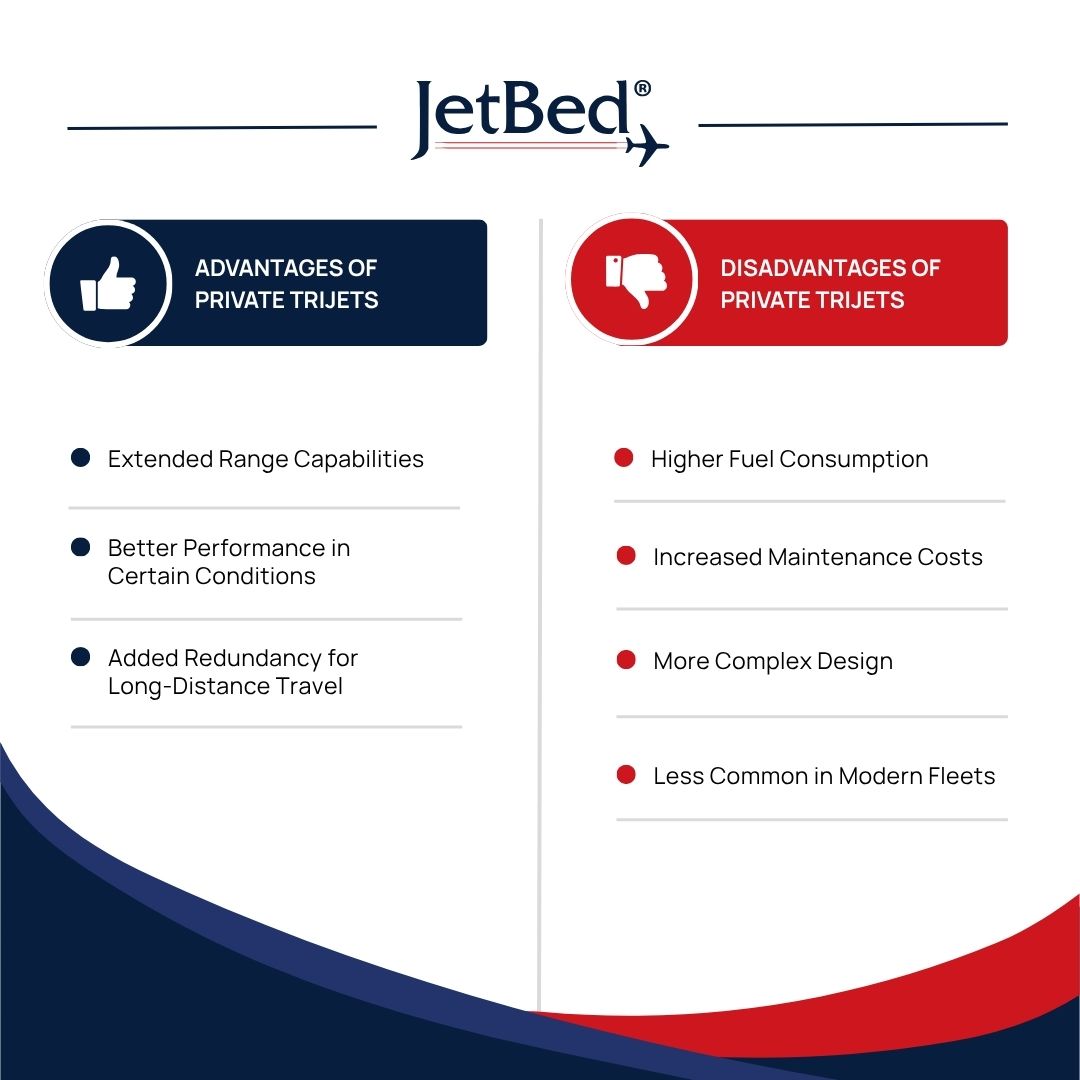
Advantages of Private Trijets
Extended Range Capabilities
A third engine means more thrust and greater fuel capacity, which translates directly into range. As a result, many trijets are capable of flying nonstop routes that would be challenging for certain twin-engine aircraft, including transatlantic and transpacific missions.
For corporate flight departments running long-haul international schedules, that range has a direct operational impact. Eliminating fuel stops saves time, reduces ground handling costs, and simplifies crew scheduling on demanding itineraries.
Learn more about private jet range in our guide “How Far Can Private Jets Fly?”
To learn more about corporate jets, read “What Is a Corporate Jet? Cost, Types, and Key Benefits.”
Better Performance in Certain Conditions
Three engines give private jets a performance edge in demanding operating environments. Additional thrust supports faster climb rates and higher cruise altitudes, where thinner air reduces fuel burn. The thrust-to-weight ratio lets three-engine jets operate from shorter runways, including remote airports that less powerful aircraft cannot reach.
This capability matters for operators flying into mountain airports, short strips, or destinations with challenging terrain. A twin-engine jet may not carry the power margin to handle those conditions as reliably.
Discover how private jets withstand certain conditions in our guides “Can Planes Fly in Thunderstorms?” and “Flight and Safety at High Altitudes.”
Added Redundancy for Long-Distance Travel
Engine redundancy is the trijet’s most practical safety advantage. With three engines, the aircraft sustains a failure and continues on two engines. Before ETOPS certification expanded the rules for two-engine aircraft, trijets were the only practical option for transatlantic routes. Today, modern twin-engine jets meet high safety standards, and the regulatory gap has narrowed considerably.
Discover which private jets offer enhanced safety in our guide “Safest Private Jets.”
Disadvantages of Private Trijets
Higher Fuel Consumption
Trijets consume more fuel than two-engine aircraft. The added weight and complexity of a third engine increase operation costs on every flight. Meanwhile, a twin-engine jet flying the same route will spend less at every fuel stop. For operators running high-frequency schedules, that cost gap compounds quickly.
The third engine earns its place on long overwater missions. On shorter domestic routes, the operating cost premium is harder to justify compared with an aircraft with greater fuel efficiency.
Compare fuel costs of a private jet in our guide “Private Plane Fuel Costs: Fuel Budgeting Made Easy.”
Increased Maintenance Costs
Three engines means three sets of scheduled inspections, engine reserves, and parts inventories. Every overhaul, life-limited part replacement, and unscheduled repair multiplies accordingly. Trijet maintenance also requires specialized crews familiar with the specific airframe-engine combination. This limits the pool of qualified providers and increases costs.
For a flight department managing a tight budget, that maintenance burden is a real operational consideration. It belongs in the total cost-of-ownership calculation before committing to the platform.
Explore what private jet maintenance entails in our guides “Private Jet Inspection and Maintenance Frequency Guide” and “Private Plane Maintenance.”
More Complex Design
The trijet configuration adds engineering complexity that twin-engine aircraft do not carry. For example, the center engine requires an S-duct air intake through the tail. That adds structural weight and design constraints affecting both manufacturing and maintenance. In the hangar, technicians need familiarity with systems that most modern jets do not use.
Meanwhile, spare parts availability is narrower than for twin-engine platforms. Qualified maintenance providers outside major aviation centers are also harder to source. For operators based away from large MRO facilities, that is a logical consideration worth factoring into the platform decision.
Less Common in Modern Fleets
Dassault is the only manufacturer still producing trijets. That exclusivity narrows the market in practical ways. Pre-owned options are fewer, parts pricing is less competitive, and the resale market is thin. The broader aviation industry has shifted toward efficient twin-engine designs, and that trend shows no sign of reversing.
Are Three-Engine Private Jets Still Used Today?
Three-engine jets occupy a narrow but active segment of business aviation. Dassault remains the only manufacturer still producing trijets serving business travelers, charter operators, and high-net-worth owners.
Their value is mission-specific. Operators flying transatlantic routes regularly, using short or high-elevation airstrips, or prioritizing redundancy over open ocean, have a practical case for the trijet. To further support this, Dassault’s FalconEye Combined Vision System adds another layer of operational capability. This technology gives pilots a unified synthetic infrared display for low-visibility approaches at remote or challenging airports.
For most other missions, a modern twin covers the route at a lower operating cost. However, the trijet survives because the niche it fills is real, though it is not universal.
Learn more about the different private jet options and their capabilities in our guide “Types of Private Jets.”
Best 3 Engine Private Jets
Dassault Falcon 8X
The Falcon 8X is the most capable trijet in production. It carries up to 16 passengers, cruises at Mach 0.90, and reaches a maximum operational altitude of 51,000 feet. At 6,450 nautical miles and a 42-foot, 8-inch cabin, it has the greatest range and longest fuselage of any current Falcon.
For operators running nonstop transatlantic and transpacific routes, nothing in the trijet category matches it. Its closest competitors are the Gulfstream G650 and Bombardier Global 7500. Both are twin-engine jets with comparable range but without the redundancy of a third engine.
Dassault Falcon 7X
The Falcon 7X was Dassault’s first fly-by-wire trijet. It introduced winglets to the Falcon line and featured Honeywell EASy II Primus Epic avionics. It carries up to 16 passengers across 39 feet of interior length and delivers 5,950 nautical miles of range. While production ended in 2016, the pre-owned market remains active.
Direct competitors include the Gulfstream G550 and Bombardier Global Express. For a flight department that wants trijet performance without the Falcon 8X price tag, the 7X is the practical choice.
Dassault Falcon 900LX
The Falcon 900LX delivers 4,750 nautical miles of range, seats up to 12 passengers, and covers transatlantic routes comfortably. Additionally, Honeywell TFE731-60 engines with blended winglets give it an approach speed of 111 knots. That is more than 10 knots slower than competing jets in its class.
That low approach speed is its defining operational advantage. It accesses shorter runways that the 7X and 8X cannot, opening destinations that other large-cabin jets cannot reach. For operators flying routes that include challenging airstrips or shorter fields, the 900LX earns its place over larger alternatives.
Arrive well-rested on long-haul flights on three-engine private jets with JetBed.
Three-engine jets occupy a specific place in business aviation. They are the right platform for long-haul international missions where range, redundancy, and short-field performance justify the cost. For most other routes, a modern twin covers the mission more efficiently. Knowing the difference helps flight departments and charter operators make the right call for their specific requirements.
On transatlantic and transpacific routes, the cabin becomes your workspace and your rest space. JetBed’s patented inflatable design creates a flat, comfortable sleeping surface in minutes. It is custom-fit to your specific aircraft model, lightweight, and easy to stow. Contact us to find the right JetBed for your aircraft.