
Executive airports play a critical role in modern private aviation. These facilities offer efficiency, discretion, and operational control that commercial airliners simply cannot match. Across the United States, these airports support several business leaders and successful corporations who value time, privacy, and personalized service.
Austin Executive Airport, in particular, has gained notable recognition among private jet travelers. Strategically located near downtown Austin and major campuses, this hub offers unparalleled accessibility, convenience, and infrastructure.
There’s a reason why it has become the preferred alternative to larger commercial airports—which is what we are discussing today. In this Austin Executive Airport guide, we will provide a comprehensive overview of what travelers can expect when visiting. Moreover, we will explore why this airport is particularly appealing to executive and leisure travelers alike.
JetBedsupports travelers who rely on executive airports like Austin Executive. Our patented in-cabin bed systems enhance quality rest during flight while preserving cabin efficiency. Designed for private charter and corporate fleets, JetBed focuses on comfortable, lightweight, and high-quality sleeping solutions.

Austin Executive Airport Guide for Private Jet Travel
When traveling by private jet, understanding potential airport options is essential to the overall experience. Similarly, this is why our posts, such as “Must-Know Private Airports in Atlanta, GA” and “LA County Airports,” prove invaluable to travelers.
More specifically, however, Austin boasts one of the fastest-growing airports in the United States. Therefore, understanding how to bypass major terminal congestion and, instead, prioritize speed and efficiency is key.
In today’s post, we will offer reliable information about Austin Executive Airport. We will discuss how this hub works by focusing on operational realities rather than surface-level travel tips. Ultimately, these details make all the difference when proficiency is the priority.
For additional information, visit “How Fast Do Private Jets Go?”
What Is an Executive Airport?
An executive airport, also commonly referred to as a private or general aviation airport, is a smaller facility designed to support private jets and charter aircraft. The facilities are appreciated for streamlined travel, additional security, and complete flexibility.
Additionally, an executive airport offers luxury amenities that commercial airlines do not, such as on-demand scheduling, exclusive lounges, faster access to hangars, and closer proximity to destinations. This is particularly indispensable for high-profile individuals seeking timeliness and discretion.
Ultimately, many passengers prefer both private jet travel and executive airport access due to tailored, personalized service and unmatched convenience.
For similar information about in-flight amenities, review “Private Jet Catering” and “Can You Smoke on Private Jets?”
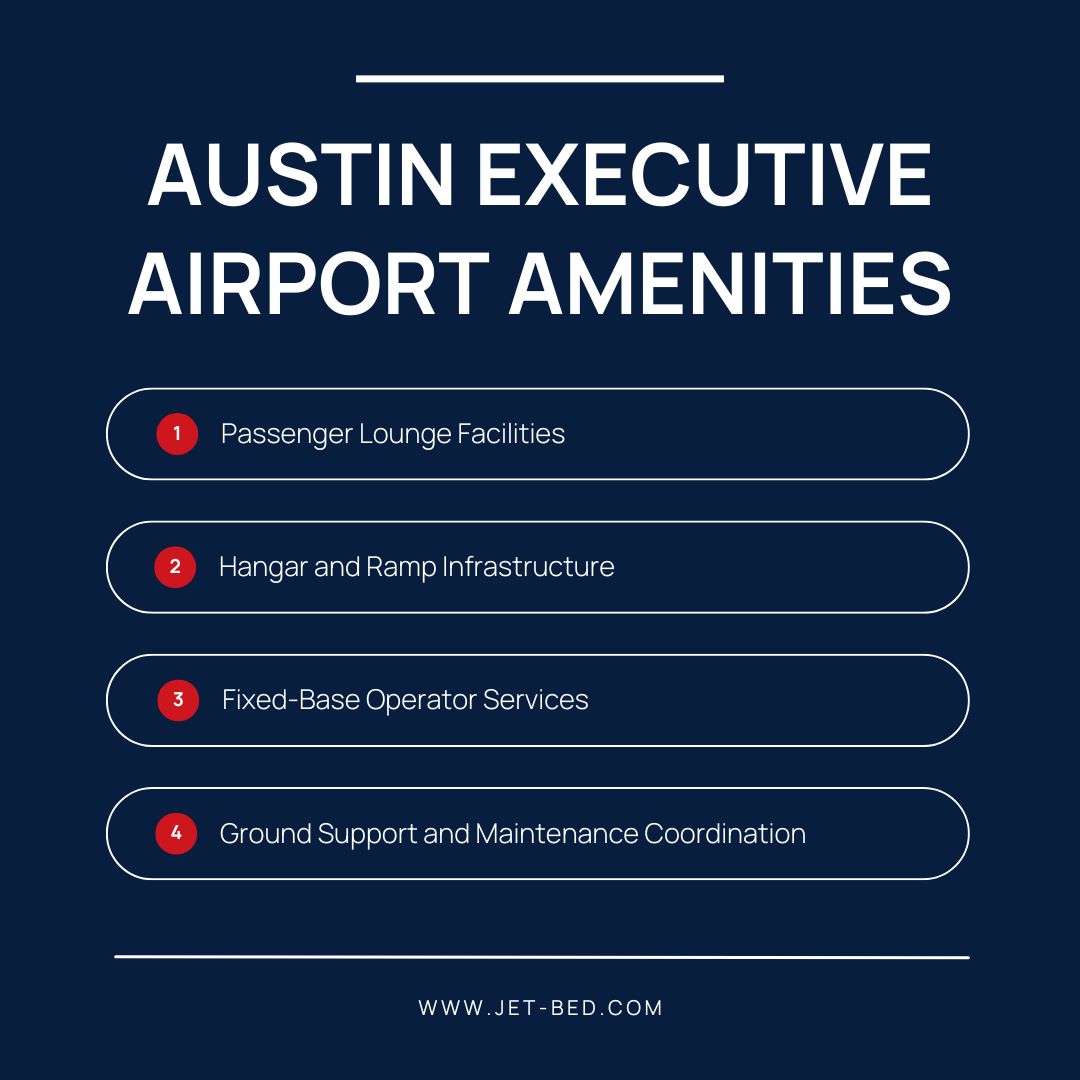
Austin Executive Airport Amenities
Passenger Lounge Facilities
Austin Executive Airport, unlike commercial airlines, offers VIP lounges within fixed-based operators (FBOs)—such as the Henriksen Jet Center. Within the lounge, passengers can enjoy complimentary Wi-Fi, spacious meeting areas, and personalized catering.
Moreover, additional amenities include flight planning rooms, showers, concierge services, and rental cars (when available). Most importantly, passengers can relax, unwind, and reduce external stress prior to departure. This standard is quintessential to the expectations of luxury private aviation.
Hangar and Ramp Infrastructure
Modern infrastructure is paramount in private aviation, and Austin Executive Airport comes fully equipped. With hangar and ramp space for various aircraft types, this accommodation supports both transient flights and based aircraft.
More specifically, the airport offers over 130,000 square feet of hangar space, providing secure, climate-protected storage for private jets and turboprops alike. This capacity allows operators to protect aircraft from weather exposure—a benefit for crews and passengers alike.
Fixed-Base Operator Services
As mentioned previously, the fixed-base operator at Austin Executive Airport serves as the primary hub for private charter. Designed specifically to support general aviation, the FBO centralizes essential services while maintaining the level of discretion private travelers expect.
Through the FBO, passengers and flight crews gain access to streamlined ground handling, fueling coordination, hangar arrangements, and passenger amenities. More importantly, these benefits are all managed through a single, secure facility.
Ground Support and Maintenance Coordination
It’s important to note that Austin Executive Airport does not fully operate as a maintenance hub. However, it does support maintenance coordinated by Henriksen Jet Center, as we discussed above. In addition to fuel services and baggage management, teams assist in aircraft detailing, parking, and flight planning.
Aircraft companies value airports that simplify access to support. Even limited maintenance coordination can significantly improve operational reliability. Moreover, it improves both efficiency and discretion for those on board.
How to Fly Private From Austin Executive Airport
Choose a Charter Operator or Aircraft Management Company
Flying private from Austin Executive Airport begins with selecting a qualified operator. Charter companies familiar with the Austin area understand local procedures, therefore improving scheduling and compliance.
Additionally, aircraft management companies support owners who base aircraft at executive airports. They handle maintenance scheduling, crew staffing, and regulatory requirements, ensuring all operations run smoothly and efficiently.
Coordinate Scheduling and Flight Planning
Austin Executive Airport, due to its exclusivity, offers greater scheduling flexibility than commercial airports. Operators can often avoid slot restrictions and long taxi times. Moreover, passengers are able to pick and adjust flight times that align with their expectations and schedules.
This general flexibility significantly supports efficient flight planning. Weather, traffic volume, and airspace congestion still require consideration. Advanced coordination ensures smooth departures and arrivals.
Prepare Passenger and Crew Logistics
Private aviation relies on precise coordination across multiple areas, including baggage handling, ground transportation, and additional amenities requested by passengers. The fixed-base operator (FBO) plays a central role here, ensuring seamless communication and minimal delays.
Additionally, crew logistics are equally important. They require duty-time planning, mandated rest periods, and operational readiness. Executive airports streamline these requirements through stringent infrastructure and coordinated support.
Execute Streamlined Departure Procedures
Executive airports are designed to simplify security screening and boarding processes. Rather than travelers having to navigate crowded terminals or extensive check-in procedures, they can arrive shortly before departure.
This streamlined approach significantly reduces stress and overall travel time. More importantly, it maintains a secure and controlled environment without sacrificing experience or operational readiness.

How to Get From Downtown Austin to Austin Executive Airport
Rideshare and Chauffeured Options
Rideshare services operate widely across the Austin area. Chauffeured options offer greater reliability and discretion. Both serve private aviation travelers effectively. Chauffeured services are often preferred for corporate travel as they align with executive expectations and reduce logistical risk.
Professional Car Services
Professional car services provide direct transportation from downtown Austin, supporting executive schedules and privacy needs. Additionally, vehicles are typically higher-end and professionally maintained, ensuring they meet each traveler’s standard. Note that travel time will vary based on traffic patterns. However, planning your departures outside peak congestion improves service reliability.
Corporate Transportation Fleets
Some organizations operate internal transportation fleets to support executives traveling from exclusive airports. This option ensures consistency and security. Corporate transportation also simplifies expense tracking and scheduling, integrating well with managed flight operations.
Are There Rental Cars Near Austin Executive Airport?
Rental cars are available near Austin Executive Airport, though not always directly on-site. Many providers operate within the surrounding Austin area. Ultimately, coordination through the FBO or car services is often required.
Availability can fluctuate during peak business periods, so advance booking is strongly recommended. While rental cars offer flexibility, many private aviation travelers opt for car services, as comfort and efficiency often outweigh convenience.
Executive airports serve as the backbone of private and general aviation in the United States.
Austin Executive Airport continues to serve as a valuable access point for private aviation in the Austin area. Its executive airport structure supports efficiency, flexibility, and controlled operations. For aircraft owners, charter operators, and corporate flight departments, this environment reduces friction and improves travel reliability. Interested in learning about other executive airports? Read our guide for Orlando Executive Airport, Chicago Executive Airport, and Dallas Executive Airport Review.
Comfort remains a critical factor in private aviation performance. This is why JetBed enhances in-flight rest through patented, lightweight bed systems. These systems convert standard aircraft seating into flat, supportive sleep surfaces, guaranteeing hotel-quality rest 40,000 feet high. For executives and aviation professionals, quality rest improves decision-making. JetBed supports those needs without compromising cabin efficiency. Learn more about how it works here.