
Private flights for executive travel remain the standard of luxury. However, their unparalleled comfort and convenience aren’t the only benefits they serve. Charter services have increasingly become a strategic tool, impacting efficiency, productivity, and operational proficiency for business leaders worldwide.
Ultimately, charter flights eliminate layovers, shorten transit times, and give executives control over arrivals and departures. For companies that view executive time as one of their most valuable resources, private aviation is an investment rather than a simple transportation expense.
Below, we will discuss the notable benefits of private jets for executive travel. We will explore how private jet charters improve scheduling, enhance productivity, and streamline operational output. With this, you can better decide whether the investment makes sense for your organization.
Executive travel demands more than a seat. JetBed’s patented inflatable design creates a flat, comfortable sleeping surface in minutes, helping executives arrive at business meetings well-rested. They are custom-fit to your private aircraft model, made in the USA, and finished with luxury Italian linens. JetBed offers passengers a comfortable way to fly.

18 Benefits of Private Jets for Executive Travel
Executives who fly on commercial airlines for business are paying for more than just the ticket—they’re giving up their valuable time. With long security lines, unnecessary layovers, and shared cabins, executives’ productivity and comfort are limited. Additionally, strict flight schedules require companies to sacrifice their own itineraries.
Private jet travel addresses each of those variables. The comfort and privacy are well understood. The deeper focus lies in the scheduling control, improved productivity, and operational flexibility that flying private provides corporate flight departments. Ultimately, that case gets stronger the more a company’s leadership engages in business travel.
What Is Private Jet Travel for Executives?
Private jet travel for executives provides on-demand scheduling and in-flight comfort for business travel that commercial airlines cannot. Executives can access private aviation through charter services, corporate-owned aircraft, or membership-based programs. Each model provides a different structure, but the core advantage is the same.
For a closer look at the private aircraft executives use, read our guide “What Is a Corporate Jet?”

Difference Between Commercial Flight and Private Aviation
Airport Access
In the US alone, there are 5,000 private airports, compared to roughly 500 commercial airports. These executive airports and regional fields often have closer positions to business districts and corporate campuses. A flight that would land an executive an hour from their meeting by flying commercial can put them 15 minutes away on a private aircraft.
Additionally, many executive airports offer FBOs that manage ground logistics. Therefore, travelers don’t have to share terminals, wait in commercial queues, or sacrifice their privacy. Those streamlined processes don’t start in the air; they start on the ground.
For a full breakdown of private airports, read our guide “Where Do Private Jets Land?”
Schedule Control
Private and commercial flight schedules operate entirely differently. Commercial airlines operate on fixed timetables while private aviation does not. Executives flying privately set their own departure times, adjust schedules on short notice, and can be wheels-up within an hour of deciding to travel. That flexibility is the difference between missing a last-minute meeting and making it with time to spare.
Security and Boarding
Many times, traveling commercial requires a two-hour buffer before boarding the plane. In other words, passengers should ideally arrive at least two hours early. While this accounts for time spent in security lines, terminals, and gates, it’s unarguably inconvenient. Private aviation eliminates this entirely.
More specifically, executives can arrive at their designated FBO 15 minutes before departure—and that still accounts for navigating through private terminals and boarding the aircraft. For executives with full schedules, this level of convenience matters.
Cabin Configuration
Private jet cabin configurations work around passenger use, not maximum occupancy. Executives have room to work, hold conversations, and move freely throughout the cabin. Ultimately, the standard of comfort and finish in a private aircraft exceeds what business or first-class commercial seating can ever offer.
To take a more in-depth look at what private aircraft showcase, review our guide “Custom Private Jet Interiors.”
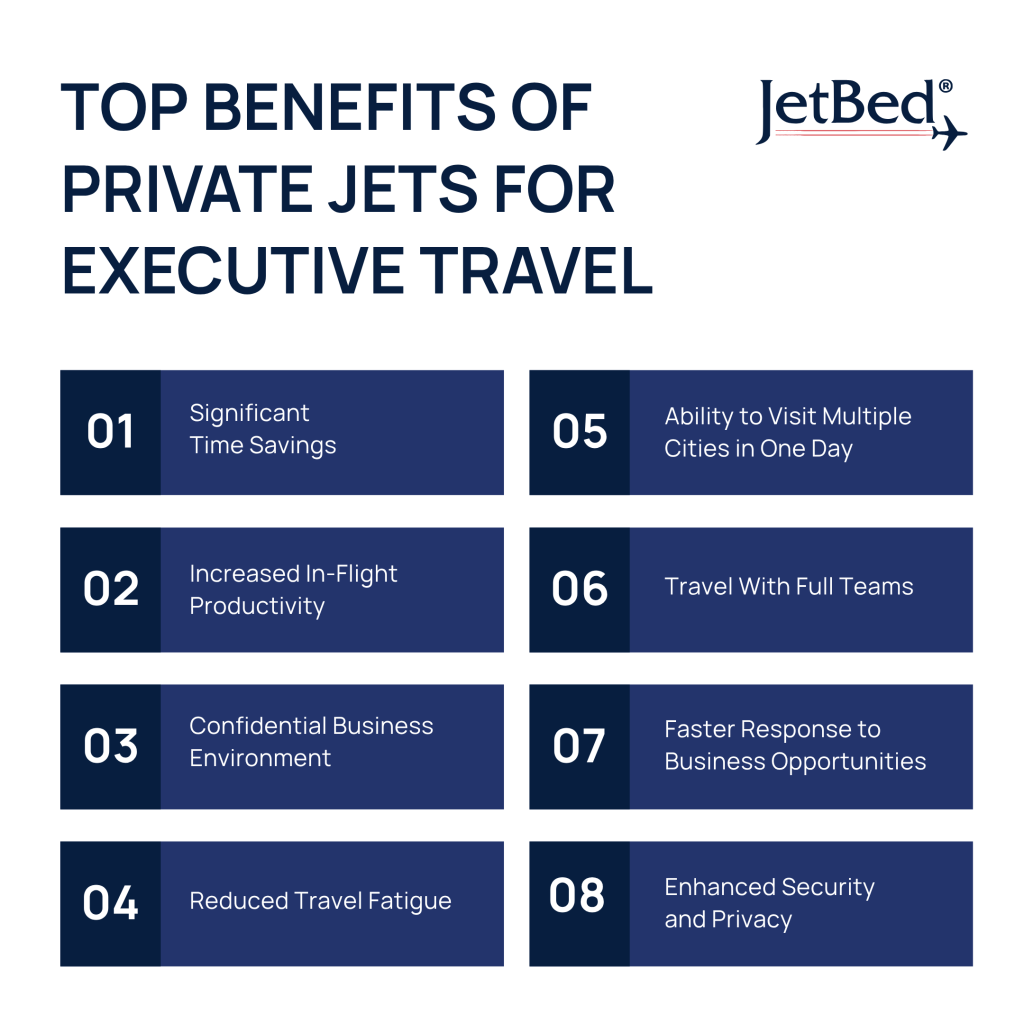
Benefits of Private Jet Travel for Executives
Significant Time Savings
Every hour spent in a commercial terminal is an hour spent not working. Security lines, gate waits, and boarding by group number are fixed costs of commercial travel that private aviation eliminates. At an FBO, the process from arrival to boarding runs just minutes. For frequent business travelers, the time saved on every trip compounds.
Flexible Departure Scheduling
When flying private, operators get the ultimate say in departure time. More specifically, executives don’t have to select departures and arrivals based on a commercial timetable. Instead, they get to set their own schedule based on their unique needs. This means executives can schedule an early-morning departure, post-meeting afternoon flight, or same-day return without rebooking or compromising.
Access to Smaller Airports
A significant benefit of private travel is airport flexibility. Unlike commercial airlines, which can only operate out of select airports, private aircraft can successfully reach regional airports, executive fields, and remote island strips. Not only can this reduce overall travel time, but it can also place executives closer to their final destination.
Increased In-Flight Productivity
Many private aircraft cabins are specifically designed to support productive in-flight work and operations for business executives. More specifically, passengers can choose an aircraft based on preferences, such as club seating, conference setups, and high-speed in-flight Wi-Fi. Rather than sacrificing working hours due to noisy environments or interruptions, passengers can continue working from departure to arrival.
Confidential Business Environment
A private cabin environment allows executives to hold confidential discussions that otherwise would not take place on a commercial flight. Sensitive conversations, deal negotiations, and board-level decisions can occur in-flight rather than waiting until arrival. For high-level executives, a controlled cabin environment ends up being a requirement rather than a luxury.
Reduced Total Travel Fatigue
Many executives transfer directly from the aircraft into a meeting, with no hotel stop, and a same-day return flight. Arriving alert is necessary in this context, and private aviation supports that by reducing the variables that cause travel fatigue.
More specifically, private jets cruise at higher altitudes than their commercial counterparts and maintain cabin pressure at or below 6,000 feet. This lower altitude helps reduce physiological stress, which may directly affect how passengers feel. This is a particularly useful benefit for longer flights and red-eyes.
To better understand how altitude affects passengers, review our guide “What Are the 3 Stages of Acclimization to High Altitude?”
Ability to Visit Multiple Cities in One Day
Multi-city itineraries are where private aviation delivers its clearest operational advantage. An executive who finishes a morning meeting in Chicago can be wheels-up for Dallas before noon. The aircraft moves on the executive’s timeline, which means they cover more ground in a single day and close more deals for the company.
No Layovers or Connecting Flights
Private jets eliminate layovers and connecting flights entirely. On routes that require a fuel stop, passengers stay on board—no need to navigate a terminal to change planes. This allows the itinerary to stay intact without disruption or wasted time.
For a closer look at jet range, read our guide “How Far Can Private Planes Fly?”
Reliable Scheduling Control
When flying commercially, delays and cancellations are a consistent risk. In fact, recent data shows that 89% of U.S. commercial flyers prepare for these timeline shifts. Private aviation reduces a considerable portion of that stress. Operators control departure times; private aircraft often fly above or around disruptive weather conditions; and flights operate point-to-point without layovers. For executives with tight itineraries, that reliability is crucial.
Improved Executive Efficiency
The time executives save from bypassing commercial terminals, security lines, and gates is not wasted. It simply goes back into their workday. More specifically, they can use the cabins to handle tasks, hold meetings, and make confidential decisions in a productive environment. As a result, the travel day continues to function as a workday rather than a disruption.
Custom In-Flight Experience
Many executives increasingly prefer to fly privately due to how much control they have over the cabin environment. Everything from seating configuration and onboard catering to connectivity and service standards reflects the executive’s needs. As a result, customization isn’t simply an added perk; it’s an operational necessity.
For a closer look at in-flight catering options, read our guide “Private Jet Catering.”
Travel with Full Teams
Oftentimes, private jets comfortably accommodate full teams, regardless of the size. In other words, the workday doesn’t have to stop at the gate. A group can board together, continue their meeting in the air, and arrive at the destination prepared. While cabin capacity varies by the type of private plane booked, there are an abundance of options designed to accommodate group size and mission requirements.
For a full breakdown of passenger capacity by aircraft, read our guide “How Many People Can Fit in a Private Jet?”
Enhanced Security and Privacy
Private aviation reduces security exposure by design. Executives can bypass commercial terminals and board through private FBOs with controlled access and limited foot traffic. For high-profile individuals where personal security is a consideration, that environment is a meaningful risk reduction.
Faster Response to Business Opportunities
Private aviation removes scheduling barriers, a particularly valuable benefit for business executives who require immediate travel. More specifically, travelers can arrange a charter in as little as a couple of hours and be in the air directly after. For businesses working within time-sensitive operations, this operational impact proves indispensable.
Global Accessibility
Private aviation handles international itineraries with fewer logistical barriers than commercial travel. For example, customs clearance on private flights is handled at the aircraft. More specifically, agents come to the ramp rather than passengers navigating a shared arrivals hall.
On long-haul routes, heavy jets have the range to fly New York to Tokyo non-stop, eliminating the fuel stop entirely. This removes both time and ground logistics from the itinerary.
For a comprehensive look at international private travel, read our guide “Can Private Jets Fly Over Seas?”
Better Use of Work Time
A private aircraft’s cabin serves as more than a transit vehicle but as a preparation and work environment. During the flight, executives may review meeting materials and run through presentations before landing. Additionally, it provides valuable time to align with colleagues before stepping into the meeting room.
Reduced Risk of Disruptions
Business itineraries change without warning. A last-minute meeting, a schedule shift, or a change in destination can require a same-day reroute, which private aviation can seamlessly accommodate. The aircraft adjusts to the itinerary, not the other way around. If plans change before departure, the flight is rescheduled without rebooking penalties or timetable constraints.
Competitive Business Advantage
Data directly supports the business case for private aviation. To demonstrate this, the National Business Aviation Association found that companies using executive aviation generate 23% higher revenue per employee than those that do not. That figure reflects the compounding value of recovered time, schedule control, and the ability to move leadership where it needs to be.
Are Private Jets Worth It for Executive Travel?
For companies with executives who travel frequently, private aviation is a long-term cost-effective option. The time saved, the productivity gains, and the deals that close because members were available and on schedule all feed back into revenue. For high-utilization flight departments, those returns often offset a significant portion of operating costs.
However, the right private jet ownership structure depends on how often the aircraft flies. Full ownership suits companies with consistently high-volume travel. Meanwhile, fractional programs offer share-based access without full operational responsibility. For executives who travel less frequently, charter provides flexibility without a fixed asset commitment. Ultimately, budget, annual flight hours, and operational requirements determine which model fits.
Elevate the private business travel experience even further with JetBed.
Private aviation gives executives control over the variables that commercial airlines cannot accommodate. These include scheduling, routing, cabin environment, and time on the ground. When used strategically, that control translates into measurable operational and revenue advantages for the organizations that rely on it.
However, arriving ready to take on a meeting or presentation is part of that equation. On red-eye flights and long-haul routes, in-flight rest has a direct impact on how executives show up at the destination. JetBed’s patented design creates a flat, comfortable sleeping surface in minutes that’s easy to stow when not in use. Contact us to find the right JetBed for your aircraft.