
In private aviation, flight activity continues to increase, making airport selection a more strategic part of travel planning. Public airports accommodate private jets, but the busiest airports come with commercial traffic, congestion, and limited FBO access. Dedicated private jet airports are built around a different set of priorities.
FBOs at top private jet airports give passengers and crew a distinct experience. More specifically, dedicated terminals, expedited handling, and refueling services are standard. The difference between a well-chosen airport and the wrong one shows up before the aircraft even disembarks.
In this post, we will comprehensively cover the busiest private jet airports in the world. We review what makes each one worth knowing about and what to expect when operating in and out of them. For passengers and operators, this information is essential for choosing airports that align with your standards.
Long flights to major private jet hubs are exactly where in-flight rest becomes part of the operation. JetBed’s patented inflatable design creates a flat, comfortable sleeping surface in minutes. Custom-fit to your specific aircraft model, made in the United States, and finished with luxury Italian linens. It’s the comfortable way to fly.
10 Busiest Private Jet Airports
Selecting the right airport is as important as selecting the right aircraft. Fortunately, executive airports specifically serve private aviation. The infrastructure, services, and ground handling reflect that from the moment you arrive.
Busier private jet airports often have advantages that smaller fields cannot match. Proximity to major destinations, full-service FBOs, and established handling networks make them the practical choice for frequent operators. Efficiency and privacy do not have to come at the expense of capability.
For a broader look at operational flexibility, visit our post, “Where Do Private Planes Land?”
What Airports Do Private Jets Use?
Private jets operate from two types of facilities: commercial airports that operate FBOs and dedicated general aviation airports. Both are viable—the right choice depends on the mission.
At a commercial airport, an FBO provides a private entrance, a dedicated ramp, and direct aircraft access. Alternatively, ground staff work exclusively in general aviation, managing handling, fueling, and positioning separately from commercial operations.
Dedicated general aviation airports offer a different set of advantages. No commercial traffic means more scheduling flexibility and simpler ground logistics. For many operators and flight departments, these airports are the default choice.
The distinction comes down to control. At a commercial airport, you share infrastructure. At a dedicated general aviation airport, the facility exists for private aviation.
What Are the Busiest Private Jet Airports in the World?
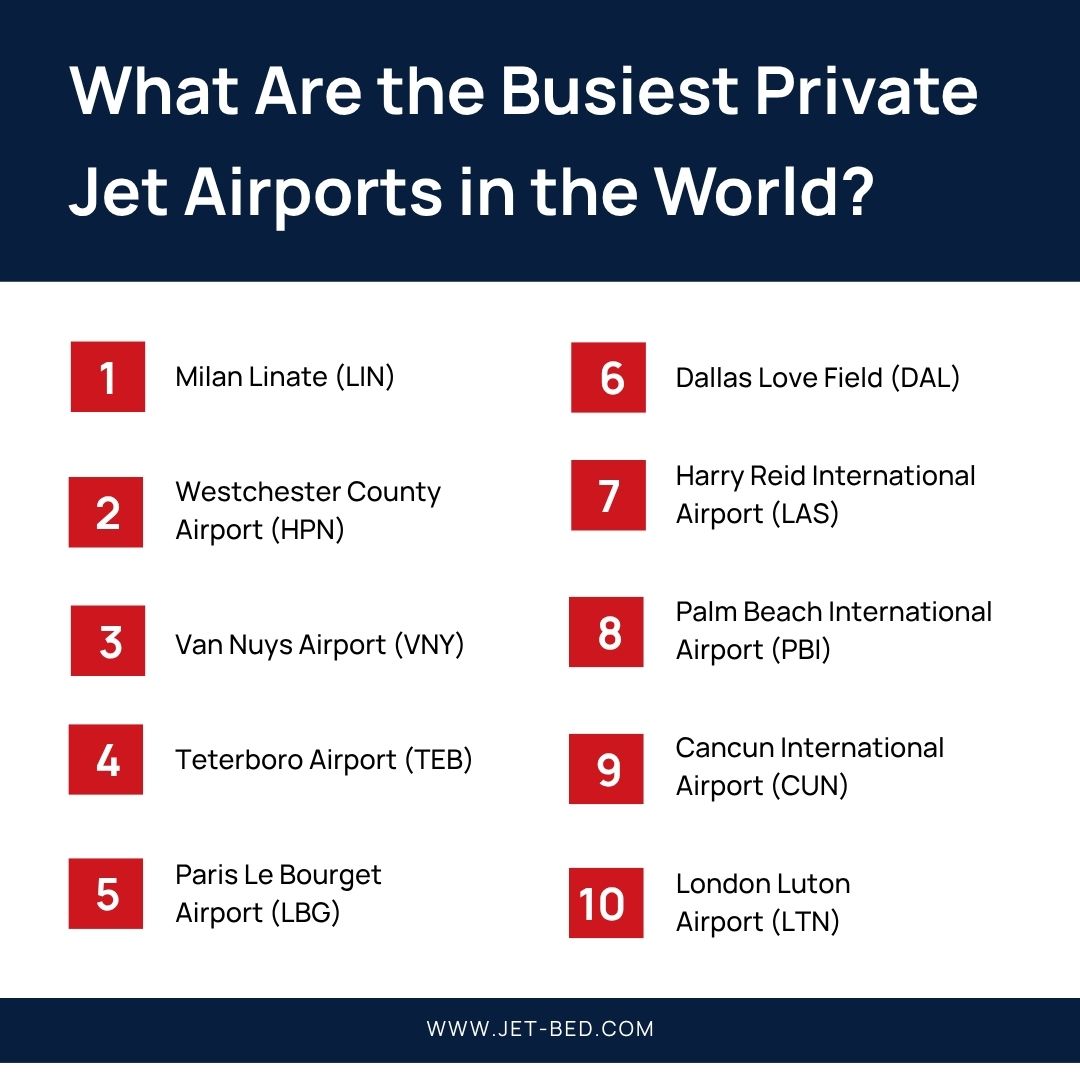
Milan Linate (LIN)
Linate Airport sits just over four nautical miles from Milan’s city center—closer than any other airport serving the region. The dedicated general aviation facility, Milano Linate Prime, handles private jets and helicopters separately from commercial operations. This spans across 10 hangars and 24,000 square meters.
The terminal includes meeting rooms with video conferencing, allowing passengers to attend conferences immediately on arrival or before departure. Combined with a 15-minute drive to central Milan, this accessibility is a key reason operators favor LIN over Malpensa.
The core passenger mix is corporate travelers, fashion week attendees, and high-net-worth visitors. Linate also serves as a practical departure point for Lake Como, Monza, and the Italian Alps.
Westchester County Airport (HPN)
Westchester County Airport sits 30 miles north of New York City in White Plains. More than 80% of operations are general aviation, ranging from light singles to large corporate jets. This is a working GA airport—not a commercial hub with a private terminal on the side.
The surrounding area attracts significant corporate activity, with PepsiCo, IBM, and Mastercard all headquartered in Westchester County. That corporate density drives consistent business aviation traffic. Executives commuting to Greenwich, Stamford, and Fairfield County use HPN specifically to avoid the congestion at JFK, LGA, and Teterboro.
An important consideration when choosing HPN is that it operates under a noise curfew. That is a real operational constraint and needs to be factored into scheduling. That said, multiple FBOs on the field provide reliable fueling, maintenance, and ground support, helping operators plan efficiently within those limitations.
Van Nuys Airport (VNY)
Van Nuys Airport sits in the San Fernando Valley and ranks among the busiest private jet airports in the world. More specifically, this facility handles more than 700 non-commercial aircraft departures daily, averaging 217,000 business, private, and government operations annually.
The main runway is 8,000 feet long, which is adequate for accommodating a range of charter jets. Four FBOs operate on the field, including Clay Lacy and Signature Aviation, demonstrating the facility’s commitment to private aviation operations.
The primary users are entertainment industry travelers, corporate operators, and high-net-worth LA residents. VNY also functions as a reliever airport, reducing private jet traffic pressure on LAX. For operators based in the Los Angeles area, it is the practical default over a commercial airport.
For more private aviation facilities in the area, review our post “Private Airports in Los Angeles.”
Teterboro Airport (TEB)
Teterboro Airport is the busiest private jet airport in the U.S. and the primary gateway to New York City. Located in Bergen County, New Jersey, 12 miles from Midtown Manhattan, TEB handles no commercial airline traffic. Every operation on the field is private.
The airport processes roughly 143,000 aircraft operations per year across two runways. A 100,000-pound weight restriction keeps heavy commercial traffic out, dedicating all resources to private and business aviation.
Corporate flight departments, fractional operators, and on-demand charter companies use TEB as their default gateway to New York. Common routes include Miami, Chicago, Los Angeles, London, Paris, and Geneva. For operators who need New York access without the congestion of JFK or Newark, TEB is the standard answer.
Paris Le Bourget Airport (LBG)
Paris Le Bourget Airport is Europe’s busiest business aviation airport. Once Paris’s principal commercial airport, it now operates exclusively for general aviation and business jet traffic. The airport sits 14 kilometers from the city center, roughly 30 minutes by car.
Three runways and eight FBOs serve the field, each with its own dedicated terminal. Additionally, operations run 24 hours a day, which is a valuable asset for the flexibility many expect in private aviation. The primary users are corporate travelers, heads of state, and high-net-worth individuals flying into Paris for business, fashion week, and major events.
Le Bourget also hosts the Paris Air Show—the largest aerospace trade show in the world, held in odd-numbered years. Moreover, Charles Lindbergh landed here after his solo transatlantic crossing in 1927. The airport’s history in aviation runs as deep as any facility in the world. For private operators in Paris, LBG is the premium choice.
Dallas Love Field (DAL)
Dallas Love Field is a mixed-use airport, but it remains one of the busiest airports for private aviation. It sits 6 miles northwest of downtown Dallas, making it the closer option to the city center than DFW.
Four full-service FBOs handle private operations, covering fueling, maintenance, hangar rentals, and charter services. The infrastructure supports corporate and private operators well despite the commercial presence. Additionally, for private operators, the combination of the facility’s proximity to downtown Dallas and its capable FBO network makes it a practical choice over DFW.
Love Field also carries a distinct place in aviation history, most notably as the site where Lyndon Johnson took the presidential oath of office aboard Air Force One on November 22, 1963. Today, that legacy is matched by its continued relevance for private aviation.
Harry Reid International Airport (LAS)
Harry Reid International Airport is a major commercial and private jet airport. In 2025, it handled over 55 million passengers, ranking it among the world’s busiest airports by total aircraft movements. Private jets share the field with heavy commercial traffic. This can affect slot availability and require careful scheduling for private flyers.
Private aviation operations are separate from commercial terminals. The west side of the field houses private jet facilities, FBOs, and helicopter operations. Two FBOs serve general aviation operators, with a dedicated private jet terminal providing direct access away from the main concourse.
Additionally, the airport sits five miles south of downtown Las Vegas, putting private arrivals minutes from the Strip. The primary users are high-net-worth leisure travelers, entertainment industry operators, and corporate groups attending conventions. It’s also important to note that major events push private jet volume beyond normal capacity, requiring operators to plan accordingly.
Palm Beach International Airport (PBI)
Palm Beach International Airport sits just west of West Palm Beach and leads Florida in private flight operations. It handles more private aviation activity than Miami Executive, Miami International, and Fort Lauderdale-Hollywood. Total passenger volume runs roughly 6.5 million per year across commercial and private aviation.
Three FBOs serve private operators on the south side of the field, all positioned near the U.S. Customs and Border Protection Office. The primary runway runs 10,001 feet, accommodating everything from light jets to large VIP airliners.
The primary users are high-net-worth individuals with Palm Beach residences, corporate operators, and seasonal travelers. Private jet traffic peaks sharply in winter as wealthy Northeast residents relocate south.
Cancun International Airport (CUN)
Cancun International Airport is Mexico’s second busiest airport, handling approximately 25 million passengers per year across commercial and private aviation. Private jets share the field with heavy commercial traffic. However, private aircraft taxi to a separate FBO terminal away from the commercial concourses.
Three on-site FBOs offer private terminals, ground handling, expedited customs processing, and ramp access. The main runway runs 11,483 feet and accommodates most private jets, though only that runway has the length required for larger aircraft. Operators flying heavy jets should confirm runway availability during planning.
The primary users are leisure travelers and resort-bound charter operators flying in from the United States. The General Aviation Terminal sits adjacent to Terminal 1, with the Hotel Zone roughly 20 minutes by car. For operators serving the Caribbean resort market, CUN is the standard entry point into the Yucatan Peninsula.
To extend the luxury experience of arriving in CUN, review our guide on “Private Transportation from Cancun Airport to Playa del Carmen.”
London Luton Airport (LTN)
London Luton Airport handles approximately 16.5 million passengers per year, ranking it fourth among London’s commercial airports. Commercial and private aviation share a single runway. However, private jet facilities are entirely separate from the main terminal, keeping operators clear of commercial queues.
Three FBOs serve private operators at LTN, including Signature Flight Support and Harrods Aviation. Accommodations meet private travelers’ standards, primarily including seamless ground travel. The airport sits 29 miles from central London with direct access to the M1 motorway, making road transfers to the city straightforward.
The primary users are business travelers, corporate flight departments, and high-net-worth individuals seeking London access without Heathrow’s restrictions. Luton operates around the clock and routes private travelers through dedicated lounges, bypassing the main terminal entirely.
Why Some Airports Are Busier for Private Jets
Proximity to Financial Centers
Most private jet traffic is corporate. As a result, airports near major financial centers consistently handle higher volumes than those serving leisure destinations. That proximity supports same-day trips and tight scheduling, which are operational demands that drive most business aviation decisions.
Luxury Tourism Destinations
Leisure destinations drive a different kind of private jet traffic. Airports serving markets like Mykonos, the Caribbean, Nice, Florida, and Mexico consistently rank among the most popular private jet routes. The primary passengers are high-net-worth individuals, entertainers, and executives traveling for vacations and events. Seasonal demand at these airports can be significant and operate at a different pace than the rest of the year.
Nearby Major Events
Major events drive significant spikes in private jet traffic. These events include Formula 1 races, fashion weeks, the Super Bowl, the Cannes Film Festival, and large professional conferences. They all pull high-net-worth individuals into the same market simultaneously. Airports serving those events see demand compressed into a narrow window.
What Is an FBO and Why It Matters for Private Jet Airports
A Fixed Base Operator (FBOs) is the facility that handles everything on the ground for private and business aviation. This includes fueling, maintenance, ramp coordination, and passenger handling. At an FBO, your aircraft pulls onto a dedicated ramp, and the ground crew manages the turnaround. Meanwhile, passengers move through a private lounge directly to the aircraft.
For corporate flight departments, FBO quality is operational infrastructure. Many operators maintain pre-established accounts at key airports with crew preferences and ground transportation already arranged. A good FBO removes variables—a poor one creates them.
How to Select Airport for Private Flight
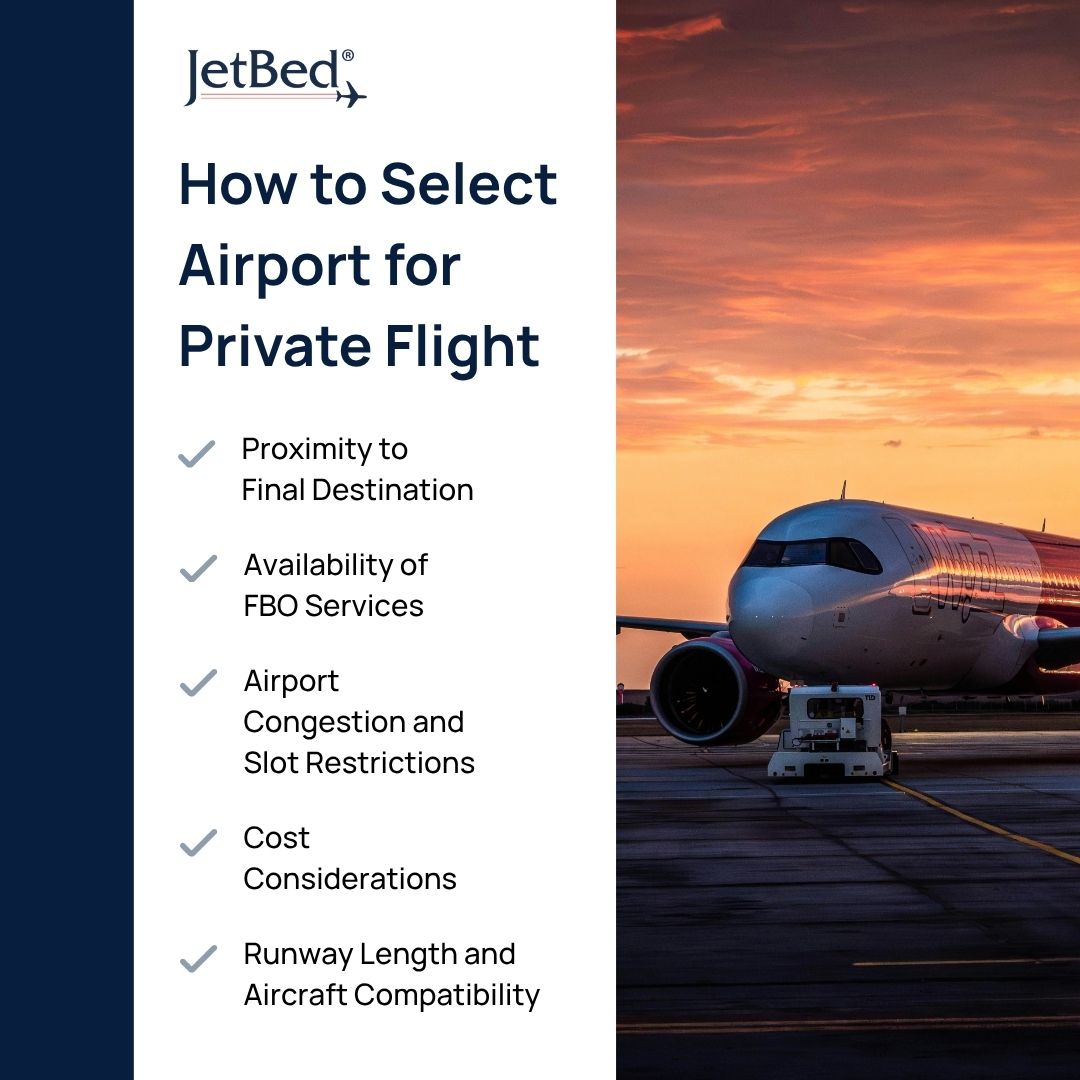
Proximity to Final Destination
Private aviation gives operators more flexibility over where they land. More importantly, dedicated private jet airports and executive terminals are often closer to city centers than major commercial airports. For business travelers, that proximity translates directly into time saved on the ground.
Availability of FBO Services
When selecting an airport, confirm FBO availability. FBOs handle the ground operations that enable seamless private aviation operations. They also give passengers a private, efficient path to and from the aircraft. Without a capable FBO on the field, the operational advantages of flying private erode quickly on the ground.
Airport Congestion and Slot Restrictions
At the busiest private jet airports, slot availability and operational restrictions are real planning considerations. Confirming both before scheduling saves time later. In some cases, a nearby secondary airport is the more practical choice. A longer ground transfer is often a worthwhile tradeoff for better ramp access and simpler scheduling.
Cost Considerations
Every airport on your route carries its own cost structure. Landing fees, FBO handling charges, and ramp fees vary by facility. Operators should confirm all costs before scheduling, as experienced flight department managers and private owners account for costs upfront. Surprises in the budget are avoidable—the information is there if you ask for it before booking the trip.
Runway Length and Aircraft Compatibility
Not every runway accommodates every type of private plane. Larger jets require minimum runway lengths that not all private jet airports can meet. Confirm compatibility between your aircraft and the airport’s runway specifications before scheduling. Missing this detail means rerouting, delays, and added costs—all of which are avoidable with the right planning.
Fly to and from the busiest private jet airports comfortably with JetBed’s patented design.
Choosing the right airport is a core part of private aviation planning. The facilities you use, the access they provide, and the infrastructure on the ground all directly impact trip efficiency. When those pieces align, the experience becomes exactly what private aviation is meant to be: controlled and seamless.
Long flights between major private jet hubs are where in-flight rest becomes a real operational consideration. JetBed’s patented design creates a flat, comfortable sleep surface in minutes. It’s custom-fit to your specific aircraft model, lightweight, and easy to stow.
Browse our full catalog to find the right JetBed for your aircraft.