
Flying into Dallas via private aircraft offers several airport options. The choice you make can have a real impact on the efficiency and professionalism once you land. Seemingly minor details, such as ground logistics and proximity to downtown Dallas, matter for esteemed travelers on tight schedules. Most travelers are familiar with major facilities like Dallas Fort Worth International Airport or Dallas Love Field.
However, many private pilots and charter operators often look beyond the largest airports. Smaller general aviation facilities, such as Dallas Executive Airport (RBD), can offer a smoother experience for pilots and passengers alike. The airport sits south of the city center and primarily supports business aviation, training flights, and privately operated aircraft.
Formerly named Redbird Airport, RBD continues to serve as a reliever airport for Dallas traffic. Moreover, learning about an airport before arrival is essential—for pilots to understand runway performance, for charter operators to examine ramp efficiency, and for passengers who care about drive times. Therefore, in this Dallas Executive Airport Review, you’ll receive an overview of what pilots and travelers should know before choosing this executive airport as a Dallas landing option.
Before we dive into the details of private flights to Dallas Executive Airport, take a moment to explore our range of JetBeds. They’re designed to elevate your private jet experience through comfort, style, and convenience. Proudly made in the USA, JetBeds are the perfect addition to your next trip.

Dallas Executive Airport Review: FBOs, Amenities, and Services
When pilots evaluate an airport, the small details matter. A useful Dallas Executive Airport review looks beyond location alone and focuses on the operational aspects. For example, pilots usually want to understand local traffic flow first. How busy is the pattern? What kind of aircraft operate there daily? Those questions give a quick sense of what arrivals might look like.
Fuel pricing is another factor that often comes up in conversation. Additionally, operators pay attention to ramp space and turnaround efficiency. If an airport handles general aviation traffic smoothly, crews notice. Logistics after landing also play a crucial role in how smoothly passengers, crews, and pilots perceive airports. Ground transportation, road access, and congestion in Dallas County all influence whether an airport works well for a particular trip.
Combine all of this information, and it’s clear why many pilots prefer to carefully research airports before committing to a landing location.
What Is Dallas Executive Airport?
The City of Dallas owns Dallas Executive Airport, a public-use general aviation airport. The airport primarily supports business aviation, private aircraft, flight training programs, and charter operations. Many longtime pilots still remember the facility as Redbird Airport, which was its original name. Over time, however, the airport evolved into a regional executive airport serving private aviation in southern Dallas.
The airport has two asphalt runways, particularly well-suited for turboprops and light business jets. Some midsize aircraft also operate here regularly. Because the airport focuses on general aviation, the atmosphere tends to be quieter than what you would see at major airline hubs. This usually means fewer delays on the ground and more predictable operations. Ultimately, this difference is important when flights are operating on tight schedules.
Where Is Dallas Executive Airport Located?
Dallas Executive Airport sits about six miles south of downtown Dallas. It’s close enough that, for most general aviation trips, getting into the city isn’t a major leg of the journey. That alone makes it a practical alternative to the larger airports further out.
Access is mainly via Interstate 35E and Loop 12. On a clear run, the drive into downtown is around 15 minutes. In peak traffic, it can push closer to 30. Even with that, though, the route is still more straightforward than what you’d deal with coming in from the busier commercial airports.
Dallas Executive Airport Runway Specifications and Operational Capabilities
The performance of the runway is always a crucial consideration when evaluating any general aviation airport. Dallas Executive Airport operates two asphalt runways:
- Runway 13/31 – approximately 6,451 feet long and 150 feet wide
- Runway 17/35 – approximately 3,800 feet long and 100 feet wide
The longer runway comfortably supports most light jets and midsize business jets. Moreover, pilots operating these aircraft types usually find the runway length sufficient for routine operations. However, Texas summer temperatures can directly impact landing logistics. High heat reduces air density, for example, which affects aircraft performance during takeoff. Pilots are very aware of that, which is why careful performance calculations matter.
The airport sits at roughly 660 feet above sea level, which is relatively moderate. Still, when temperatures climb, crews are particularly mindful about weight and performance planning. The airfield also includes instrument approaches, runway lighting, and a staffed control tower during scheduled hours. These features help keep operations predictable, consistent, and in compliance with safety standards.
Dallas Executive Airport Airspace and ATC Experience
Dallas Executive operates within a complex regional airspace environment. The airport sits beneath the outer layers of Class B airspace that also serve Dallas Love Field and DFW International Airport. Because of that proximity, coordination with regional traffic is part of normal operations. Pilots flying into Dallas Executive often communicate with multiple controllers during arrival.
While seemingly complex at first, Dallas-area controllers are accustomed to handling mixed traffic. Airline flights, business jets, and training aircraft all operate in the region. Pilots generally report that the system runs efficiently. Additionally, clear communication helps keep traffic moving smoothly, which is why many operators remain comfortable using this executive airport.

Dallas Executive Airport FBO Services and Amenities
Dallas Executive Airport features two full-service fixed-base operators: Ambassador Jet Center and Jet Access Dallas Executive. Together, these facilities support a steady mix of business aviation, private jet traffic, and general aviation activity:
Jet Access
Jet Access Dallas Executive is the newer FBO on the field, bringing a more modern facility and an elevated passenger experience. Designed with contemporary business aviation in mind, it combines efficient operations with a more refined terminal environment.
Jet Access Dallas Executive amenities consist of:
- Dedicated pilot lounge and crew rest areas
- Concierge services, including catering and hotel bookings
- Ground transportation coordination and rental car access
- High-speed Wi-Fi and business amenities
- Modern passenger lounge with upscale finishes
- Private meeting rooms and executive conference spaces
This FBO introduces a slightly more premium feel to the airport. This experience aligns more closely with that at larger metropolitan FBOs—but without the same level of congestion. The result is a balance between comfort and efficiency, where passengers enjoy a quieter, more private experience while still having access to high-quality facilities and attentive service.
Ambassador Jet Center
Ambassador Jet Center has a strong reputation for reliability and consistent service. Its team, for example, has extensive experience in handling a wide range of aircraft. Additionally, the updated facility meets modern business aviation expectations while maintaining an efficient, no-frills operational flow.
Ambassador Jet Center amenities consist of:
- Conference rooms and flight planning areas
- Concierge services for hotels, catering, and transport
- Crew cars available for local transport
- Ground transportation coordination (rental cars and limousines)
- Passenger lounge with refreshments
- Pilot lounge with Wi-Fi and TV
- Complimentary Wi-Fi throughout the facility
The overall experience here leans toward practical and dependable. While it may not feel as high-traffic or high-gloss as FBOs at major hubs like Dallas Love Field or Dallas/Fort Worth International Airport, that’s often the advantage. Crews can expect quicker turnaround, easier ramp access, and a more relaxed operating environment without compromising on essential services.
Dallas Executive Airport Safety Record and Infrastructure Improvements
Airports owned by the City of Dallas periodically receive upgrades to maintain safety and operational standards:
Ongoing City Investment
Dallas Executive Airport plays a supporting role within the wider Dallas aviation network. As a reliever airport, it takes on general aviation traffic that would otherwise move through larger, busier fields.
Investment reflects that role. It’s not purely about expansion. Instead, a lot of it comes down to maintaining what’s already there—runways, systems, facilities—and improving them incrementally. Some upgrades are visible, others less so. Over time, that approach keeps the airport steady and usable without changing its core function. For operators, that consistency tends to matter more than large-scale redevelopment.
Runway Surface Maintenance
Runway condition is a constant focus at Dallas Executive Airport. Maintenance isn’t something done occasionally—it’s ongoing. Inspections happen regularly, and resurfacing is carried out as needed to keep the pavement serviceable for daily operations.
For pilots, surface consistency is where this really shows. Small changes—wear, minor pooling, surface fatigue—can all affect how an aircraft handles on takeoff or landing. Keeping those variables under control matters more than it might seem at first glance. It’s not especially visible from the outside, but operationally, it’s significant.
Lighting and Navigation Enhancements
Lighting upgrades at the airport have been introduced progressively rather than all at once. Runway and taxiway systems have also been improved over time, mainly to support visibility when conditions aren’t ideal.
At night, or in reduced visibility, that clarity becomes essential. Pilots rely on it to stay oriented, particularly during taxi and approach. Navigation support and instrument procedures sit alongside that—less noticeable, but just as important when weather conditions shift. It’s a combined system, not one single upgrade doing all the work.
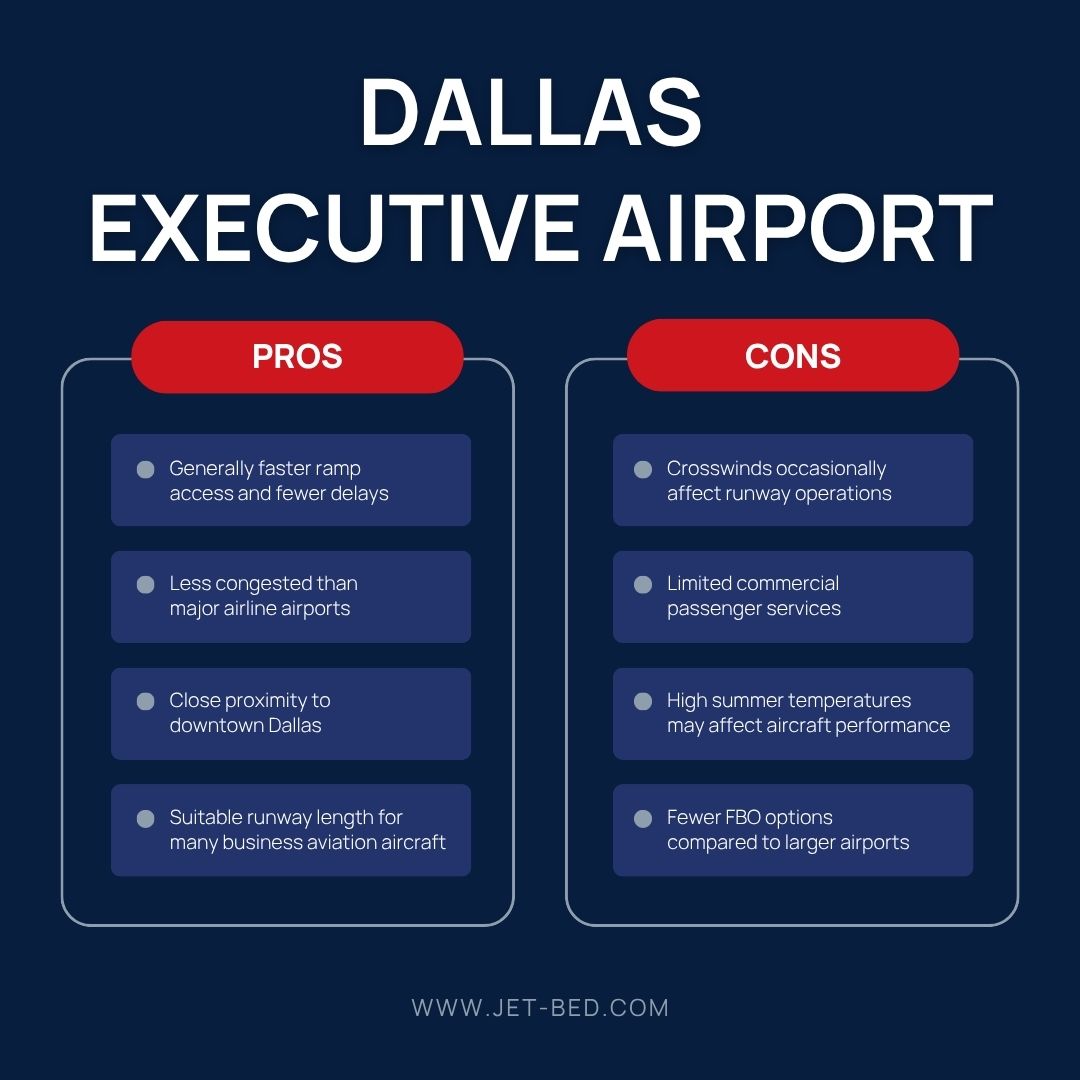
Pros and Cons of Dallas Executive Airport
Pros
- Generally faster ramp access and fewer delays
- Less congested than major airline airports
- Close proximity to downtown Dallas
- Suitable runway length for many business aviation aircraft
Cons
- Crosswinds occasionally affect runway operations
- Limited commercial passenger services
- High summer temperatures may affect aircraft performance
- Fewer FBO options compared to larger airports
Who Should Use Dallas Executive Airport
Dallas Executive Airport works well for several types of aviation users, including:
- Aviation maintenance providers serving local aircraft fleets
- Corporate flight departments traveling to downtown Dallas
- Flight schools conducting training operations
- Charter operators seeking a quieter general aviation airport
- Private jet owners visiting Dallas County
Travelers curious about where private jets land often discover that airports like Dallas Executive play a major role in private aviation access. Find out more in our blog post “Where Do Private Jets Land?”
If you’re interested in learning about the top airports in Space City, read our guide “What Airports Are in Houston, Texas?“
Dallas Executive Airport-RBD Review
Overall, Dallas Executive Airport fills an important niche in the Dallas aviation landscape. It provides a practical alternative to larger airline airports while still maintaining solid infrastructure for general aviation operations. The airport works especially well for turboprops, light jets, and midsize business aircraft.
Pilots who prefer a quieter operating environment often appreciate that. It may not offer the scale of larger commercial airports. But for many private aviation flights, that is exactly the point.
Dallas Executive Airport continues to stand out as a practical aviation gateway to Dallas.
For many pilots and private aviation travelers, Dallas Executive Airport offers a high-quality option for flying into the Dallas area. Its location just south of downtown Dallas helps keep ground travel manageable, while the airport itself remains noticeably less congested than larger facilities like Dallas Love Field.
Pilots tend to appreciate this efficiency. With solid runway capability and a steady focus on general aviation, the airport continues to serve an important role as a reliever airport for Dallas traffic.
Additionally, comfort both on the ground and in the air matters during private travel. This is why thoughtful cabin solutions have become a large part of the modern private jet experience. For passengers looking to improve rest during longer flights, products like JetBed offer a practical upgrade. Designed to convert aircraft seating into a more comfortable sleeping surface, JetBed helps travelers arrive more rested—something business travelers heading into Dallas County meetings can certainly appreciate.