Flight attendant positions are often associated with extensive travel, flexibility, and dynamic work environments. However, flight delays are an unfortunate yet common reality of air travel—even in private aviation. This often leads to an important question: Do flight attendants get paid for delays?
While delays are frustrating for passengers, resulting in missed connections and extended airport waits, they can have an even greater impact on flight attendants and flight crews. Delays may affect pay, duty hours, safety regulations, and compliance with FAA limitations.
In this guide, we will explore how flight attendants are paid, how compensation works during delays, and how airline pay structure accounts for extended ground time. This information is important for both aviation professionals and passengers seeking a clearer understanding of flight crew operations.
Whether on the ground or in the air, sleep remains crucial for long days as a flight attendant. At JetBed, we developed a patented sleep solution that’s as simple to set up as it is easy to enjoy. With a perfectly uniform surface, USA manufacturing, and luxury Italian linens, quality rest in between flights has never been better.
Do Flight Attendants Get Paid for Delays? Compensation Explained
Various factors contribute to flight delays, disruptions, and cancellations, as discussed in “Why Are Flights Delayed for Private Planes?” Likewise, pay structures vary across airline flight attendants, employment contracts, and flight types. As a result, the impact of delays on pay can differ significantly.
Ultimately, however, most compensation models follow a consistent framework—which is what we discuss below. To better understand how delays affect wages, it’s important to review the different ways flight attendants are paid and the factors that influence compensation.
For additional context, you may find the following guide helpful: “How Does a Flight Attendant Schedule Work?”
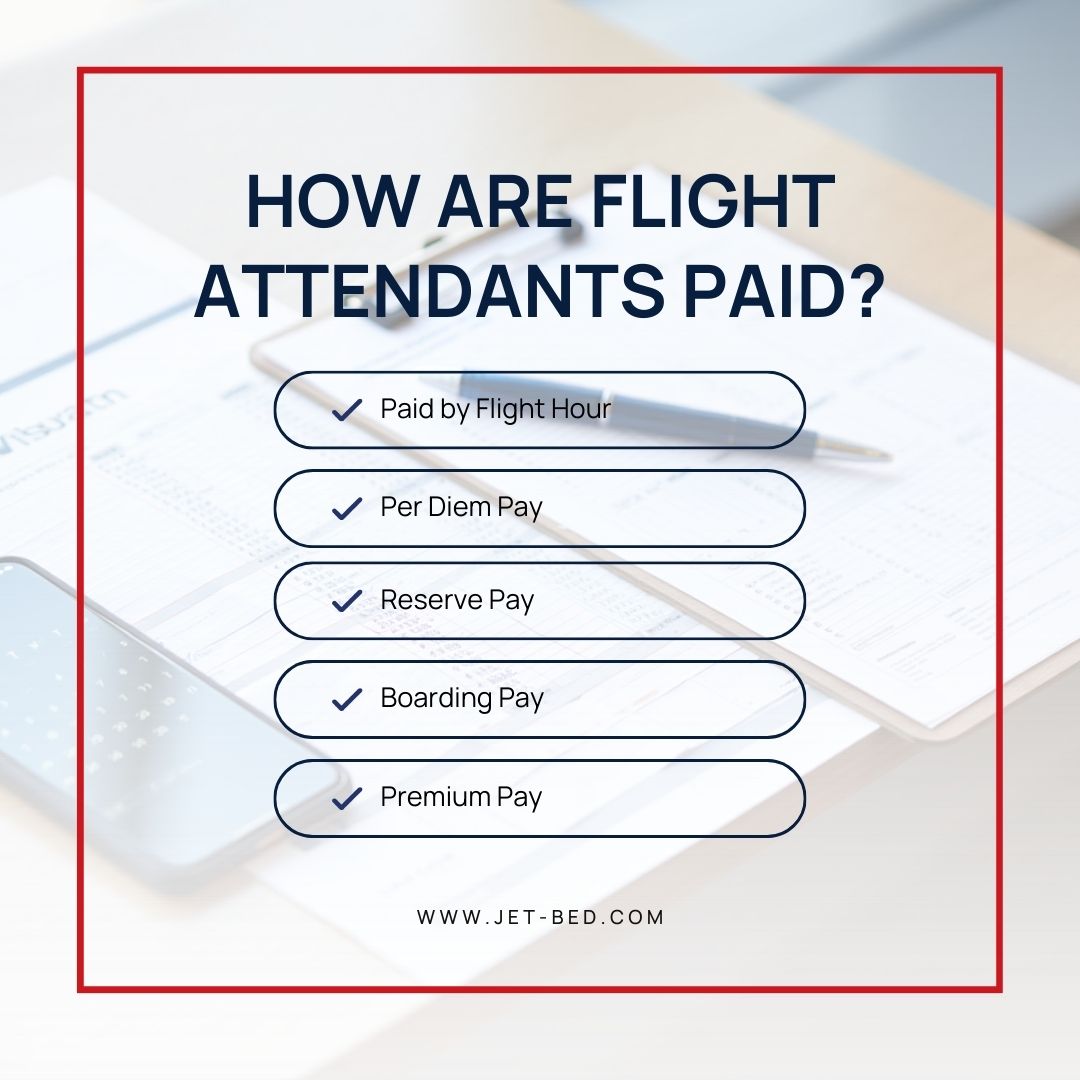
How Are Flight Attendants Paid?
Starting pay for flight attendants is typically lower and increases with seniority. However, many opportunities are available to increase pay, gain experience, and qualify for higher-earning roles over time.
Paid by Flight Hour
Many flight attendants receive payment based on flight hours, or “flight time.” Rather than accounting for the full duty day, including boarding and security checks, payment follows what’s referred to as a “block-to-block” schedule. Flight attendants’ pay period begins when the aircraft doors close and continues until they open again at the destination.
Block hour payment is the only standard, foundational, and industry-accepted method. Below, we will explore additional payment models that vary by airline.
Learn more about scheduling in our guide, “How Many Hours Does a Flight Attendant Work?”
Per Diem Pay
In aviation, per diem payment is a tax-free, hourly wage paid to flight attendants for time away from base (TAFB). It begins at check-in and ends approximately 15–30 minutes after the attendant’s final flight arrives at the gate.
Often ranging from $1.50 to $3.00+ per hour, per diem pay covers meals, incidentals, and additional out-of-pocket expenses. Rather than a fixed payment, the rate varies with every hour the attendant is away from home base, whether working or resting. Essentially, per diem is “around-the-clock” pay.
Most major airlines, such as United Airlines, American Airlines, and Delta, pay per diem to both flight attendants and pilots. However, this is not a universal standard or a requirement. Additionally, per diem generally does not cover hotel costs. You can learn more about this in our guide, “Do Flight Attendants Get Free Hotels?”
Reserve Pay
Flight attendants can be on call, also known as “reserve status.” This requires that the flight attendant remain available to arrive at an airport on short notice due to absences or schedule changes. Flight attendants do not choose this position, as it’s often a mandatory requirement for new members.
Although reserve status can be challenging, many airlines provide reserve pay. This guarantees flight attendants a set number of paid hours each month, regardless of flight frequency. There are different types of reserve pay structures, including:
- Home Reserve (RSV): Flight attendants must be on call at home and arrive within a 2-hour reporting window.
- Airport Reserve (Hot Reserve/HRV): Flight attendants must wait directly within the airport crew lounge. Report windows range from 10 minutes to 1 hour. These hours account for daily limitations, which we discuss in “Where Do Flight Attendants Sleep?”
Moreover, the average reserve salary ranges from $19 to $30+, depending on the specific airline, seniority, and reserve structure.
Boarding Pay
The time flight attendants spent helping passengers board flights was traditionally widely unpaid. However, Delta Air Lines was the first U.S. carrier to implement boarding pay in June 2022, and many other airlines followed suit. As a result, many passengers receive “boarding pay.”
Boarding pay begins when the cabin door closes and is often 50% of the flight attendant’s standard hourly rate. For those working multiple legs monthly, this addition can significantly increase an attendant’s overall salary.
Premium Pay
Within the aviation industry, attendants may take on additional or premium roles. We’ve discussed some previously, such as boarding pay and reserve pay. However, additional position and speciality pay, often known as “premium pay,” also consists of:
- Lead Flight Attendant: This role involves managing the cabin crew, ensuring FAA compliance, and overseeing all in-flight operations.
- Language Qualified: Attendants who speak airline-required secondary languages receive additional compensation. This form of premium pay is most common on international routes.
- Line Check: A flight attendant tasked with line checks will train, mentor, and evaluate new team members to ensure proper procedural and service standards.
- International Routes: Attendants working international routes may receive additional compensation for longer flight hours and stricter contractual terms.
- Holiday Pay: Depending on the airline or employment contract, flight attendants may earn a premium pay of 100%-300% above their standard hourly rate when working on designated holidays. Some airlines offer dynamic rates, while others apply a flat-rate structure.
- Red-Flag Flights: Certain high-demand, operationally complex, or last-minute flights may qualify for premium pay incentives. Red-flag flights often encourage crew coverage and maintain schedule reliability.
Premium pay rates offer additional compensation above hourly rates, depending on the position. Additionally, specific positions require seniority, contractual eligibility, or additional certifications.
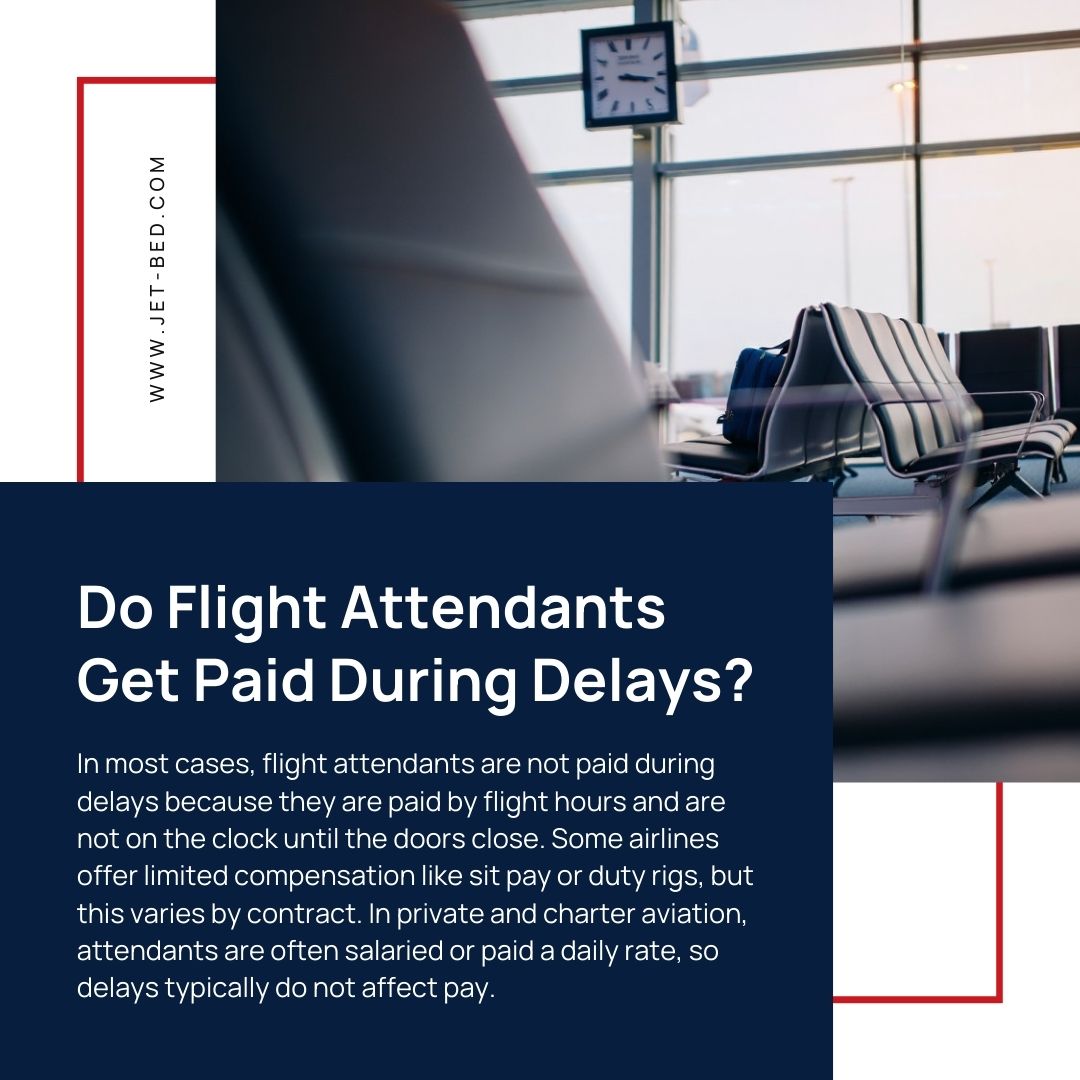
Do Flight Attendants Get Paid During Delays?
In most cases, flight attendants do not get paid during delays, as many operate on a per-flight-hour basis. This is primarily because flight attendants are not “on the clock” until the doors close. Therefore, if the flight is delayed before departure and the doors remain open, flight attendants are unpaid during that period.
However, some airlines offer exceptions. Major airlines, such as United Airlines, offer “sit pay” or “duty rigs.” This structure offers approximately 1 hour of pay for every 2 hours of waiting. Additionally, Alaska Airlines offers 150% trip credit for flight attendants who reroute, and 200% pay for extended reserve shifts. Protections are not universal and ultimately depend on the airline and individual contract terms.
Moreover, for private aviation and charter operations, pay structures differ significantly. Flight attendants working for private airlines often have salary-based or daily-rate compensation models that account for potential delays. Essentially, this implies that attendants’ pay remains unchanged regardless of the flight’s departure time.
Flight attendants’ pay during delays often depends on contractual agreements, specific airlines, and individual compensation policies.
Flying remains one of the most efficient and convenient ways to travel. However, delays are both common and expected. While they’re inconvenient for passengers, they’re equally disruptive for flight attendants. Because many attendants are paid per flight hour, delayed flights unfortunately result in unpaid periods on the ground.
Delays can be inconvenient, but your rest doesn’t have to be. At JetBed, we formulated an in-flight sleep solution that prioritizes precision engineering and artisanal craftsmanship. With a patented inflatable design, you can have a completely flat, hotel-quality bed in minutes. To learn more, contact the JetBed team today!