High-frequency private flyers rarely want to gamble on charter pricing that swings week to week. They also don’t want to take a risk on aircraft that may or may not be available on short notice and unreliable service standards.
Private aviation is often described as simple and exclusive, yet the reality is that pricing structures, access guarantees, and service quality vary widely depending on how you book. Private jet card programs exist to close that gap for people who fly often but have no interest in owning an aircraft outright.
In the guide below, we’ll discuss what private jet card programs are and what they include. Additionally, we’ll cover what they cost, whether they’re a worthwhile investment, and how leading providers compare. This way, you can decide whether a private jet card program can be valuable in your travel strategy.
Wherever you land after a long leg, arriving rested is the part most programs never solve. Every JetBed is crafted in the USA and built to the exact make, model, and floor plan of your aircraft, creating a perfectly flat, uniform sleep surface dressed in premium Italian linens. That’s hotel-quality rest at 40,000 feet, and it’s the most comfortable way to fly.
What Are Private Jet Card Programs?
Private jet card programs are a flexible alternative that sits between full jet ownership and pure on-demand charter. You purchase a block of flight hours upfront, then draw against that balance whenever you fly. The main benefit here, however, is you do so without the capital outlay and management responsibilities of owning an aircraft.
When you purchase a jet card, you are pre-purchasing flight hours at a fixed or guaranteed rate. This ultimately removes nearly all the friction of private aviation without taking on the cost or complexity of ownership.
The model is designed for high-frequency private flyers who want guaranteed availability, predictable pricing, and simplified booking without a long-term commitment. It differs from fractional ownership, where you buy equity in a specific aircraft. With a jet card program, you are buying access, not an asset. (Read our article, “How Does Fractional Jet Ownership Work?”, to learn more.)
The appeal comes down to consistency. You know your hourly rate, you know an aircraft will be there, and you know the service standard before you ever board. For a frequent flyer, that predictability is often worth more than the raw price per hour.
What Do Private Jet Card Programs Typically Include?
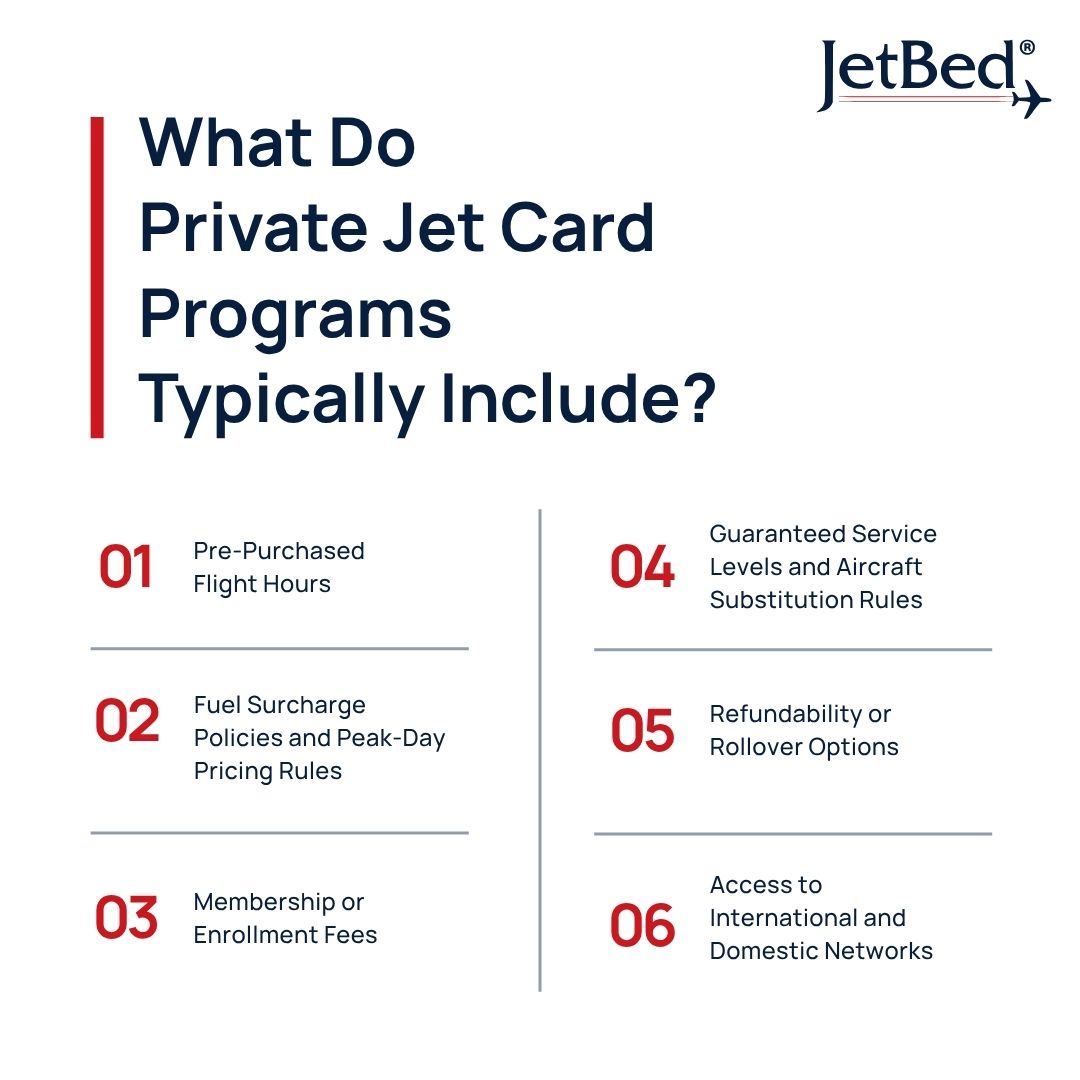
Most jet card programs bundle a similar set of features, though the specifics vary by provider. Reviewing them side by side before enrolling is the most effective way to avoid surprises on your first invoice.
- Pre-purchased flight hours. You buy a block of flight time upfront, commonly starting at a 25 hours minimum, and draw it down as you fly.
- Fuel surcharge policies and peak-day pricing rules. Some programs lock a true all-in rate, while others add fuel surcharges or charge premiums on high-demand peak days.
- Membership or enrollment fees. Certain programs carry a one-time or annual fee on top of your flight hour deposit.
- Guaranteed service levels and aircraft substitution rules. Programs define how much notice you need to book and what happens when your requested aircraft type is unavailable.
- Refundability or rollover options for unused hours. A meaningful differentiator, since some providers offer non-expiring hours while others expire them within a set window.
- Access to international and domestic networks. Coverage varies by service area, and international segments frequently carry additional fees.
A single detail, such as whether hours expire, can swing the real value of a program by tens of thousands of dollars. It’s important to read the fine print with the same care you would apply to any aircraft transaction.
How Much Do Private Jet Card Programs Cost?
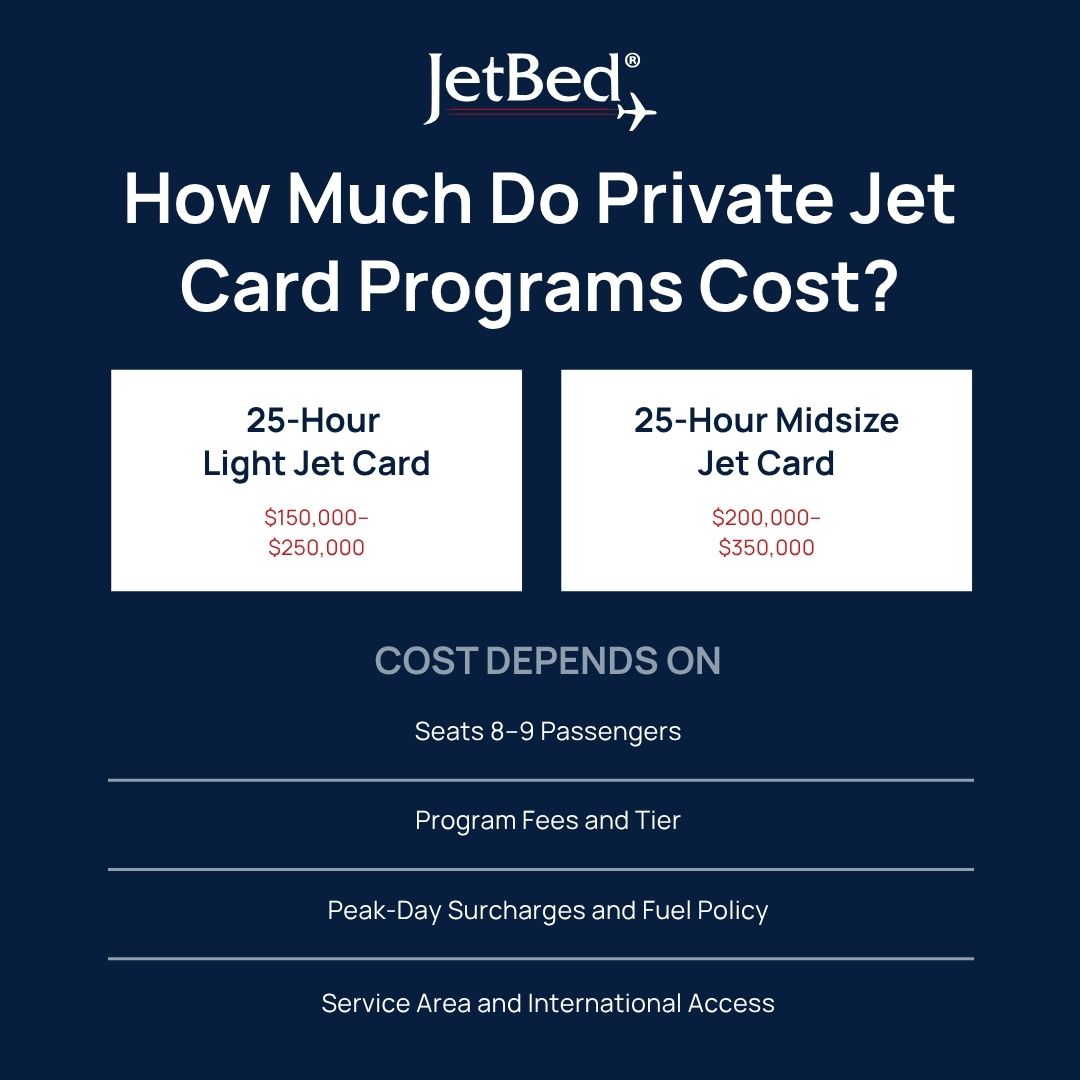
Cost depends heavily on cabin class, program structure, and how you fly. As a benchmark, the average cost for a 25-hour jet card ranges from $150,000 to $250,000 for a light jet, and between $200,000 and $350,000 for midsize jets, reflecting an all-inclusive hourly rate.
Several cost drivers move that number, including:
- Aircraft types and cabin size. Light jets carry the lowest hourly rate, while super-midsize, large-cabin, and ultra-long-range aircraft climb steeply. As a reference, one program lists a super midsize jet operator rate around $7,500 per hour and a large jet around $9,500 per hour.
- Program fees and tier. On deposit-based programs, higher deposit tiers often lower your effective management fee.
- Peak-day surcharges and fuel policy. True fixed hourly rates protect you from seasonal spikes, whereas surcharge-heavy programs erode value during busy travel windows.
- Service area and international access. International travel often incurs additional costs, including higher hourly rates, international fees, and surcharges for segments flown outside the primary service area.
The takeaway for a frequent flyer is straightforward. Model your actual routes and volume against each program’s fee structure, because the lowest headline hourly rate is not always the lowest total cost.
Are Private Jet Card Programs Worth It?
Whether a jet card program is worth it depends on travel frequency, route consistency, and your expectations for service reliability. These programs deliver the most value to travelers who fly often enough to benefit from predictable pricing and guaranteed access, rather than the occasional flyer who books a trip or two a year.
In other words, there is no universally correct answer.
If you fly consistent domestic routes at a steady cadence, a jet card program can save real money and eliminate booking friction. If your travel is sporadic or highly international, however, an on-demand charter model may be the more cost-effective option.
Whichever option you choose, comfort remains a foundational part of the private jet experience. Gary Bosstick, pilot and founder of JetBed, saw the gap between premium travel and proper rest. That’s why he closed the gap with lightweight in-flight sleep solutions that are engineered for uncompromising comfort. Preview our range of custom-made JetBeds today.
What Are the Best Private Jet Card Providers?
The right provider depends on how you fly, but a handful of names lead the business aviation market for jet card programs. Each takes a different approach to fleet, pricing, and service, so the strongest choice is the one that matches your missions.
Running your own private jet card comparisons against the profiles below is the practical next step.
NetJets
NetJets is widely regarded as the industry benchmark for scale, operational consistency, and guaranteed availability. With an extensive global fleet, a long-standing reputation for safety, and reliable service, it’s a popular choice for corporations and frequent private flyers.
While its higher buy-in requirements make it a more significant investment, travelers with consistent flight schedules often find the predictability and access worthwhile.
Flexjet
Flexjet is known for its premium service experience and owned-fleet model, which allows travelers to enjoy consistent aircraft interiors and familiar flight crews. The program also offers strong availability for large-cabin aircraft. Because of this, it remains a particularly appealing option for families and travelers who prioritize comfort and continuity.
Ultimately, its structured membership options are well-suited to those seeking guaranteed access with a personalized service experience.
Sentient Jet
Sentient Jet helped popularize the private jet card model through its straightforward prepaid flight-hour programs. Operating as a broker-based network, it provides access to a broad range of aircraft with fixed hourly pricing and flexible cabin options.
The provider is particularly competitive in the light jet category, where its SJ25 Light Jet Card combines non-expiring flight hours with strong regional economics. It’s often a good fit for moderate flyers looking for pricing transparency without a substantial upfront commitment.
Jet Linx
Jet Linx takes a relationship-focused approach by pairing members with local private jet terminals and dedicated service teams. Its Jet Card membership includes guaranteed availability, fixed hourly rates, and access to more than 20 private terminals nationwide, without peak-day surcharges or repositioning fees.
The company also stands out for its safety standards and safety ratings, holding ARGUS Platinum Elite, WYVERN Wingman Pro, and IS-BAO Stage 3 certifications. It’s well-suited for travelers who value personalized service and a consistent operating relationship without moving into aircraft ownership.
The comfort that turns jet flight hours into genuine rest is the part a jet card program can’t buy.
A jet card program solves access, pricing, and reliability. It secures the aircraft, locks your hourly rate, and simplifies booking so a frequent flyer can move without friction. What it does not address is the cabin itself. No card determines whether you can lie flat and actually sleep on a red-eye, and that’s the difference between arriving ready and arriving worn down.
This is where JetBed lives. Every JetBed is custom-fit to the exact make, model, seat dimensions, and floor plan of your aircraft, setting up in minutes into a completely flat surface with no grooves, gaps, or pressure points. With over 90% of travelers being side sleepers, that flat, even surface matters. Dressed in luxury Italian linens, JetBed brings the comfort of a five-star hotel into the aircraft you already fly. Founded by pilot Gary Bosstick in 2005 and made in the USA, JetBed is the gold standard for in-flight comfort.
When you’re ready to turn your cabin into a place you can lie flat and rest, see how a JetBed is built to fit your aircraft.
Gary Bosstick, Founder of JetBed