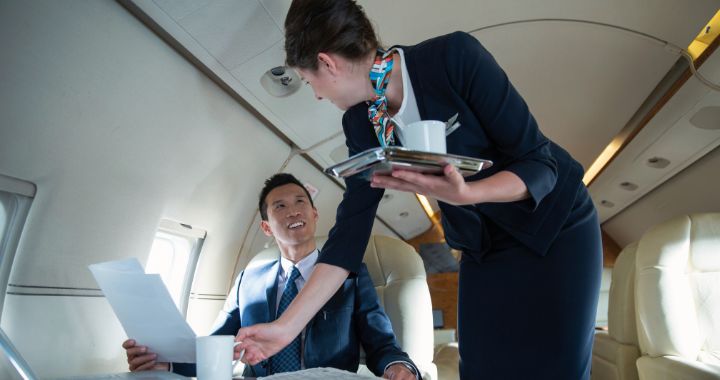
Private jet flight attendants often earn competitive salaries while working in one of the most personalized areas of the aviation industry. In many cases, these positions require attendants to be proficient in luxury hospitality services, be flexible with travel schedules, and interact directly with high-profile clients. However, salaries can vary significantly regardless of skill set alone.
Often, a flight attendant’s salary ranges by aircraft type, role structure, experience level, and operator expectations. And because they are often the sole crew member in the cabin, the responsibilities are broader. Fortunately, the compensation reflects that.
In this guide, we’re discussing the average private jet flight attendant salary, how it varies by experience level, and the core responsibilities that define the role. Understanding what drives these differences is useful before pursuing the career or evaluating candidates for a corporate flight department.
Private flight attendants are responsible for the full cabin experience—and that includes rest. JetBed’s patented inflatable design creates a flat, comfortable sleeping surface in minutes, custom-fit to your specific aircraft model. Lightweight, easy to stow, and made in the USA, it’s the comfortable way to fly.

Private Jet Flight Attendant Salary: The Real Numbers
Private flight attendant compensation varies significantly across the industry, but there is strong earning potential within the career. Experience level, aircraft type, and role structure all drive that range. A cabin crew member on a midsize jet operates in a different environment than one managing a long-range heavy jet for a Fortune 500 flight department.
Scheduling realities, service expectations, and compensation structures each differ in private aviation from those in commercial airline operations. For attendants evaluating the career and flight departments building a crew roster, understanding those differences is the right starting point.
Do Private Jets Have Flight Attendants?
Not all private jets require flight attendants. For example, very light jets and light jets may operate without a cabin crew, leaving pilots to handle hospitality needs. Midsize and super-midsize jets, on the other hand, often carry one cabin host. Heavy jets and ultra-long-range-aircraft, particularly those flying internationally, typically carry two attendants.
Unlike commercial airlines, private aviation has no regulatory requirement for a minimum number of flight attendants. Instead, the operator makes the staffing decisions based on aircraft size, mission length, and client expectations.
For a full breakdown, read our guide “How Many Flight Attendants Are on a Plane?”
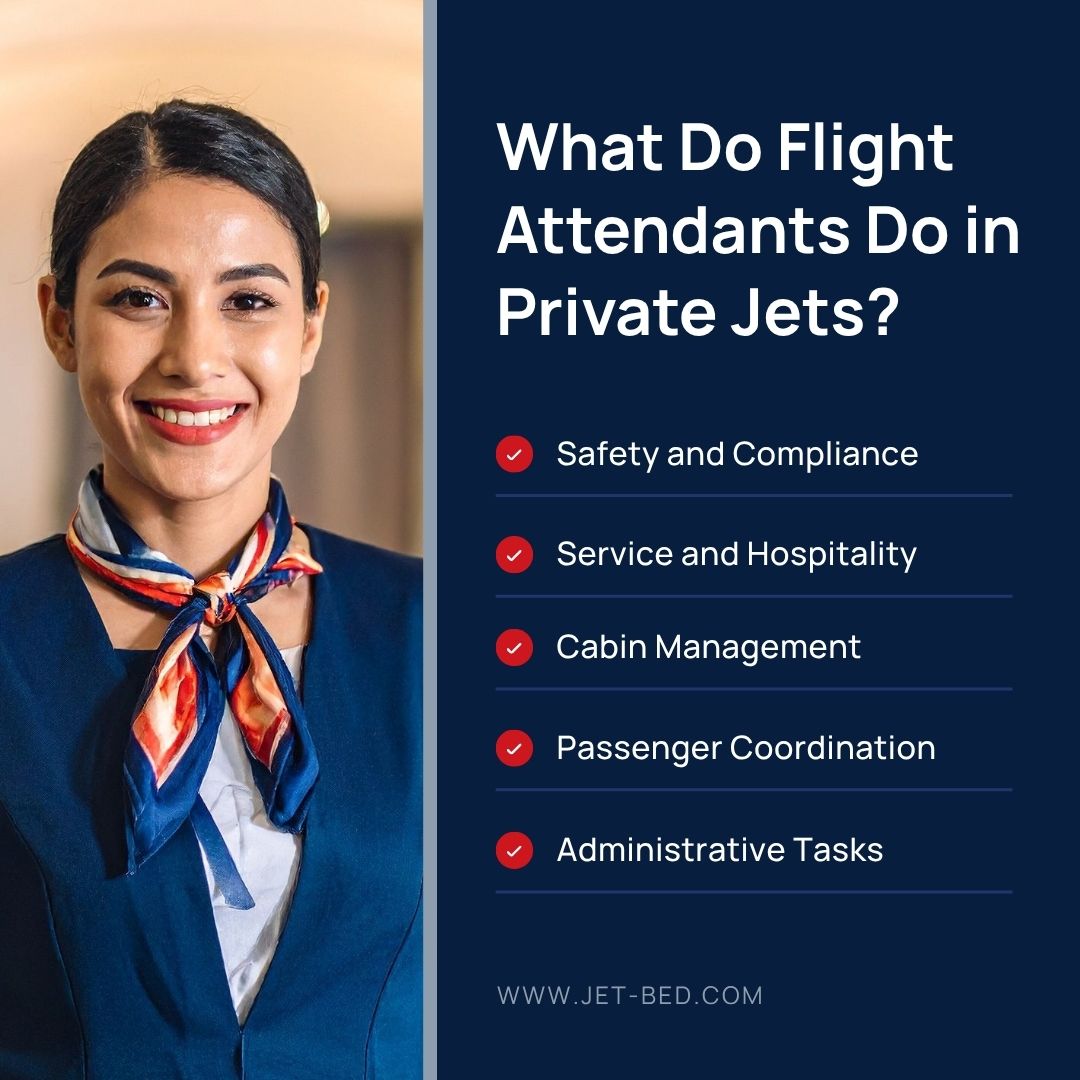
What Do Flight Attendants Do in Private Jets?
Safety and Compliance
Private jet flight attendants are the primary safety authority in the cabin. They conduct pre-flight safety checks, verify emergency equipment is stocked and accessible, and brief passengers before departure. On most private flights, there is no backup crew.
That means one attendant is responsible for every emergency scenario in the cabin, including medical emergencies, fires, decompression, and evacuation. Ultimately, Part 135 charter operations define crew training requirements that support safe, consistent operations, including first aid, CPR, and aircraft-specific emergency procedures.
Service and Hospitality
In addition to safety, private jet flight attendants manage every aspect of in-flight service, and that work starts well before the flight. They coordinate catering orders, confirm dietary requirements, and source specific items for repeat high-profile clients. By the time passengers board, the service plan is already in place.
On board, flight attendants work to handle meal preparation and presentation, beverage service, and bar setup. More importantly, private travelers expect a certain standard in-flight, and attendants are trained to meet those expectations. The difference between good service and expected service in this environment is precision and consistency.
For more information about catering services, review our guide “Private Jet Catering: The Ultimate In-Flight Dining Experience.”
Cabin Management
Crew members control the cabin environment from start to finish. Before passengers board, they prepare the space and arrange amenities to each client’s preferences. Temperature, lighting, and seating configuration are all set to match how the passenger intends to work or rest.
On long-haul flights, that preparation extends to sleep setup. Converting seating into a proper sleeping arrangement requires attention to detail. Ultimately, the quality of in-flight rest depends directly on how well the flight attendants execute that transition. Between legs, attendants reset the cabin and restock supplies before the next departure.
For those interested, JetBed can significantly enhance in-flight sleeping arrangements. Learn more in our guide, “How to Sleep on Long Flights: Tips for Restful Travel.”
Passenger Coordination
Coordinating all moving parts around the passenger experience is a core responsibility for private jet attendants. The lead attendant manages the transportation, catering vendors, and FBO staff. Meanwhile, they also ensure the flight crew remains focused on the aircraft—not logistics.
For repeat clients, attendants maintain detailed preference records. By doing so, they can automatically pull up a passenger’s usual seating request or drink order, without the client having to ask. On multi-leg trips, that coordination becomes more demanding as connecting arrangements and service timing shift with the itinerary.
Administrative Tasks
Aside from onboard tasks, private flight attendants handle documentation the flight crew does not have time to manage. These responsibilities begin even before takeoff, including preparing passenger manifests and confirming names on travel documents. On international flights, they collect passport details in advance so that ground handling can process arrivals without delay.
Galley inventory tracking falls to the attendant as well. They log the items used on each leg and flag restocking needs before the next flight. On charter operations, attendants submit trip reports to the operator. These reports confirm that the crew has met service standards and note any issues that may require follow-up.
Explore a comprehensive breakdown of the role in our guide “Private Plane Stewardess Job.”
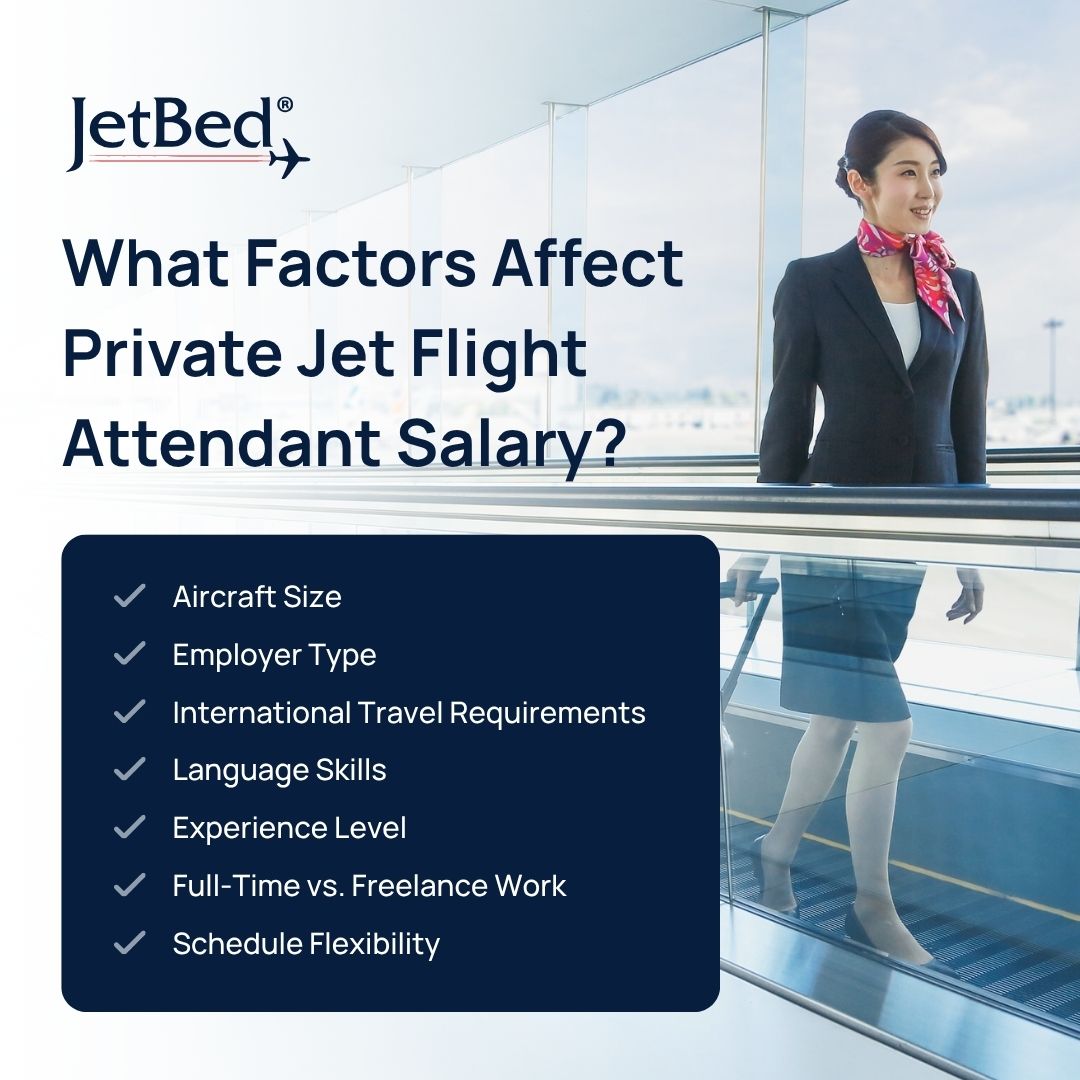
What Factors Affect Private Jet Flight Attendant Salary?
Aircraft Size
Aircraft size is one of the most direct factors in private flight attendant compensation. Attendants on large-cabin jets like the Gulfstream G650 or Global 7500 typically earn more than those on light jets. Large aircraft carry more passengers and place heavier service demands, including multi-course meals, formal table settings, and dedicated sleeping arrangements, which can add complexity.
Midsize jets often require a single attendant managing every task without support. That increased workload does not always translate into higher pay, which makes aircraft type an important variable. Meanwhile, light jets rarely carry attendants at all, since cabin service requirements at that level are minimal.
To understand the aircraft options where a flight attendant might serve, review our guide “Types of Private Planes.”
Employer Type
Employer type shapes compensation as much as aircraft size does. Corporate flight departments typically offer salaried positions with benefits and consistent scheduling. Conversely, charter operators pay on a per-trip or per-day basis, which creates variable income tied directly to flight volume.
Fractional ownership programs sit between those two models, offering more predictable scheduling than charter work with compensation structured around guaranteed flight hours. Private individual owners set their own pay scale, and high-net-worth clients flying large-cabin aircraft frequently offer premium compensation for dedicated, on-call attendants.
International Travel Requirements
International travel adds direct compensation value. Trips crossing borders require customs documentation, passport coordination, and immigration paperwork. These are responsibilities that carry a pay premium over domestic operations.
Extended international trips also include overnight stays, with per diem pay typically added to cover layover expenses. Long-haul routes on large-cabin aircraft carry the highest compensation in the category. Duty days are longer, service demands are more complex, and the attendant is often the sole crew member managing both.
Understand the details of international private travel in our guides “International Flight Plan Format” and “How to Plan International Trip in Your Own Plane.”
Language Skills
Language skills add measurable value to a private flight attendant’s compensation. Routes to Europe, Asia, and Latin America frequently require an attendant fluent in the local language. This is essential for customs, coordination, catering requests, and passenger communication on the ground. Employers pay a premium for that capability because miscommunication during international stops carries real operational risk.
Charter operators with global clientele place particular value on bilingual and multilingual attendants. French, Arabic, Russian, Mandarin, and Spanish fluency command higher day rates on routes where those languages are in play. The premium reflects operational necessity, not a soft skill bonus.
Experience Level
Experience level creates clear pay tiers in private aviation. Entry-level attendants typically start on light or midsize aircraft with lower service complexity, and base pay reflects that. As experience builds, attendants move into large-cabin roles that require advanced service skills and often include international routes.
Specialized training adds further compensation value. Wine certification, advanced first aid, or safety instructor credentials push pay higher regardless of years in the role. At the senior level, repeat clients and operators frequently pay above-market rates to retain proven talent. In reality, turnover in this environment is costly, and reliability commands a premium.
Full-Time vs. Freelance Work
Full-time versus freelance status directly affects how private jet flight attendants structure their income. Full-time attendants working for a corporate flight department receive a fixed salary with benefits, retirement contributions, and predictable scheduling. The trade-off is a lower earning ceiling than freelance work.
Freelance attendants work on a per-trip basis, hired by charter operators and owners for specific flights at higher day rates. The model rewards flexibility but removes the income stability of a salaried role. Freelancers who build strong relationships with brokers and clients often see steadier work over time. Nonetheless, income remains directly tied to flight volume.
Schedule Flexibility
On-call availability commands a premium in private aviation. More specifically, attendants who accept short-notice trips or last-minute schedule changes tend to earn more than those with fixed availability. Owners and corporate flight departments value this flexibility enough to build it into contracts with dedicated stipends.
Freelance attendants see the effect most directly. Charter brokers pay higher day rates to attendants who can fill gaps on short notice. Ultimately, availability is one of the most reliable ways to increase earnings. Attendants who limit their availability trade that earning potential for predictable time off.
Learn more about scheduling in this role in our guide “How Do Flight Attendants’ Schedules Work?”
How Much Does a Private Jet Flight Attendant Make?
Entry-Level
Entry-level private flight attendants typically earn around $45,000 per year. This range reflects roles on light or midsize aircraft where corporate cabin service complexity is lower. Meanwhile, new attendants are still developing their experience. As skills build and aircraft assignments grow in size and range, compensation moves accordingly.
Experienced
Flight attendants with 10 or more years of experience typically earn $100,000 or more per year. That compensation reflects a track record with high-profile clients, advanced service skills, and the kind of operational reliability that operators pay to retain. At this level, roles tend to involve larger aircraft and longer international routes. Both carry higher day rates and more complex service demands.
Freelance
Freelance income varies more than salaried roles, and the wide range reflects that directly. A freelancer working consistently across domestic and international trips can reach $60,000 to $120,000 per year. The daily rates run between $500 and $900 for domestic routes and $800 and $1,200 for international. However, without steady bookings, income drops well below that range.
Experience and network drive the difference in income. Freelancers with strong relationships with charter brokers see more consistent trip flow than those relying on occasional bookings. Building those relationships early in a freelance career is the most reliable path to stable earnings.
Provide a comfortable and luxurious private aviation experience with JetBed.
Private flight attendant roles carry broader responsibilities than commercial flight attendant positions, and the compensation reflects that. With the right experience, aircraft assignments, and client relationships, earnings can reach $100,000 or more per year. For aviation professionals evaluating career paths, the private sector offers a different ceiling.
Setting up the cabin for rest is part of a private flight attendant’s role. JetBed’s patented inflatable design creates a flat, comfortable sleeping surface for passengers in minutes. They are custom-fit to your specific aircraft model, lightweight, easy to stow, and made in the USA. Contact us to find the right JetBed for your aircraft today.