
For those interested in pursuing an aviation career, understanding a private pilot’s salary is of utmost importance. For many, this directly determines whether they explore the opportunity. However, pilot income is not defined by a single number; it varies based on license level, flight hours, and the type of aircraft flown.
Moreover, private pilots’ salaries differ significantly from those of commercial airline pilots. This is often because private pilots typically operate outside of structured airline pay scales and compensation models. Recognizing these differences, nonetheless, provides aspiring pilots with a more informed perspective when entering the field.
In this guide, we will discuss how private pilot salaries vary by license, hours, and aircraft type. Additionally, we will explore how much private pilots can earn, how their pay differs from that of commercial pilots, and how to increase earning potential. This information is essential for gaining a clearer, more realistic understanding of a pilot’s salary at every stage.
At JetBed, we’re extremely passionate about the luxury, convenience, and comfort that private aviation provides. This is why, after years of design and engineering, we developed a patented sleep solution free of grooves and pressure points. Crafted in the USA, complemented with premium Italian linens, and custom-fit to your aircraft, JetBed makes every leg of your journey as relaxing as the destination itself.

Private Pilot Salary by License, Hours, and Aircraft
When people question how much private pilots can earn, they’re often expecting the answer to involve a single number. However, it’s much more nuanced than that. Income in aviation depends on multiple variables—especially in private aviation.
For example, a private pilot may:
- Fly recreationally without compensation
- Work toward advanced certifications
- Transition into advanced roles such as charter, corporate, or private jet pilots
As a result, a private pilot’s salary is not a fixed number. It relies heavily on flight hours, experience, certifications, aircraft type and size, and geographic location. This is why, below, we will thoroughly discuss what a private pilot is, how the role differs in the aviation field, and how pilots can increase their earning potential.
For those interested in pursuing the position, we encourage you to read: “How Much Does It Cost to Get Private Pilot License?”
What Is a Private Pilot?
A private pilot is a professional who holds a Private Pilot License (PPL), which allows them to operate aircraft for personal or non-commercial purposes. This license plays a critical role in providing pilots with foundational knowledge, such as flight planning, advanced navigation, emergency procedures, and aircraft control.
However, it does not permit them to fly for compensation, hire, or profit. This is where the term “salary” often gets blurred in private aviation. As discussed previously, private pilots do not operate on traditional compensation models. To earn income from flying, pilots must obtain additional credentials, which we will discuss below.
When knowing this, the distinction becomes straightforward. A PPL is the first essential milestone for aspiring private pilots. However, it is not designed as a direct income-generating license.
Learn more about what licensure requires in our guides, “How to Get a Pilot’s License” and “How Long Does It Take to Become a Pilot?”
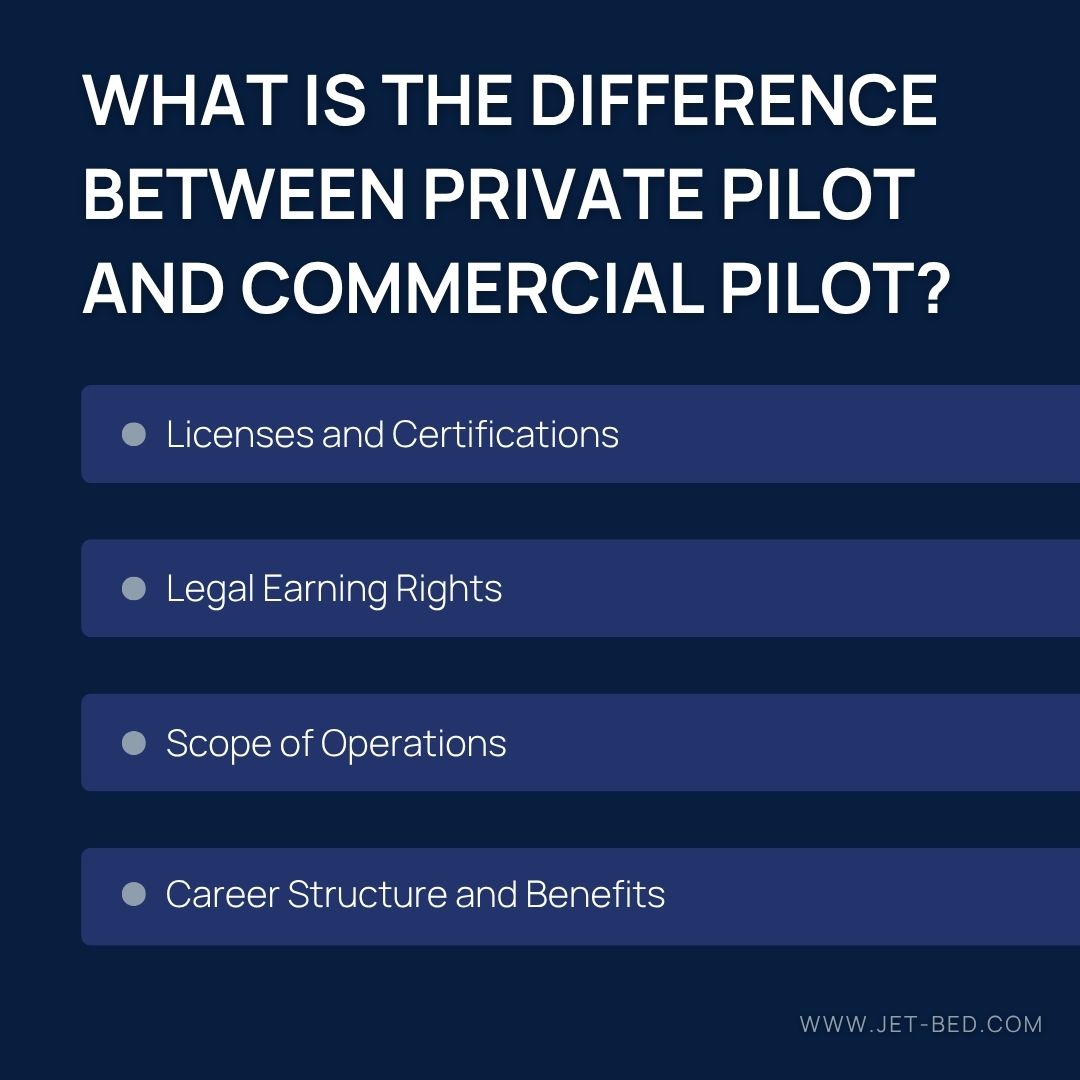
What Is the Difference Between Private Pilot and Commercial Pilot?
Licenses and Certifications
To begin, private pilots must earn a Private Pilot License (PPL) for personal use, followed by a Commercial Pilot License (CPL) for compensation. Those entering aviation through structured commercial training programs may not follow this exact sequence. Nonetheless, the distinction between privileges remains essential.
Many assume the necessary licenses for private pilots end there. And while this may be true for hobbyist flyers, those seeking compensation must pursue additional certifications and ratings that expand their operational capabilities. Licenses and certifications necessary for flying both commercially and privately for compensation include:
- Instrument Rating (IR): Allows pilots to fly in low-visibility conditions
- Multi-Engine Ratings (ME): Enables pilots to fly aircraft with more than one engine, increasing speed and safety
- Second-Class Medical Certificate: Also known as a Class 2 Medical Certificate, this verifies that pilots meet the mental and physical health standards necessary for flying
- Certified Flight Instructor (CFI): Allows pilots to teach others, which is one of the most common ways to build flight hours early in a career
- Type Ratings: Required for operating specific aircraft, such as turbojet-powered planes, multi-pilot aircraft, and heavy jets.
These are standard, baseline certifications and licenses necessary for private commercial pilots to earn compensation. However, there are various additional qualifications that, while not required, can significantly increase a pilot’s earning potential.
For additional information regarding type ratings, review: “How Many Pilots Are Required in a Plane?”
Legal Earning Rights
As mentioned above, private pilots are not legally authorized to receive compensation for flying. They may share operating expenses with passengers, splitting costs such as fuel, oil, and rental fees. Additionally, private pilots can receive compensation or reimbursement for:
- Incidental to Business: Flight is incidental to a business, but pilots do not carry passengers and cargo for compensation
- Charity or Non-Profit: Flights approved by the FAA for non-profit, community, or charity events, outlined by Part 91.146
- Glider Towing: Provided pilots meet the requirements under 14 CFR 61.69, they can aerially tow a motorless glider
- Search and Rescues: Pilots receive reimbursement for expenses incurred during search-and-rescue operations sanctioned by local, state, or federal agencies.
- Production Test Flights: Pilots can test production flights for light-sport aircraft, receiving necessary compensation or reimbursement
In contrast, commercial pilots are legally allowed to receive compensation, a salary, or hire for flying. Moreover, they can earn this through charter operations, cargo transport, or employment through major airlines.
Here is an essential distinction: private pilots who obtain a Commercial Pilot License (CPL) are authorized to receive compensation for flying passengers or property. Without this, however, private pilots are prohibited from receiving payment for flight services.
Scope of Operations
Generally, private pilots without a CPL fly strictly for pleasure, a hobby, or personal transportation. Commercial pilots, on the other hand, are authorized to receive compensation for flying passengers or cargo, or operating specialized services.
Without commercial licensure, private pilots do not have to undergo nearly as many training requirements or regulations. Those flying commercially, however, must meet more rigorous standards, maintain additional certification, and adhere to stricter operational guidelines. Those same standards apply to private pilots seeking commercial licensure for compensation.
Learn more about additional certifications in “When Is a Type A Rating Required?” and “Guide to Airman Certification Standards.”
Career Structure and Benefits
Commercial aviation roles generally follow structured compensation packages. Beyond general salaries, commercial pilots often benefit from comprehensive health insurance, 401(k) matching, profit sharing, retirement plans, and travel perks. Additionally, they must adhere to strict regulatory compliance standards, including structured schedules, appropriate rest limitations, and type ratings.
Private pilots, on the other hand, operate with more versatility. They benefit from flexible schedules, access to smaller regional airports, and specialized training across various aircraft types. These advantages allow pilots to operate outside of the constraints of traditional commercial aviation, often serving as one of the role’s most compelling benefits.
For further details regarding scheduling, visit: “How Many Flights Does a Pilot Do a Day?”
How Much Do Private Pilots Make?
The average private pilot in the United States earns roughly $76,000 to $130,000+ per year. Remember, however, private pilots do not earn salaries in the same sense that commercial airline pilots do. Once they obtain the necessary certifications, income begins to scale based on experience:
- Entry-Level (Hour Building/Early Role): Pilots may earn modest hourly rates while accumulating flight hours. These roles often include a certified flight instructor, who makes roughly $30,000–$50,000 annually.
- Private Roles: As pilots gain experience, they move into charter operations or work alongside experienced crew. At this stage, pilots may operate as a charter first officer, who makes roughly $60,000–$80,000 annually.
- Experienced Private Jet Pilots: More established private jet pilots flying advanced aircraft can make significantly more. They often obtain the advanced certification, licenses, and skills necessary to operate larger-cabin jets or work in high-demand regions. Senior-level private jet pilots often earn an average of $130,916 per year.
Ultimately, compensation structures for private pilots may vary by aircraft type, daily rate, and the certifications held. For additional details, review our guide, “First Officer Pilot Jobs for Private Planes.”
Do Private Pilots Make More Than Commercial Pilots?
In many cases, no, commercial airline pilots often earn more consistently and at higher levels. There are some discrepancies, however. Commercial airline pilots generally receive structural pay based on hourly flight rates. Private pilots, on the other hand, earn higher base salaries or day rates depending on aircraft type, size, and experience.
Ultimately, pilots working for major airlines receive benefits typically associated with commercial aviation roles, including:
- Employer-sponsored retirement plans
- Per diem allowances
- Profit sharing
- Seniority-based pay increases
- Long-term career stability
- Health and insurance benefits
- Union protections and contracts
However, there are exceptions. Highly experienced private jet pilots, particularly those flying corporate clients or high-end charter services, can earn competitive salaries. These salaries are often comparable to mid-level commercial airline pilots.
Nonetheless, private aviation offers distinct advantages. This includes more flexible schedules, varied flight experiences, and the opportunity to operate a wider range of aircraft.
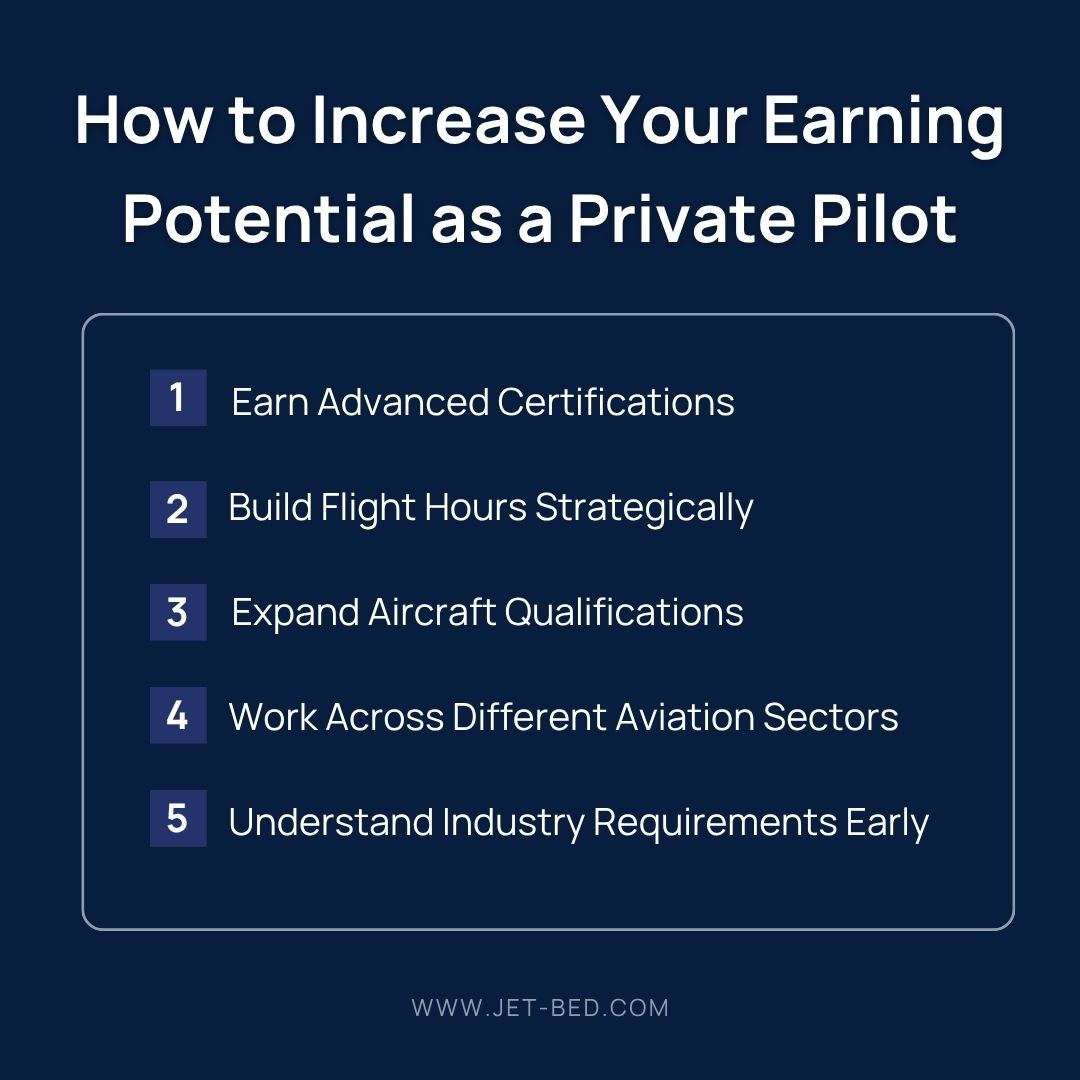
How to Increase Your Earning Potential as a Private Pilot
Earn Advanced Certifications
To increase pay, private pilots need to progress beyond the standard Private Pilot License (PPL). More specifically, certifications that can increase income potential include:
- Certified Flight Instructor (CFI)
- Commercial Pilot License (CPL)
- Instrument Rating (IR)
- Multi-Engine Rating (ME)
- High-performance, complex, tailwheel endorsements
Additional income-generating opportunities also include charity flying, towing, and sales demonstrations. Ultimately, experience and certifications can significantly expand earning opportunities.
Build Flight Hours Strategically
The more flight hours a pilot accumulates, the more qualified they become for higher-paying roles. Additionally, there are various strategic time-building methods pilots can pursue to increase experience. This includes:
- Become a CFI, as teaching is one of the most efficient ways to build time while also getting paid
- Seek an entry-level position that offers paid, high-volume flying
- Offer to act as a safety pilot, which permits logged Pilot in Command (PIC) time
Entry-level aviation jobs, while they don’t pay as much, provide an opportunity for aspiring pilots to gain the experience necessary to advance in the field.
Expand Aircraft Qualifications
Training across multiple aircraft types can increase value. This includes flying smaller aircraft and larger or more complex aircraft. Doing so demonstrates adaptability, operational flexibility, and enhanced safety. Additionally, this can increase the likelihood of receiving higher-paying positions.
Work Across Different Aviation Sectors
Exploring opportunities such as charter services and corporate aviation can offer more flexible schedules and unique career paths. This diversity demonstrates a professional’s commitment to gaining experience across different aircraft, operators, and networks.
Understand Industry Requirements Early
Understanding industry requirements, especially in the beginning, directly increases earning potential. While this level of knowledge is generally important, it also equips aspiring pilots with the information needed to target high-growth areas and invest their time wisely.
Private pilots’ salaries are ultimately defined by progression, specialization, and experience.
A single variable doesn’t define a private pilot’s salary; it’s shaped by dedication. From initial training to advanced certifications, each step builds momentum toward a higher earning potential. For aspiring pilots, the path often begins with a passion. However, the end result is a strategic career built on specialization and commitment.
For those interested in the private aviation industry, it’s essential to understand the value of quality enhancements. This is why, at JetBed, we patented an inflatable design that creates a completely flat, hotel-quality bed within minutes. Smaller and lighter than any other in-flight sleep solution, JetBed allows you to experience what true comfort at 40,000 feet feels like.
Contact the JetBed team today to learn more about how you can elevate your private jet in-flight experience. Or, for your convenience, visit our website to order JetBed online.