
In private aviation, management-level safety processes reflect a deeply ingrained understanding that safety is not operational—it’s foundational. More specifically, every procedure, inspection, analysis, and audit upholds these principles, reinforcing that safety is as much a leadership responsibility as it is an operational one.
Frontline teams, including the cabin crew, ground crew, and airport staff, ensure operational safety throughout both routine and critical circumstances. It’s the senior management team and executive-level leaders who are responsible for building the systems that prevent incidents before they occur.
Ultimately, these systems shape the aviation industry, creating the framework for identifying, assessing, and controlling risks. To better understand the process, today’s post will serve as a comprehensive guide to management-level safety processes. We will discuss what it is, its pillar components, and how aviation organizations continuously utilize it to improve safety procedures.
At JetBed, as with safety operations, we understand the importance of maintaining the highest standards in private aviation. That’s why we developed a perfectly flat sleep solution custom-fit to your aircraft model. Made in the U.S. and offering uncompromised comfort, sleep soundly knowing every leg of your journey can be as comfortable as it is secure.

What Is a Management Level Safety Process Aviation?
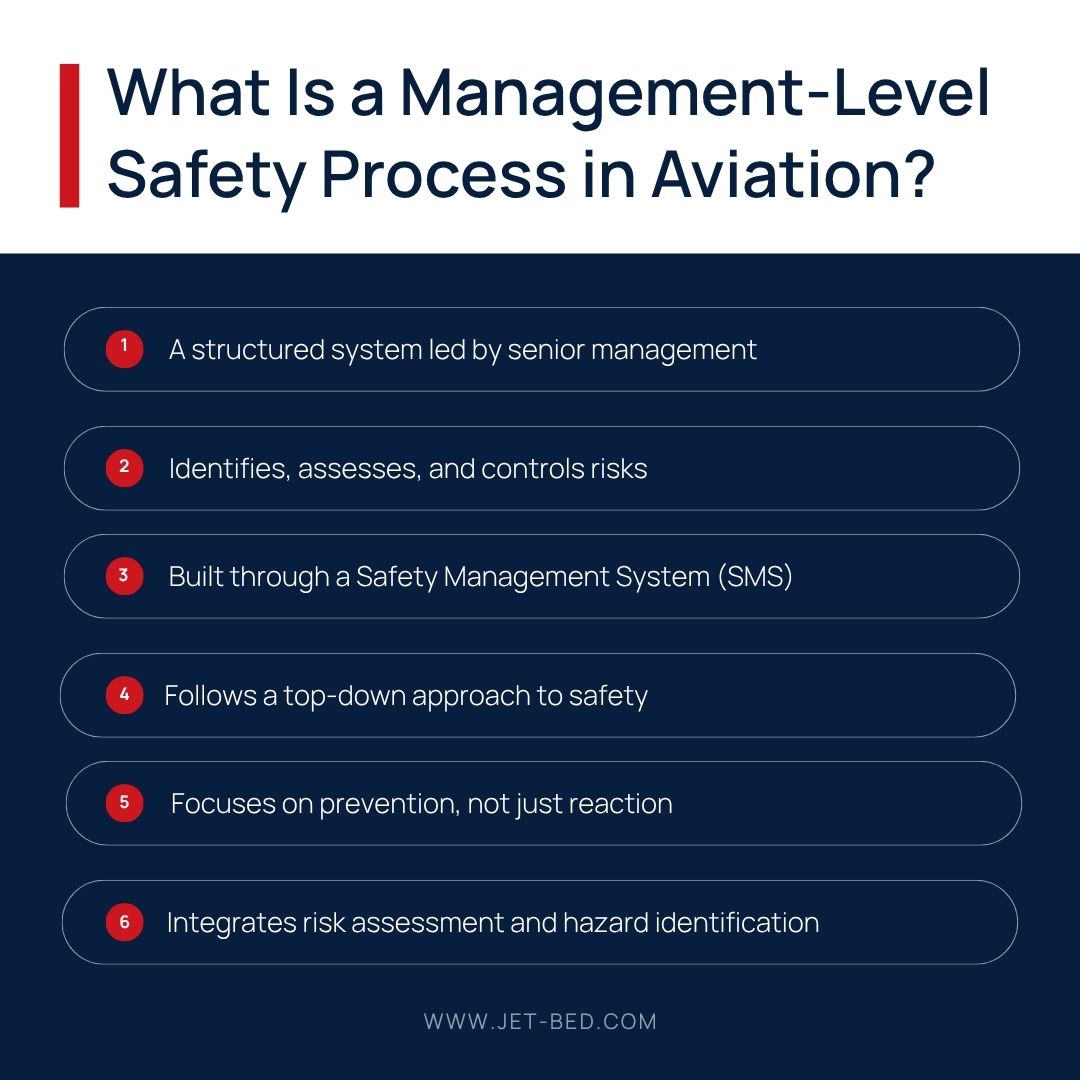
A management-level safety process in aviation refers to a structured oversight system that identifies, mitigates, and monitors risks at the highest levels of leadership. In practice, these processes are implemented through a Safety Management System (SMS), a structured framework established by the International Civil Aviation Organization (ICAO) and enforced by aviation authorities worldwide.
Ultimately, this system prioritizes a top-down approach to managing safety—initiatives are mandated by senior management and then passed down to operational personnel. Rather than simply reacting to incidents, management-level safety processes emphasize a systematic alternative. It integrates risk assessment, hazard identification, and organizational structure to execute proactive prevention.
For additional information, review our guide, “Importance of Safety Management System in Aviation,” next. For now, however, we will further discuss the four components of a Safety Management System.
What Are the Components of a Safety Management System?
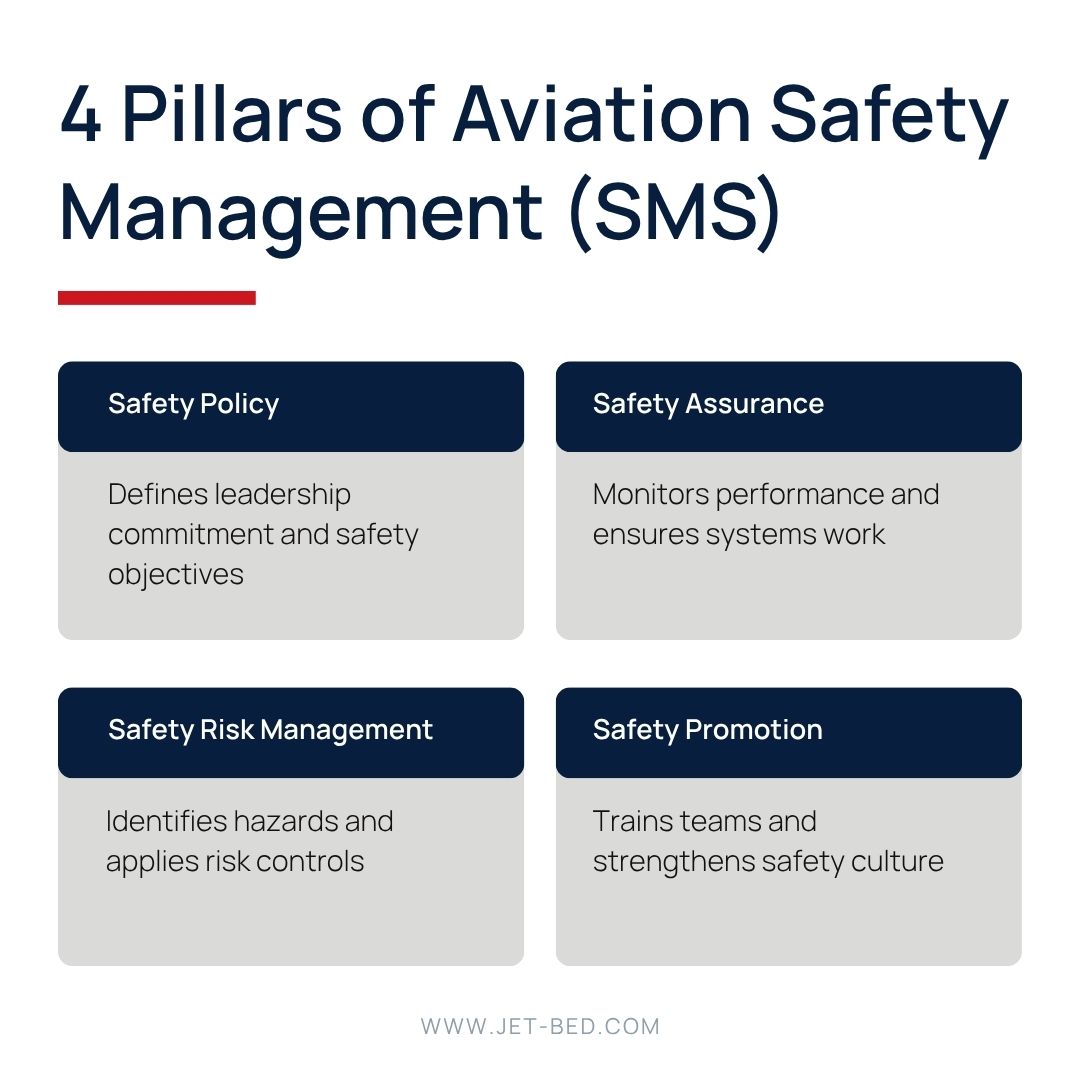
In aviation, Safety Management Systems consist of four separate pillars, each serving a distinct function. While they operate independently in scope, they work together to create a cohesive, systematic approach to a strong safety culture.
Safety Policy
A safety policy is a written document that establishes an organization’s commitment to safety in aviation. This pillar serves as the foundation, verifying that leadership is actively involved in and committed to identifying hazards and improving safety performance.
Moreover, the document formally defines executive responsibilities, outlines safety objectives, and communications expectations across the industry. Per the ICAO Annex 19 and FAA Part 5 requirements, the safety policy establishes the following:
- Safety remains the number one priority for all operators.
- There are strategic methods, processes, and structures necessary to comply with standardized operational safety.
- Everyone understands their role and responsibilities at all levels.
Safety Risk Management
Safety risk management focuses on hazard identification, risk assessment, and the implementation of mitigation strategies. The structured three-step approach enables operators to assess likelihood and severity, then apply effective risk controls.
As mentioned previously, risk controls are an essential preventative measure across aviation operations. To demonstrate efficacy, a recent study found a 30% reduction in safety events among SMS-equipped operators. Ultimately, it’s a crucial component to strengthening overall safety and minimizing risks.
Safety Assurance
Safety assurance, the third pillar within the SMS, ensures that safety systems are functioning as intended. While required by aviation authorities, individual operators remain responsible for overseeing and continuously improving performance. Key elements of this process include:
- Safety Performance Monitoring: Using safety performance indicators (SPIs) and safety performance targets (SPTs), operators can monitor trends to identify any unusual events or patterns.
- Corrective Action Implementation: If there are any potential hazards, operators must address them promptly.
- Sustained Improvement: Safety performance is an ever-changing process. Operators will continuously use audits and inspections to streamline and strengthen safety performance.
This component of an SMS supports continuous improvement throughout the industry. By monitoring trends and reporting anomalies, aviation authorities can better structure proactive approaches to maintaining safety.
Safety Promotion
While leadership responsibility is a core component of Safety Management Systems, these principles must be consistently communicated and reinforced across all levels of the industry. More importantly, this framework fosters a stronger safety culture from crew members to executives.
This process includes training employees, communicating data, and prioritizing a learning culture. Implementation of safety promotion ultimately emphasizes that risk management isn’t a recommendation; it’s a requirement for regulatory compliance.
Executive Responsibilities in Aviation Safety
At the leadership level, the Accountable Executive (AE) plays a crucial role in overall operational efficiency. This individual serves as the final authority over the Safety Management System and is ultimately responsible for safety performance.
Key responsibilities include:
- Establishing clear safety objectives aligned with organizational goals
- Allocating appropriate budget and staffing resources for safety initiatives
- Approaching and overseeing risk mitigation strategies
- Reviewing safety performance indicators
- Leading safety review boards and governance committees
Through these actions, senior management ensures that safety remains a top strategic priority across the industry.
Hazard Identification and Risk Assessment at the Management Level
Voluntary Reporting Systems
Voluntary reporting systems allow employees to report safety concerns, potential hazards, incidents, or near misses without the fear of disciplinary action. This is a crucial aspect of ensuring comprehensive safety, as in rare circumstances, hazards may be missed during formal audits. Ultimately, voluntary reporting programs contribute to a stronger, more authoritative safety culture through early risk detection.
Flight Data Monitoring
Flight Data Monitoring (FDM), also known as Flight Operational Quality Assurance (FOQA), analyzes operational data to identify trends. Using data recorded during a flight, authorities and operators can identify potential hazards and develop proactive responses. This can include unstable approaches, harsh landings, or excessive pitch altitudes.
With this information, operators can adjust training to better account for continuous operational inefficiencies rather than one-time mistakes. For further information, refer to our guide: ”Flight and Safety at High Altitudes.”
Maintenance Irregularities
As outlined in our post, “Private Jet Inspection and Maintenance Frequency Guide,” private jets are required to undergo routine inspections and adhere to strict maintenance schedules. By tracking irregularities, operators can identify recurring technical issues that could ultimately impact safety. Furthermore, management can implement additional targeted risk controls and improve maintenance protocols.
Human Factors Trends
Human Factors (HF) play a significant role in aviation safety. Even with advanced technology and systems aviation implements today, Human Factors continue to contribute to over 70% of aviation incidents. To bridge that gap, operators are increasingly integrating behavioral science and data analytics to incorporate risk mitigation.
Audit Findings
Internal and external audits provide a structured evaluation of compliance and system effectiveness. More importantly, audits compile archives of text-based communications to ensure compliance and accountability. Following this, audits can highlight performance gaps and provide actionable insight to improve operations.
Safety Performance Indicators and KPIs
Safety Performance Indicators (SPIs) and Key Performance Indicators (KPIs) effectively evaluate an organization’s safety performance. This system incorporates two performance metrics: Leading Indicators, which are proactive and preventive measurements, and Lagging Indicators, which are reactive measurements.
More specifically, common safety performance indicators include:
- Runway excursion rate
- Maintenance error frequency
- Voluntary report volume
- Training completion rates
- Incident recurrence trends
This broader range of valuable information enables aviation organizations to evaluate the effectiveness of the current safety management system. As a result, they can successfully implement additional procedures, improving safety throughout aviation services.
Internal Audits and Continuous Improvement
Continuous safety improvements are a cornerstone in modern aviation operations. Internal audits and structured review processes ensure that safety systems evolve alongside operational demands.
Scheduled SMS Audits
Scheduled quarterly, biannually, or annually, SMS audits are recurring reviews that verify an organization’s safety performance. It will closely review key factors, such as safety policies, procedures, and risk management protocols, to ensure they function efficiently. Additionally, significant system changes, safety incidents, and policy updates may trigger ad-hoc audits.
Corrective Action Taking
To improve safety performance across the industry, individuals, operators, and authoritative figures must frequently implement operational adjustments. Rather than fixing a simple error, it encourages structural change to prevent future issues. Initiated in safety reports, audits, and investigations, any strategy implementation requires immediate action to determine its effectiveness.
Management Review Meetings
Management review meetings provide a forum for senior management to assess safety performance, review audit results, and make strategic decisions. Ultimately, these meetings serve as an internal feedback loop. Aviation authorities will review performance, identify areas for improvement, and continue monitoring them over time.
Root Cause Analysis
Generally, there are fundamental reasons why a safety incident or hazard transpired. Root Cause Analysis (RCA) identifies the underlying causes, such as poor training, inadequate features, or confusing frameworks. This system then allows operators to develop procedures to prevent similar reoccurrences.
Documentation and Recorded Retention
Maintaining accurate records is critical to ensure regulatory compliance and operational transparency. Proper documentation supports audits, facilitates knowledge transfer, and ensures continuity in overall safety management practices.
Management-level safety processes are a foundational component for safe, efficient, and compliant aviation operations.
Aviation safety cannot rely on isolated actions alone. It requires a strategic, leadership-driven effort that integrates policy, data, and culture into a cohesive system. By adopting this systematic approach, organizations can prevent hazards and incidents rather than simply react to them. As a result, this maintains the high level of safety management for which aviation is known.
When traveling by private aircraft, multiple factors contribute to a safe, flexible, and comfortable experience. And at JetBed, we understand that every detail, both operational and onboard, plays a critical role in delivering that standard. Compact, lightweight, and custom-fit to your aircraft, discover why more and more travelers prefer JetBed for optimal in-flight comfort. Contact the JetBed team today to learn more, or visit our website to order JetBed online.