
Executive airports, a type of general aviation airport, are purpose-built for private and business aviation. They operate separately from commercial terminals, with infrastructure and services designed around the specific demands of private aircraft operators.
For frequent flyers and corporate flight departments, they are not just a perk. They are the preferred point of entry. These facilities handle the full range of private aviation needs, from private lounges and jet refueling to FBO services and dedicated runway access. Arrival-to-departure is built for efficiency rather than volume alone.
This guide covers what executive airports are, who uses them, and how they differ from commercial airports. It also discusses what services to expect when operating in and out of them. For frequent travelers, understanding these distinctions offers valuable insight into what truly sets private aviation apart.
Executive airports set the standard on the ground. JetBed carries that standard into the air. Our patented inflatable design creates a flat, comfortable sleeping surface in minutes. They are custom-fit to your specific aircraft model, made in the USA, and finished with luxury Italian linens. Fly with JetBed—the comfortable way to travel.
What Is an Executive Airport? Services and Benefits
Executive airports are specialized facilities primarily designed to accommodate private jets and corporate and general aviation. More specifically, executive airports fall under the FAA’s general aviation classification, which means they receive federal funding to support non-commercial operations. The infrastructure supports the privacy and service requirements for private aircraft operators.
For anyone planning a charter flight or evaluating private aviation options, understanding how executive airports differ from commercial airports is a practical starting point. The operational experience is fundamentally different, from ground handling to departure procedures.
For a closer look at how these facilities operate in practice, read our review of the Fort Lauderdale Executive Airport. It covers available services, FBOs on the field, and what to expect on the ramp. Understanding the purpose behind these facilities clarifies why operators rely on them.
What Is the Purpose of an Executive Airport?
Executive airports exist to serve private and corporate aviation efficiently, with infrastructure built around operator needs rather than commercial schedules.
Supports Private and Corporate Aviation
Executive airports are built for the operational realities of business aviation. They handle private jets, charter flights, and corporate fleets without the constraints of commercial terminals.
Fixed-base operators (FBOs) on site provide fueling, hangar space, ground handling, and crew services tailored for general aviation. Overall, the facility reflects how corporate flight departments truly operate.
Reduces Congestion at Major Commercial Airports
Routing private and corporate traffic through executive airports keeps it out of congested commercial hubs.
As a result, that reduces pattern delays and cuts ground holding time. Commercial carriers receive the slots they require, while private operators avoid unnecessary congestion and extended ground queues. Less time on the ground means faster, more flexible travel for the operator.
Provides Faster, More Flexible Travel Options
Executive airports sit closer to business districts than major commercial hubs, which reduces overall ground transfer time. Passengers skip the commercial terminal entirely, with no check-in queues or security lines. As a result, transferring from vehicles to aircraft takes minutes—not hours.
Schedule control is equally as important as flexibility. The operator sets the departure time, not a published timetable, so the aircraft adjusts to the client’s schedule. For a flight department moving executives across multiple cities in a day, that flexibility remains foundational for private aviation.
Who Uses Executive Airports?
Executive airports serve a wide range of general aviation operators. The facilities and services on the field reflect that variety. Common users include:
- Corporate flight departments operating company aircraft for executive travel
- Aircraft owners flying their own jets for business or personal use
- Charter operators running Part 135 flights for paying clients
- Fractional ownership programs like NetJets and Flexjet
- Government and military aircraft on official travel
- Air ambulance and medevac operators
- Cargo operators running time-sensitive freight
- Flight schools and training operations
- General aviation pilots flying piston and turboprop aircraft
- High-net-worth individuals traveling privately
What these operators share is a need for professional ground handling away from commercial congestion. Fortunately, this is exactly what executive airports offer.
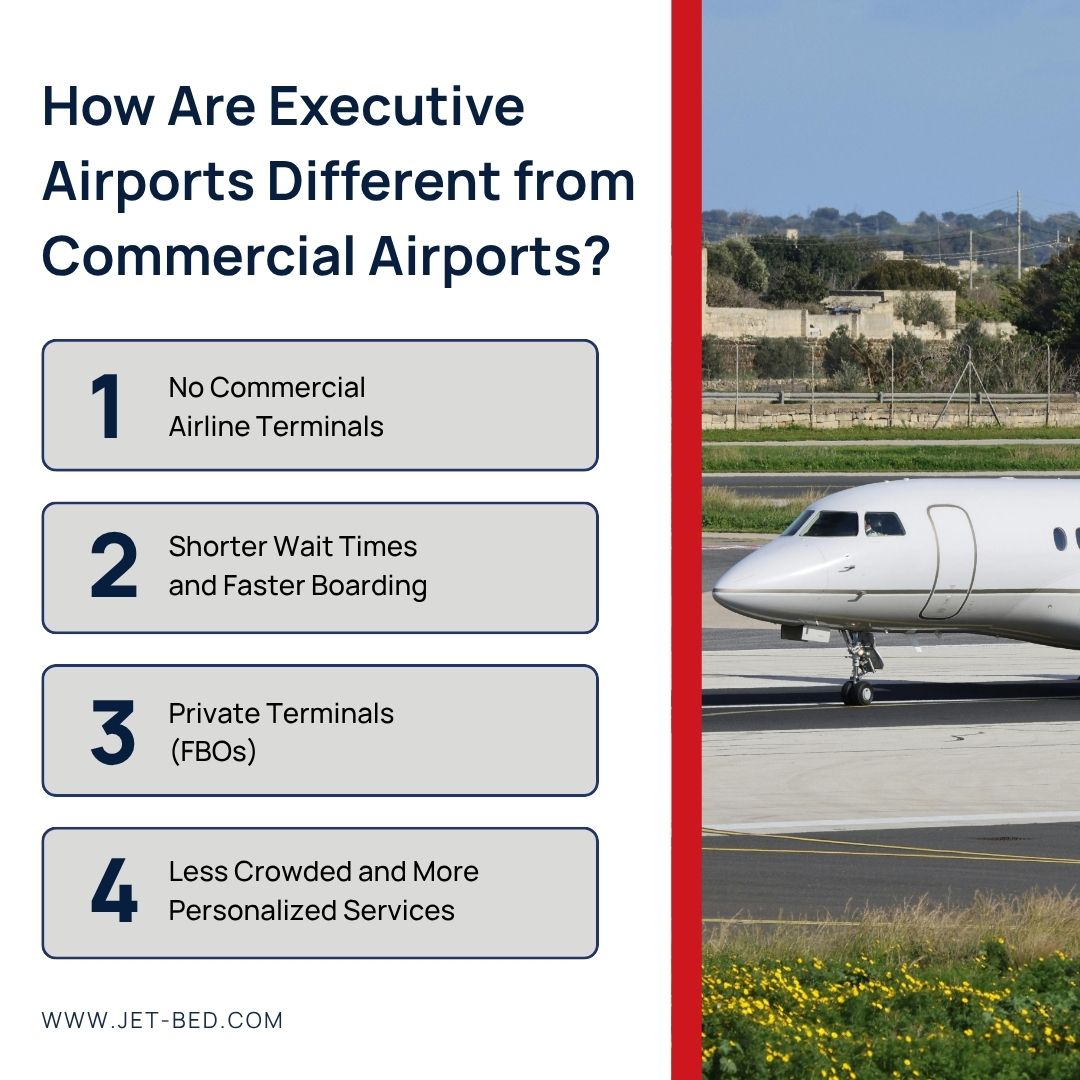
How Are Executive Airports Different From Commercial Airports?
Ultimately, commercial and executive airports differ in who they serve. Commercial and international airports move volume. Executive airports move operators.
No Commercial Airline Terminals
Executive airports do not host scheduled commercial airline service. This means there are no gates, jet bridges, or baggage carousels. The infrastructure is built exclusively for private and corporate operations, keeping the field focused entirely on general aviation traffic.
Shorter Wait Times and Faster Boarding
Commercial airports require travelers to arrive at least two hours before departure to clear security and check in. At an executive airport, arriving 15 minutes before departure is standard. Operators handle security screenings separately, while boarding happens directly on the ramp.
Private Terminals (FBOs)
FBOs serve as terminals for private operations. They handle fueling, ground services, crew planning, and passenger reception within one centralized facility. Most include quiet, private lounges, conference rooms, and easy access to the ramp for passengers. The entire experience is closer to a private club than a public airport.
Less Crowded and More Personalized Services
Executive airports handle a fraction of the daily traffic that commercial hubs process. Regular operators are known by name and tail number in these general aviation airports. The FBO team directly coordinates all catering, ground transportation, and hangar requests to provide more personalized service.
Though executive airports are generally less crowded, they can still become busy at certain times. When choosing which airport to fly into, review our guide “Busiest Private Jet Airports” to avoid crowds.
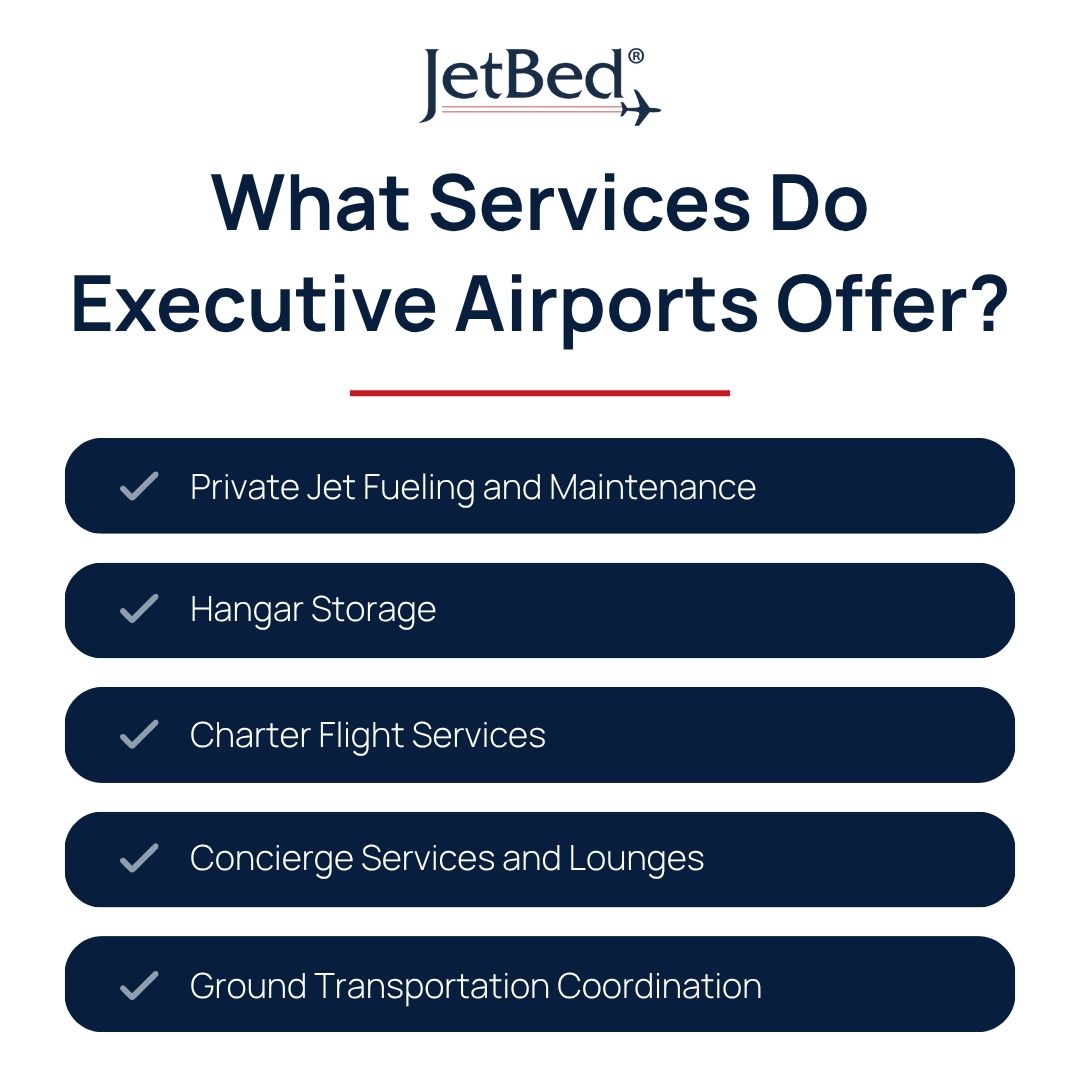
What Services Do Executive Airports Offer?
Services at executive airports cover the full operational lifecycle of a private flight, from fueling to ground transportation. Below, we will provide an overview of the top services both operators and passengers can expect.
Private Jet Fueling and Maintenance
FBOs handle Jet A and 100LL fueling directly on the ramp at executive airports. This quick-turn service refuels aircraft and gets them back in the air within an hour. Additionally, most executive airports also have on-field maintenance facilities covering routine inspections, AOG support, and avionics work.
For additional information, review our post: “Private Jet Inspection and Maintenance Frequency Guide.”
Hangar Storage
Dedicated hangar space protects aircraft from weather, UV exposure, and ramp wear. Executive airports offer transient storage for overnight stays and long-term lease agreements for based aircraft.
Additionally, climate-controlled options are available for aircraft with specific temperature requirements. Most of these storage agreements also include services such as towing, washing, and pre-flight positioning.
Charter Flight Services
Many executive airports host on-site Part 135 charter operators. These companies provide on-demand flights using their own fleets or managed aircraft. They offer charter desks at the FBO handling same-day trips, multi-leg itineraries, and aircraft repositioning. Operators range from single-aircraft companies to national fleets.
Concierge Services and Lounges
FBO lounges offer quiet seating, dedicated workspaces, and conference rooms for pre-flight meetings. Furthermore, concierge staff coordinate catering, hotel bookings, and special requests directly with arriving passengers. Most facilities also include showers, crew rest rooms, and pilot planning areas equipped with weather and flight planning tools.
Ground Transportation Coordination
FBOs coordinate rental cars, car services, and limousine pickups directly to the aircraft. Most facilities keep crew cars available for short trips into town as well. Additionally, for those who require it, operators can arrange helicopter transfers to city centers. Meanwhile, vehicles meet passengers at the aircraft door, bypassing walking to the terminal and curbside queues.
Executive airports provide streamlined services for private and corporate aviation.
Airport selection is one of the most consequential decisions in private aviation planning. Not every airport is equipped to handle private jets. More specifically, fueling, ramp access, and dedicated ground handling are not guaranteed at commercial facilities. Understanding what executive airports offer and which ones serve your routes directly impacts how efficiently your operation runs.
The efficiency of an executive airport ends at the aircraft door. Inside the cabin, comfort takes over. JetBed’s patented inflatable design creates a flat, comfortable sleeping surface in minutes. Browse our catalog to find the right custom-fit JetBed for your aircraft.