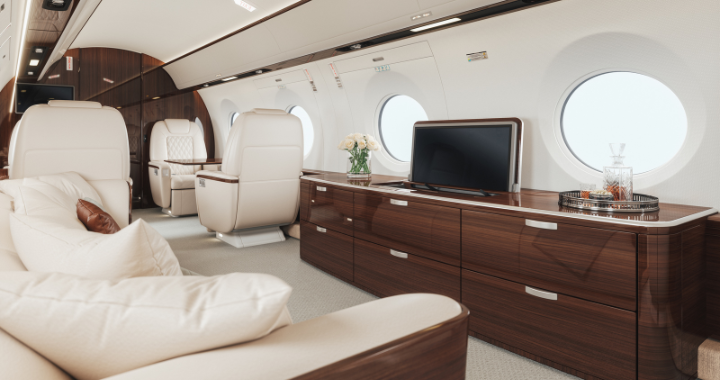
The most capable private luxury jets offer so much more than a means of transportation. They are fully configured airborne environments designed for heads of state, Fortune 500 executives, and ultra-high-net-worth individuals. Luxury interiors offer privacy, productivity, and security at cruising altitude, comparable to those in high-rise offices and penthouses.
Beyond prioritizing discretion, the most luxurious private planes offer designated zones to enhance comfort and efficiency. Many of the options we’ll discuss below, for example, feature multi-room layouts, including bedrooms, private bathrooms, lounges, and advanced entertainment systems.
This guide covers the most luxurious private jets in the world. We will explain what they offer, which features set them apart, and what they cost. For operators and procurement teams evaluating the top of the market, this is the reference you need.
Whether you are flying on a luxury private plane or a standard charter model, JetBed enhances your in-flight comfort. Our patented inflatable design creates a flat, comfortable sleeping surface in minutes. Custom-fit to your specific aircraft model, lightweight, easy to stow, and made in the USA, our product offers a comfortable way to fly. Arriving well-rested isn’t a luxury; it’s a necessity.

5 Most Luxurious Private Planes: Inside the Cabins
The demand for luxury private jets from ultra-high-net-worth individuals, celebrities, and corporate executives continues to grow. These passengers have one goal in their travels that private jets can satisfy: a controlled environment that provides security, privacy, and the ability to work and rest in flight. For passengers managing sensitive schedules, that combination has direct operational value.
However, luxury private planes serve as more than a means of transportation from one city to another. For most passengers, the aircraft’s configuration promotes productivity, rest, and discretion. Therefore, tasks, downtime, and even entertainment can proceed regardless of the 40,000-foot altitude.
For those interested in learning more, visit our guide, “What Are the 3 Stages of Acclimatization to High Altitude?” Knowing this information allows you to better prioritize comfort in future travel.
What Makes a Private Jet Luxurious?
Fully Customized Cabin Layouts
A fully customized cabin layout turns a private jet into a functional environment built around the passenger. Seat configurations shift to match operational priorities. For example, some owners specify a conference room setup for in-flight meetings. Others specify a private berth for rest on long-haul routes. Regardless, the cabin can transform into whatever the travel requires it to be.
For a comprehensive look at luxury interior options, review our guide “Custom Private Jet Interiors: From Concept to Cabin.”
Premium Materials
Luxury private planes prioritize premium materials that can perform at altitude while also providing an elevated appearance. More specifically, many jets feature full-grain leather seating, as it resists cracking from temperature, use, and UV exposure. Additionally, walnut hardwood veneers make up armrests and paneling. The material can survive pressurization cycles without warping, making it a high-quality investment for the interior.
Fabric selection is also a weight consideration on private planes. Wool blends and technical textiles reduce cabin weight while maintaining the tactical quality passengers expect. Every material choice is as important for functionality as it is for aesthetics.
Multi-Room Configurations
Multi-room configurations divide a large-cabin jet into distinct functional zones rather than one open space. A forward area typically serves as a private office with a table for calls, document review, or pre-landing preparation. The mid-cabin handles group seating for meetings or meals, with enough separation from the working area to keep both functions productive.
The aft section is usually the private suite. Most commonly, it holds a berth or a convertible sleeping arrangement for long-haul routes. Many of them also feature a dedicated closet and lavatory for ultimate privacy and comfort. Each zone serves a different phase of the flight, so work, meetings, and rest can happen without one activity interrupting another.

Onboard Bathrooms with Showers
Some large-cabin and long-range jets include full bathrooms with showers, not just a lavatory. Pressurized and heated water systems that function reliably at altitude add weight and engineering that most aircraft cannot support. That limits the features to the largest cabins with the payload capacity to carry it.
For passengers on ultra-long-haul routes, the practical value is direct. Executives flying transcontinental often land and go straight into meetings. Arriving clean and alert after a ten-hour flight is an obvious operational advantage for luxury private aviation.
To explore this concept in more depth, review our dedicated guide “Private Jets with Showers” to see which models offer full onboard bathrooms.
Advanced Soundproofing
Advanced soundproofing on luxury jets uses multiple layers of acoustic insulation, vibration-dampening mounts, and cabin lining engineered to absorb noise. Some manufacturers even tune the materials to target specific frequency ranges that cause fatigue on long flights. This is a level of acoustic engineering that standard aircraft interiors lack.
The soundproofing has a measurable difference. A well-soundproofed cabin drops from the mid-80 decibel range to the low 60s, closer to a quiet office environment. As a result, passengers often notice reduced fatigue, easier conversation, and the ability to sleep without noise interference. Soundproofing remains a differentiator at the top of the market for luxury private planes rather than a standard specification across the category.
High-Speed Satellite Connectivity and Entertainment Systems
High-speed satellite connectivity keeps executives connected and productive through an entire flight. Video calls, large file transfers, and real-time market data all run without the lag that older air-to-ground systems produced. It is as if they never left the office. Time in the air no longer means time offline. Instead, a transcontinental flight can hold a full workday without interruption.
Entertainment systems also build on that infrastructure. Large displays, surround sound, and streaming access give passengers a genuine choice between working and unwinding. However, reliable bandwidth at 40,000 feet is expensive to install and maintain. For this reason, it remains a differentiator on luxury aircraft rather than a standard specification across the fleet.
Ultra-Long-Range Capability Enabling Non-Stop Global Travel
Ultra-long-range capability lets an aircraft fly non-stop between continents, eliminating fuel stops that add time and customs exposure to an already demanding itinerary. Routes like New York to Tokyo or Los Angeles to Singapore become a single leg rather than two. The operational impact is direct—passengers arrive without the disruption of a mid-journey restart.
To understand the range of certain aircraft, review our guide “How Far Can Private Planes Fly?”
What Is Inside the Most Luxurious Private Jets?
Luxury private jet interiors are fully customizable. Therefore, no two jets will look the same on the inside. That said, the most capable configurations share a consistent set of features:
- Master bedroom suites with full-size beds
- Ensuite bathrooms with showers and premium fixtures
- Private lounges and dedicated entertainment areas
- Conference rooms and meeting spaces for business travel
- Full-service galleys supporting private chef and dining arrangements
- Cinema-style entertainment systems
- Customizable lighting and climate control zones
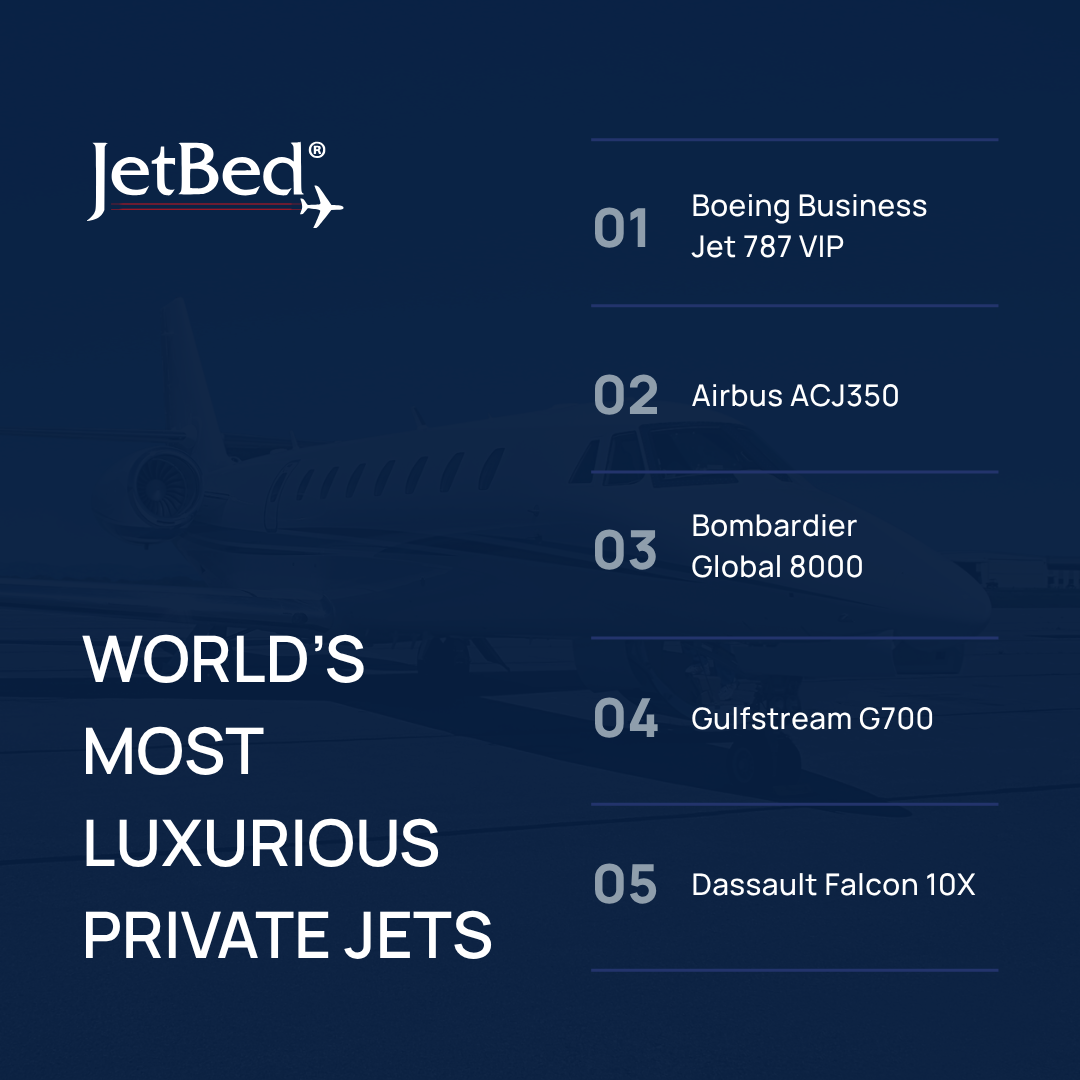
World’s Most Luxurious Private Jets
Boeing Business Jet 787 VIP
The Boeing Business Jet 787 VIP covers nearly 10,563 miles nonstop, connecting virtually any two cities on a single fuel load. In VIP configuration, the cabin accommodates up to 40 passengers, though most owners configure for far fewer to maximize space.
That space supports master suites with private bathrooms, conference rooms, dining areas, and dedicated lounges. Cabin pressurization is lower than standard commercial aircraft, which reduces passenger fatigue on long routes.
Initially, the aircraft arrives without a factory interior, which means owners design the cabin from scratch. The result is a fully customized flying environment built for ultra-long-range travel without operational compromise.
Airbus ACJ350
The Airbus ACJ350 covers up to 11,100 nautical miles nonstop, which translates to more than 22 hours in the air. It is the longest-range VIP widebody Airbus produces, and the cabin reflects the scale of that mission.
At 308 square feet, the interior supports up to 25 passengers across private suites, conference rooms, dining areas, and full bathrooms. Carbon composite construction keeps cabin altitude near 6,000 feet, reducing passenger fatigue on the longest routes.
For operators who require genuine global reach without operational compromise, the ACJ350 represents the top of the Airbus VIP lineup.
Bombardier Global 8000
The Bombardier Global 8000 flies nonstop up to 8,000 nautical miles at Mach 0.85 with a top speed of Mach 0.94. These specs make it the fastest certified business jet in the world. Routes like New York to Hong Kong or Los Angeles to Sydney become single-leg operations rather than multi-stop itineraries.
The cabin holds up to 19 passengers across four distinct zones. These include a club suite, a conference suite, an entertainment suite, and a principal suite with a full-size bed. Cabin altitude sits at 2,691 feet—the lowest in its class—which reduces passenger fatigue. Additionally, advanced sound insulation with a HEPA filtration system reinforces that comfort advantage. Ultimately, the Global 8000 is as capable on the ground arrival as it is in the air.
Enhance your experience even further by exploring the Bombardier Global 7500/8000 JetBed.
Gulfstream G700
The Gulfstream G700 connects cities such as New York and Cape Town in a non-stop flight, a key advantage of luxury private planes. The cabin holds up to 19 passengers across multiple living areas, including a grand suite with a dedicated shower. Moreover, it features handcrafted seats that convert into flat beds to elevate comfort on overnight flights.
The G7000 features 20 panoramic oval windows—the largest in business aviation—that bring in natural light into the full length of the cabin. Cabin altitude sits at 2,840 feet, among the lowest of any business jet, reducing passenger fatigue. Meanwhile, the cabin air is replenished every few minutes to keep the environment fresh throughout the trip.
Choose your Gulfstream G700/800 JetBed depending on seat type here.
Dassault Falcon 10X
Dassault introduced its newest private jet model, the Dassault Falcon 10X, in March 2026 as its new flagship. The aircraft can fly an impressive 7,500 nautical miles nonstop. This range connects cities such as New York and Shanghai in a single flight. However, the flight range is just the beginning. The cabin offers the widest and tallest in all of business aviation. Rather than basing the design on a traditional jet interior, engineers built it around a residential scale.
The interior configuration includes private suites, conference areas, and a primary bedroom with a full-size shower. The cabin pressure holds at 3,000 feet at cruise to reduce fatigue on long missions. Meanwhile, fresh air circulates continuously throughout. For those who want top-of-the-class luxury in private aviation, the Dassault Falcon 10X delivers.
Dive deeper into private plane options and their features in our guide “Different Types of Private Planes.”
How Much Do the Most Luxurious Private Planes Cost?
Luxury private jet pricing spans a wide range depending on the aircraft size, customization, and brand. For example, large-cabin ultra-long-range platforms like the Gulfstream G700 and Bombardier Global 8000 list between $75 million and $85 million before customization. Meanwhile, widebody VIP conversions like the Airbus ACJ350 and Boeing 787 VIP start near $240 million and can exceed $450 million.
Interior designs add substantially to the base price of luxury private planes. A custom cabin can cost $15 million to $60 million depending on materials, layout, and technology. For buyers considering a luxury private plane, consider the interior build-out as a separate significant investment from the aircraft itself.
For a deeper breakdown into private jet costs, review our guides “How Much Does It Cost to Maintain a Private Jet?” and “Airplane Finance Calculator.”
Are Luxury Private Jets Worth It?
Luxury private jets are worth the large price tag when used as operational tools rather than convenience alone. For corporate leaders and heads of state, their designs for efficiency, global reach, and flexible schedules are beneficial.
The time value that it offers is a distinct advantage. The ability to connect to multiple cities in a single day without layovers or refueling changes how organizations operate. Ultra-long-range platforms eliminate fuel stops entirely, turning intercontinental trips into uninterrupted single-leg flights. Additionally, a well-maintained aircraft also signals financial stability and operational reach to partners and clients in ways that chartered or commercial travel cannot.
For the right buyer, the investment justifies itself in recovered time and schedule flexibility. They now have the ability to respond to opportunities on their own terms.
Transfer luxury to any private plane model with JetBed’s inflatable lie-flat sleeping surface.
Luxury private jets serve a specific and narrow segment of the market. They are purpose-built for ultra-long-range missions and configured around the demands of high-profile passengers who require a fully equipped airborne environment. For most private operators, a large-cabin or super-midsize jet covers the mission without the capital cost of a widebody VIP conversion.
The standard for in-flight rest does not require a $75 million aircraft. JetBed’s patented inflatable design creates a flat, comfortable sleep surface ready in minutes. They are custom-fit to your specific aircraft model, lightweight, and dressed in luxury Italian linens. Contact us to find the right JetBed for your aircraft and elevate inflight comfort today.