
When the One, Big, Beautiful Bill was signed into law on July 4, 2025, it sent ripples through the investment and aircraft-ownership communities in the United States. The bill revived and expanded key incentives, including depreciation benefits, enhanced deductions, and tax credits that encourage capital spending.
By extending 100% bonus depreciation, it gives private aircraft owners a renewed opportunity to align tax planning with fleet investments. For private aircraft owners, these changes could reshape when and how they acquire, upgrade, or refurbish jets.
Because aviation is a capital-intensive industry, restoring favorable depreciation rules significantly impacts cash flow, overall costs, and long-term ownership strategy. Understanding how the bill works will help current and future private jet owners make informed decisions on buying, refurbishing, or expanding their fleet.
In today’s post, we will explain what bonus depreciation for 2025 means under new legislation. Additionally, we’ll examine which assets qualify, how deductions work, and how private jet owners can maximize benefits while avoiding compliance pitfalls. Are private jets tax-deductible under the new bill? Continue reading to find out more.
A final note on passenger experience: a sophisticated aircraft investment deserves matching cabin comfort. JetBed enhances your onboard environment by converting seats into comfortable flat surfaces designed for rest and productivity. If restorationand professionalism matter in the air, investing in the right sleep setup can make a measurable difference.

2025 Trump Tax Bill Bonus Depreciation: What It Means for Private Jet Owners
The renewed bonus depreciation rules particularly affect capital-heavy sectors—aviation, heavy equipment, manufacturing, and luxury assets. For private jet owners, this means the acquisition of aircraft, upgrades, avionics, and even refurbishments may now offer favorable capital investment advantages under the updated law.
By taking advantage of these significant changes, aircraft owners and operators can reduce upfront costs, accelerate depreciation benefits, and preserve cash flow. Moreover, this applies to all in the aviation sector—charter operators, corporate flight departments, fractional operators, or high-net-worth individuals acquiring a business jet. This bill makes it possible to treat a significant investment as a smart business decision.
Ultimately, understanding this law gives you a strategic advantage. You’ll know which assets qualify, when to act, and how to schedule purchases or upgrades to maximize tax savings. For current and future owners, this clarity helps structure upgrades, fleet expansion, or replacement cycles with greater clarity.
What Is Bonus Depreciation for 2025?
Bonus depreciation lets businesses immediately deduct a large portion—up to 100%—of the cost of qualified assets in the year they’re placed into service.
Under prior law changes, including the Tax Cuts and Jobs Act (TCJA), bonus depreciation had been phased down gradually. 2025 was on the path to suffer another decline. Instead, the One, Big, Beautiful Bill restored full 100% bonus depreciation for qualified property acquired and placed into service after January 19th, 2025.
In practical terms, bonus depreciation converts a long-term capital expense into an immediate tax benefit. Initially, Section 179 also allowed accelerated spending. However, bonus depreciation typically provides a larger, more flexible deduction for high-cost assets, such as private aircraft.
Rather than depreciating over many years (the usual recovery periods for aircraft and equipment), the full expense is wiped against taxable income in the acquisition year. This sharpens tax planning and improves cash conversion for asset-heavy operations.
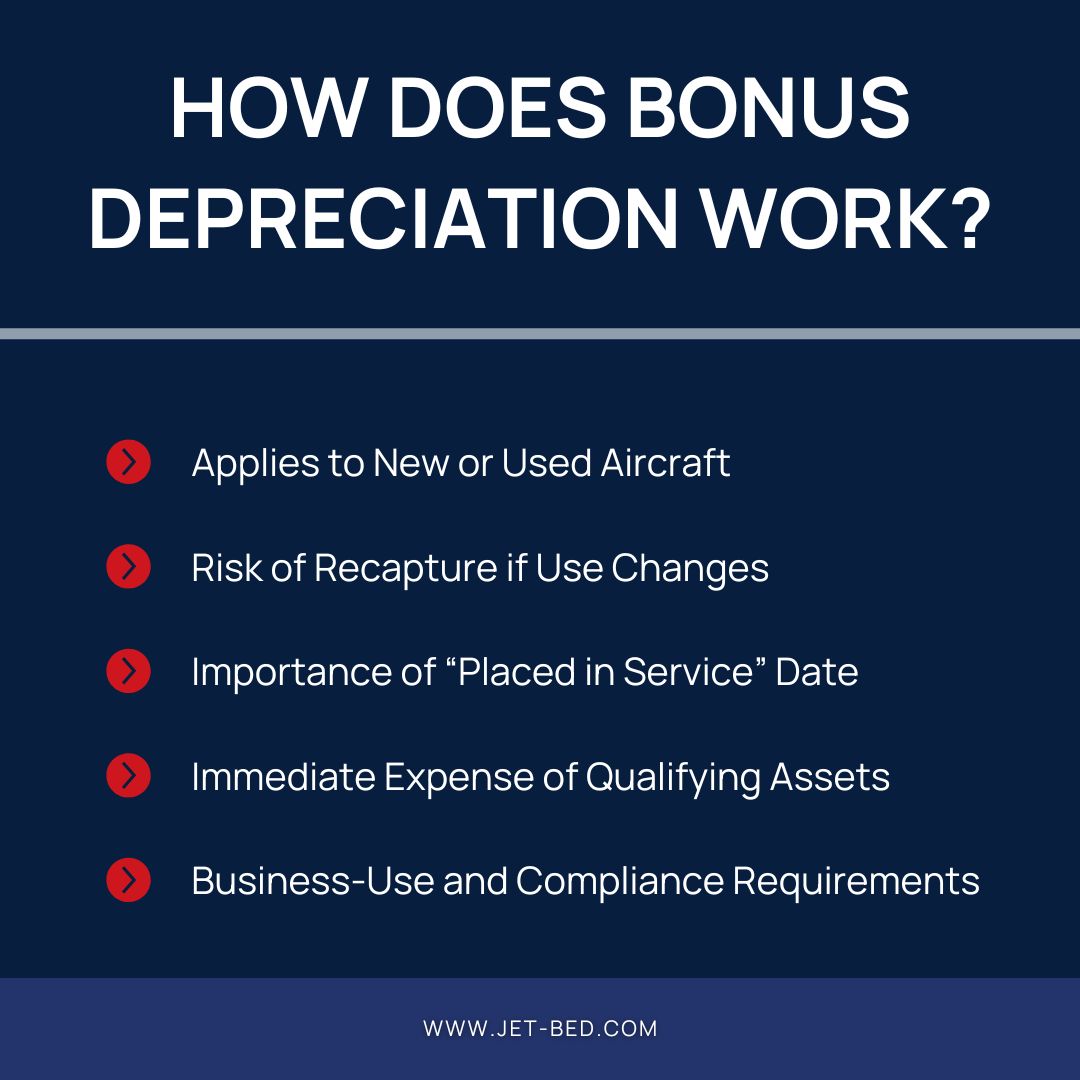
How Does Bonus Depreciation Work?
Applies to New or Used Aircraft
One key benefit of the 2025 law is that both new and used aircraft qualify. However, this only applies as long as the acquisition is after the effective date and business-use requirements are satisfied. This opens opportunities in the pre-owned market, where many buyers prefer value and depreciation benefits.
Risk of Recapture if Use Changes
If business usage drops or the aircraft is converted to personal use, the IRS may require depreciation recapture. Maintaining compliant usage logs and a consistent corporate ownership structure is essential to preserve the deduction’s benefits.
Importance of “Placed in Service” Date
It’s not enough to just sign a purchase contract. The aircraft must be delivered, certified, and ready for business use within the same tax year you claim the deduction. Delays in certification, delivery, maintenance, or modifications before use may shift eligibility to the following tax year. Unfortunately, this affects both timing and potential benefit.
Immediate Expense of Qualifying Assets
When you purchase a private jet or upgrade and complete delivery in a tax year, and that jet is property placed in service, you may elect to deduct 100% of its cost in that same year. This reduces your taxable income immediately, improving liquidity and providing capital for other investments or operating expenses.
Business-Use and Compliance Requirements
To qualify, the jet must be used predominantly for business or corporate purposes. Personal use can jeopardize deduction eligibility. It’s the owner’s responsibility to keep detailed manifest records, detailed flight logs, and documentation. These reports are necessary to verify usage in the year the aircraft is placed into service.
What Assets Qualify for Bonus Depreciation?
Qualified property generally includes tangible business assets with a useful life of 20 years or less. For aviation, the following typically qualify:
- Safety equipment upgrades, mission-specific customizations, and interior modifications
- Entire aircraft (airframe, engines) when used for business or charter operations
- Avionics, technology upgrades, and communication systems
- Significant structural improvements, cabin upgrades, or refurbishments
Additionally, routine maintenance or cosmetic upgrades may qualify. However, the expense must meet thresholds of “improvement,” “adaptation,” or “betterment” under depreciation rules. Proper classification and documentation are required.
What Is the Bonus Depreciation for 2025 on Private Aircrafts?
Under the 2025 law, private aircraft, new or used, acquired and placed into service after January 19, 2025, may be fully expensed. As a result, a jet purchased and delivered in the same year no longer depreciates over time. Instead, it can qualify for a 100% write-off.
This is a significant improvement for owners who desire immediate tax relief. Given the high cost of private jets and associated upgrades, this benefit reduces the first-year after-tax cost of ownership. It can dramatically affect cash flow, acquisition strategy, and return-on-investment calculations.
Because the deduction happens in the tax year the plane is placed into service, timing is everything. Owners must work closely with tax advisors, delivery teams, and registration authorities to ensure the placement date meets qualification requirements.

How Does the 2025 Bonus Depreciation Affect Private Jet Owners?
Strategic Fleet Planning and Replacement
With depreciation benefits restored, the financial calculus for replacing older or underused jets changes. Owners may accelerate replacement cycles or expand fleet size with clearer ROI and tax benefits.
Incentive for Upgrades and Refurbishments
Because interior refurbishments, avionics upgrades, and safety improvements qualify, older jets become prime candidates for investment. Owners can modernize a fleet while recouping much of the cost in the same tax year.
Enhanced Business Use Justification
The need for proper flight logs, corporate governance, and business use-tracking can significantly raise operational standards. For companies that treat their jets as working assets rather than status-driven purchases, the new rules reinforce disciplined usage and oversight.
Major Cash Flow and Tax Savings
Owners can immediately reduce taxable income by writing off the full asset cost. That translates into meaningful cash savings. More specifically, funds can be redirected into upgrades, maintenance, additional aircraft, or business expansion.
Better Resale Value and Market Demand
Jets eligible under bonus depreciation are more attractive to buyers and operators who understand the depreciation advantage. This increased demand may help retain or even boost resale value.
Time-Sensitive Planning and Compliance Risk
To claim the benefit, owners must document the placement date, business use, and maintain compliance. Missed deadlines or poor record-keeping could result in recapture or disallowed deductions—undoing perceived benefits.
The 2025 Trump Tax Bill Bonus Depreciation offers a renewed opportunity for aircraft owners to align tax planning with fleet investments.
The 2025 bonus depreciation overhaul significantly reshapes the financial landscape of private jet ownership. Jets acquired and placed in service after January 19th, 2025, can now qualify for full expensing in the first year. This turns what was once a multi-year write-off into immediate tax relief and improved cash flow.
For private jet owners and operators, this creates a timely opportunity to refurbish, upgrade, or expand their fleet. However, it’s essential to maintain careful attention to placement-in-service dates and business-use requirements.
Flights can be both comfortable and financially strategic. At JetBed, our premium bedding solution for private aircraft elevates sleep quality in the sky. Quality restoration shouldn’t be a luxury—it should be a necessity. Find out more about how JetBed works on our site.