
Corporate jets are purpose-built for business travel. They give executives control over scheduling, routing, and cabin configuration that commercial airlines cannot offer. For flight departments managing tight itineraries—same-day round-trips, multi-city schedules, or time-sensitive client visits—a corporate jet is an operational tool.
The distinction between a corporate jet and a private jet is straightforward. Corporate jets operate specifically for business use, typically by the company’s flight department or through a managed aircraft program. Meanwhile, private jets serve luxury travelers and high-net-worth individuals.
This guide covers what corporate jets are, which types are available, what it costs to operate, and when the investment makes sense. By the end, you can determine whether corporate jet travel is suitable for your executives.
Arriving rested is an essential factor for many in corporate aviation. JetBed’s patented inflatable design creates a flat, comfortable sleep surface in minutes. They are custom-fit to your specific aircraft model, lightweight, and easy to stow. It’s the comfortable way to fly to business meetings worldwide.

What Is a Corporate Jet? Cost, Types, and Key Benefits
A corporate jet is a private aircraft operated specifically for business purposes. It is a productivity tool configured for executives and key personnel with tight schedules that commercial airlines cannot accommodate.
In a corporate jet, the cabin design features layouts that support focused work, sensitive conversations, and quality rest. Beyond in-flight advantages, passengers can also benefit from scheduling flexibility, direct access to destinations, and a more efficient travel experience. Ultimately, privacy and flexibility are core to the value proposition, not incidental features.
Most business jets operate under FAA Part 91 for private use or Part 135 for charter. A dedicated flight crew manages scheduling, maintenance, and compliance. In some cases, the company holds aircraft ownership outright. In others, it partners with a charter service or fractional provider to structure the operation.
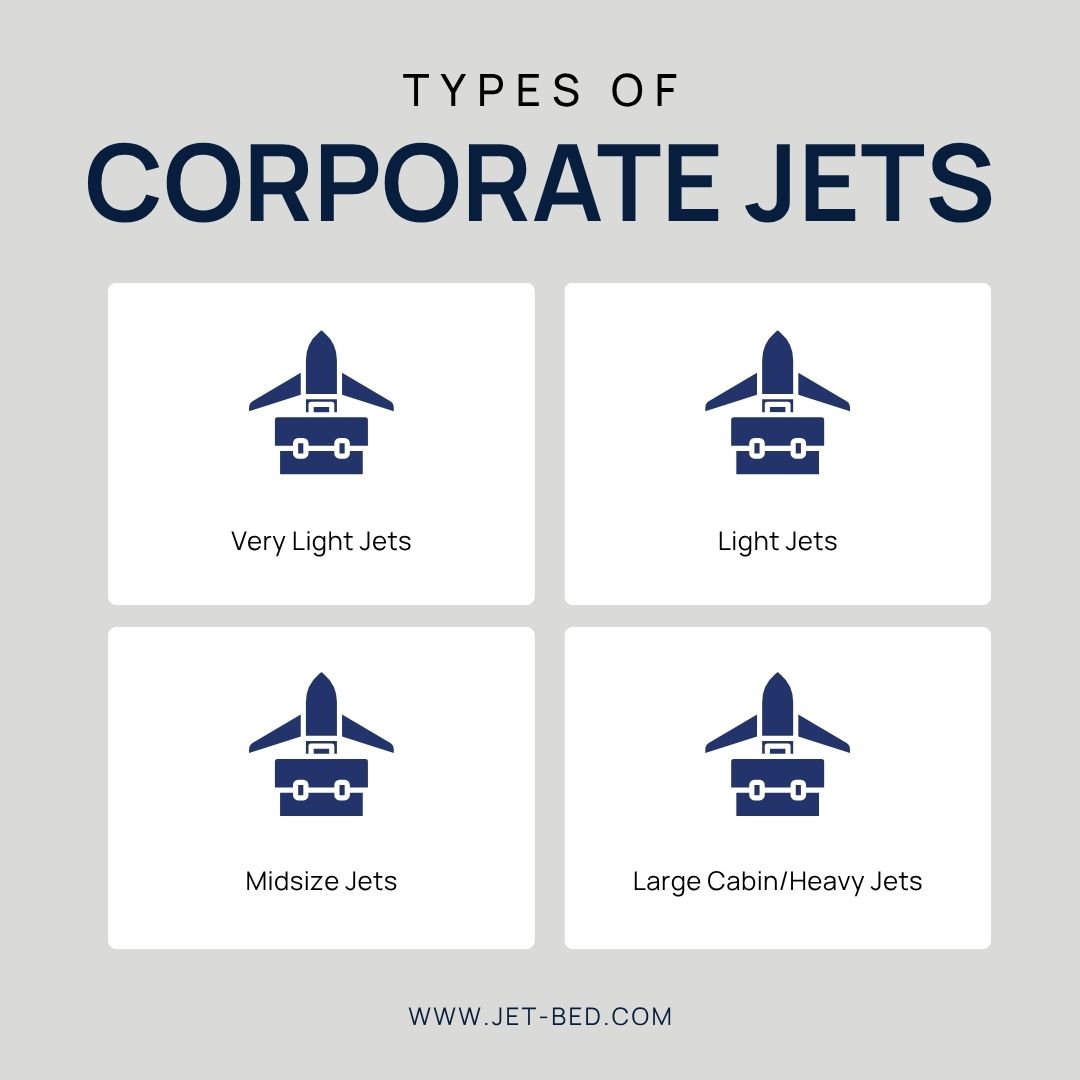
Types of Corporate Jets
Very Light Jets
Very light jets (VLJ) are the smallest category of corporate aircraft. They seat four to six passengers, support single-pilot operation, and carry lower operating costs than any other jet category. Common models include the Cirrus Vision Jet, Embraer Phenom 100, and Cessna Citation Mustang.
VLJs are for short- to medium-range missions, typically under 1,500 nautical miles. They are ideal for a regional sales team covering multiple cities in a day. Additionally, this aircraft class can also be useful for a small executive group that does not require a large cabin. Transatlantic routes are outside their capability, but for domestic regional travel, they offer a cost-efficient and capable platform.
For those interested in VLJs for future corporate travel, review our guide, “Small Aircraft Charter Flights.”
Light Jets
Light jets offer more range, cabin space, and passenger capacity than VLJs. They seat six to eight passengers and cover trips up to 2,000 nautical miles. Common models include the Embraer Phenom 300, Cessna Citation CJ4, and Bombardier Learjet 75.
This is the most active category in corporate aviation. Operating costs remain manageable, and capability comfortably covers most domestic routes. Moreover, the aircraft is well-suited for leadership teams flying coast to coast on a regular schedule. Light jets do not offer stand-up cabins, but they deliver the range and reliability that high-frequency corporate operations require.
Midsize Jets
Midsize jets offer stand-up cabins, longer range, and more space for passengers than light jets. They seat seven to nine passengers and cover routes of up to 3,000 nautical miles. Models such as the Citation XLS and Bombardier Challenger 350 often serve the corporate general aviation market.
This category suits corporate flight departments running a mix of domestic and international routes. For example, a full executive team flying from New York to London with a fuel stop fits the midsize cabin well. The interior is large enough for productive work and, on longer flights, proper rest. When light jets run short on range or space, the midsize jet is the practical next step.
For those traveling on long-haul corporate flights, JetBed becomes a seamless addition. For additional information, review our post, “How to Sleep on Long Flights: Tips for Restful Travel.”
Large Cabin/Heavy Jets
Large cabin and heavy jets represent the top of the corporate aviation category. They seat ten to nineteen passengers and cover ranges exceeding 7,000 nautical miles nonstop. Common models include the Gulfstream G650, Bombardier Global 7500, and Dassault Falcon 8X.
These aircraft are ideal for long-range international travel without fuel stops. A full executive team flying nonstop from New York to Tokyo, for example, is well within their capabilities. Moreover, the cabin configuration supports productive work, meetings, and rest. Some models even add luxury features such as showers, private staterooms, and dedicated crew rest areas.
For a deeper dive into available private jet models and their specifications, review our guide “Types of Private Planes.”

Why Do Corporate Jets Fly Higher?
Reduced Turbulence Above Weather Systems
Corporate jets cruise between 41,000 and 51,000 feet, often above most commercial traffic and weather systems. At that cruising altitude, the air is stable, and turbulence is uncommon. Most storm systems do not reach the flight levels, which keeps the ride smooth even when conditions on the ground are severe.
That said, corporate jets generally do not fly through thunderstorms. Pilots track storm cells using onboard weather radar and reroute around them. These altitude advantages significantly reduce weather encounters, but active avoidance remains standard practice on every flight.
Less Air Traffic Congestion
When corporate jets cruise above 40,000 feet, they operate in less congested airspace. Most commercial aircraft run between 30,000 and 38,000 feet, creating meaningful vertical separation. Fewer aircraft sharing the same space means cleaner routing and fewer ATC-related delays.
For those interested in learning more about this process, review “What Does ATCM Stand for in Aviation?”
Improved Fuel Efficiency
Higher cruising altitudes give corporate jets a significant fuel efficiency advantage. Thinner air at 45,000 feet reduces aerodynamic drag, and modern turbofan engines perform best in that environment. This means they burn considerably less fuel per nautical mile than at lower altitudes.
Aircraft like the Gulfstream G700 and Bombardier Global 7500 center their design on high-altitude efficiency. As a result, better fuel burn extends range and reduces the need for fuel stops. For a flight department managing operating costs across a full year, that efficiency compounds quickly.
Understand how to calculate fuel costs in our guide “Private Plane Fuel Costs: Fuel Budgeting Made Easy.”
Faster Cruising Speeds
Thinner air at higher altitudes reduces drag, allowing corporate jets to cruise faster with the same engine output. Most large cabin jets cruise between Mach 0.85 and Mach 0.925—faster than commercial airlines operating at lower altitudes.
A transatlantic route that takes 8 flight hours commercially can take 6.5 hours in a Gulfstream G650. For executives managing tight schedules across time zones, that difference has direct operational value.
Learn more about private jet speed in general aviation in our guide “How Fast Do Private Jets Go?”
Increased Passenger Comfort
Higher cruise altitudes produce smoother air and a quieter cabin. Corporate jets pressurize at a lower cabin altitude than commercial aircraft—typically 6,000 feet versus 8,000 feet on commercial liners. That difference reduces passenger fatigue on long flights and supports better rest in transit.
The cabin environment reinforces that advantage. Wider seats, lower noise levels, and controlled lighting make genuine rest possible in a way that commercial flights cannot replicate. On a long transatlantic or transpacific flight, arriving rested is an operational necessity, not a comfort preference.
JetBed elevates passenger comfort even further, creating a comfortable sleeping surface in minutes. They are custom-fit to your specific aircraft and made right here in the USA. Executives who land rested perform better, and that’s the point of corporate jet travel.
How Much Does a Corporate Jet Cost?
Corporate jet pricing spans a wide range. For example, a used very light jet starts around $1 million. Conversely, a new Gulfstream G700 or Bombardier Global 7500 lists for above $75 million. The pricing gap reflects category, range, cabin size, and specification level.
A ten-year-Aircraft age also significantly affects pricing, but maintenance history and avionics currency matter as much as the year of manufacture.old Phenom 300 costs a fraction of what a new one costs. Meanwhile, the value depends on how well the owner maintained it and whether they kept the avionics and connectivity systems up to date.
Ownership of a corporate jet comes in several forms, affecting pricing. Full ownership suits high-utilization flight departments with the infrastructure to manage an aircraft program. Fractional programs offer share-based access without full operational responsibility, and jet cards provide prepaid flight hours through a charter operator.
Each of these models trades cost against control. The right structure depends on annual flight hours and the level of operational oversight the organization can manage. To understand which model suits your company, review our “Airplane Finance Calculator” guide. Additionally, our guide on buying your own private jet can serve as a foundational resource for future purchases. You may also be interested in learning more about private jet card programs.
Who Makes Corporate Jets?
Several manufacturers dominate the corporate jet market. Understanding who builds what helps narrow the aircraft search before engaging a broker or operator. The major manufacturers include:
- Gulfstream Aerospace
- Bombardier
- Dassault Aviation
- Embraer Executive Jets
- Cessna Citation
- HondaJet
Organize corporate jet travel and arrive well-rested for business meetings worldwide with JetBed.
Corporate jets are an operational investment, not simply a comfort upgrade. Flexible scheduling, direct airport access, and faster city-to-city times translate into measurable efficiency gains for organizations. For many businesses, the aircraft pays for itself in recovered time and productivity across a full year of operations.
Configuring the cabin correctly is part of that investment. On international routes and red-eye flights, in-flight rest directly affects how executives perform upon landing. JetBed’s patented inflatable design creates a flat, comfortable sleeping surface in minutes. Contact the JetBed team to find the right JetBed for your aircraft and elevate your comfort when you travel.